Why you should visit the Musée d’Orsay.
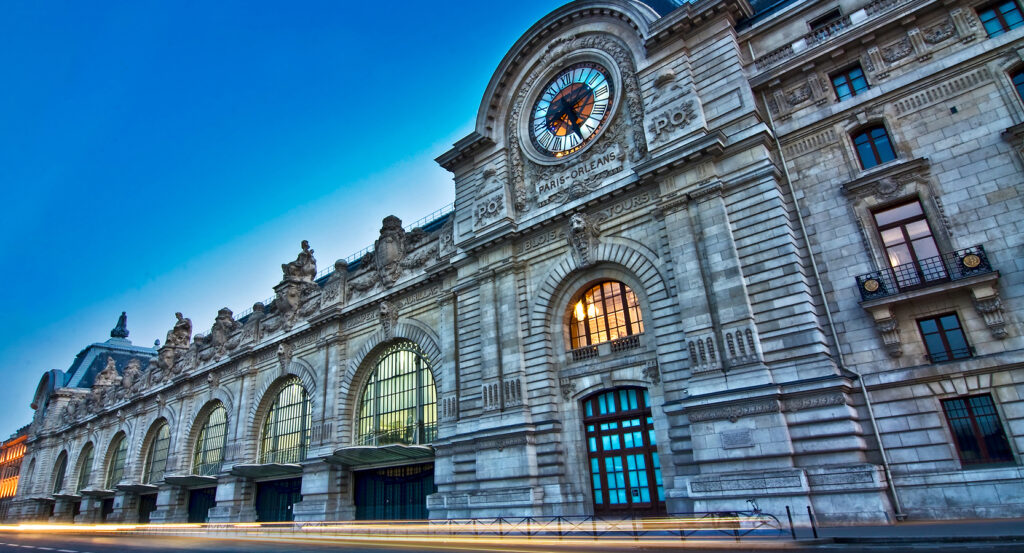
There’s a particular thrill in stepping into the Musée d’Orsay, that moment when the clock strikes your gaze and you realize this isn’t just a museum, but a cathedral to beauty reborn.
Once a Beaux-Arts railway station, Orsay’s transformation into an art sanctuary feels almost poetic, the industrial turned divine. Its grand nave, lined with statues and bathed in honeyed light from the glass ceiling, invites you to wander among Impressionist masterpieces that altered the trajectory of modern art. Manet’s bold brushstrokes, Monet’s luminous water lilies, Degas’ dancers frozen mid-spin, each gallery hums with rebellion disguised as elegance. Visiting Orsay is not about seeing paintings; it’s about feeling the pulse of a cultural revolution. The space itself mirrors that transformation, the rhythm of trains replaced by the quiet footsteps of awe-struck visitors. It’s a place where time stretches, where art transcends centuries, and where Paris’s restless spirit, the one that refuses to stop evolving, feels alive in every corridor.
What you didn’t know about the Musée d’Orsay.
What you may not know is that the Musée d’Orsay’s very existence is a defiance of erasure, a triumph of vision over practicality.
In the 1970s, the building was slated for demolition, dismissed as an outdated relic of the past. But fate, and France’s deep reverence for art, intervened. Visionaries recognized the potential to bridge the artistic gap between the Louvre’s classical grandeur and the Pompidou’s avant-garde energy. When the museum opened in 1986, it became a revelation, housing the world’s largest collection of Impressionist and Post-Impressionist works. Its collection isn’t confined to French masters, Van Gogh’s tortured swirls and Gauguin’s tropical dreams coexist with Rodin’s sculptures and Whistler’s delicately moody portraits. The great clock on the fifth floor, a remnant of its railway past, now frames Paris like a moving painting, a perfect metaphor for the museum itself: always in motion, always timeless.
How to fold the Musée d’Orsay into your trip.
To fold the Musée d’Orsay into your Paris itinerary, allow yourself to slow down, it’s a museum best savored, not conquered.
Arrive early to avoid the midday rush and begin your visit in the upper galleries, where light floods through the arched glass and the city glimmers through the clock face. Let your journey unfold chronologically, tracing art’s evolution from neoclassical restraint to Impressionist liberation. Pause often, in front of Renoir’s sunlit scenes, in Degas’ pastel ballet studios, or before the haunting melancholy of Van Gogh’s self-portraits. When you’ve filled your senses, step out onto the museum’s terrace café overlooking the Seine, where the dome of the Louvre gleams across the water. From there, stroll along the river toward the Tuileries Gardens, the same route that inspired many of the artists whose works now line the walls. Visiting Orsay isn’t just cultural, it’s sensual, introspective, and transformative, much like Paris itself.
Hear it from the Foresyte community.
People swear it’s all about the Louvre, but honestly the Orsay feels cooler. Impressionists on every wall, the whole place buzzing like history remixed. Like Paris showing its taste without flexing too hard.
Where meaningful travel begins.
Start your journey with Foresyte, where the planning is part of the magic.
Discover the experiences that matter most.