Why you should visit Fourth Plinth.
Among the historic statues and imperial grandeur of Trafalgar Square, the Fourth Plinth stands as London’s most provocative conversation piece, a stage where art, politics, and public sentiment collide in ever-evolving form.
Originally intended to hold a statue of King William IV, the plinth stood empty for more than 150 years, an unfinished thought in the city’s sculptural lexicon. Yet this void became its power: a blank canvas for contemporary expression that redefined what public art could mean. Since 1999, it has hosted a rotating series of installations that oscillate between humor, critique, and wonder, from Marc Quinn’s Alison Lapper Pregnant, celebrating strength and visibility, to David Shrigley’s Really Good, a monumental thumbs-up that became a defiant symbol of optimism during political uncertainty. Each new work transforms the square’s classical order into a dialogue between past and present, between empire’s marble certainty and modernity’s restless doubt.
What you didn’t know about Fourth Plinth.
What many don’t realize is how precarious the Fourth Plinth’s journey to cultural significance truly was.
After decades of bureaucratic limbo, the idea of filling the plinth was revived not by royal decree but by artists and curators determined to democratize London’s monuments. The inaugural commissions were meant as a temporary experiment, a test of whether the public could embrace contemporary art in the city’s most traditional space. Instead, it became a phenomenon, drawing millions of visitors and spawning fierce debates about representation and national identity. Behind each installation lies a delicate dance of politics, patronage, and public opinion: some sculptures are adored, others reviled, yet none ignored. The plinth’s location, directly opposite Nelson’s Column, amplifies its defiance, inviting viewers to question who gets immortalized in stone and who is silenced by history. In that tension lies its enduring brilliance: permanence achieved through impermanence.
How to fold Fourth Plinth into your trip.
To fold the Fourth Plinth into your visit, treat it as a living gallery, one that rewards curiosity as much as contemplation.
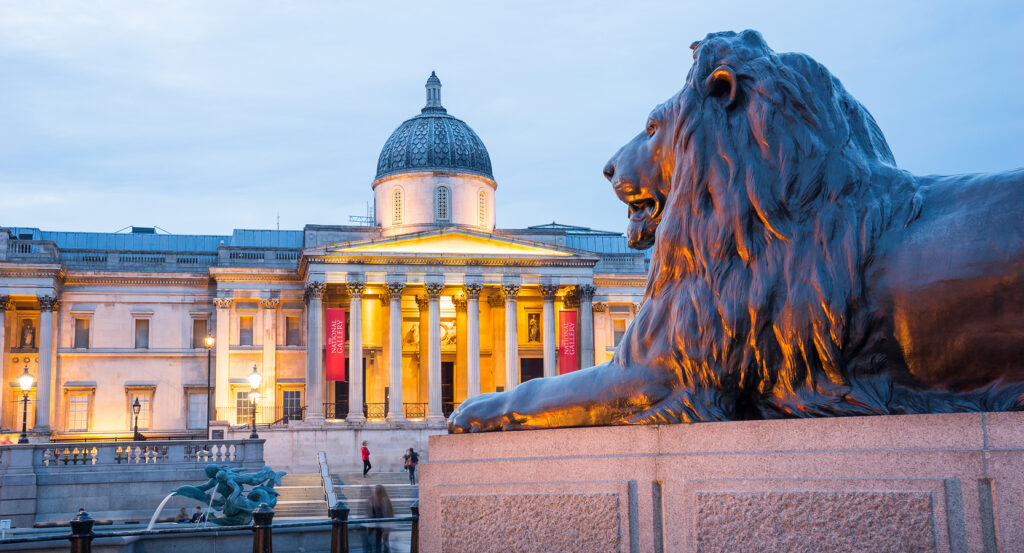
Approach from the southwest corner of Trafalgar Square, where you can take in the sculpture’s silhouette against the sky, the lions’ stillness, and the city’s hum rising all around. Each installation remains on display for roughly two years, so no two visits are ever the same. Pair your stop with a stroll through the nearby National Gallery, where centuries of artistic evolution hang in quiet dialogue with the plinth’s bold experiments. Return at dusk, when the square’s lights flicker on and London’s pulse slows for a moment, and you may sense, in that suspended space, how a simple stone platform became the beating heart of Britain’s cultural conscience.
Hear it from the Foresyte community.
You can grab a sandwich, sit by the fountain, and suddenly you’re starring right at a lion that’s lowkey judging you but in a supportive way. Doesn’t matter what you’re eating, even crisps make it cinematic.
Where meaningful travel begins.
Start your journey with Foresyte, where the planning is part of the magic.
Discover the experiences that matter most.