
Why Prague Astronomical Clock matters.
Prague Astronomical Clock is a fifteenth-century astronomical timepiece where Old Town's medieval civic heritage meets Bohemian mathematical astronomy, the mechanical measurement of celestial movements and the ceremonial authority of Prague's municipal government.
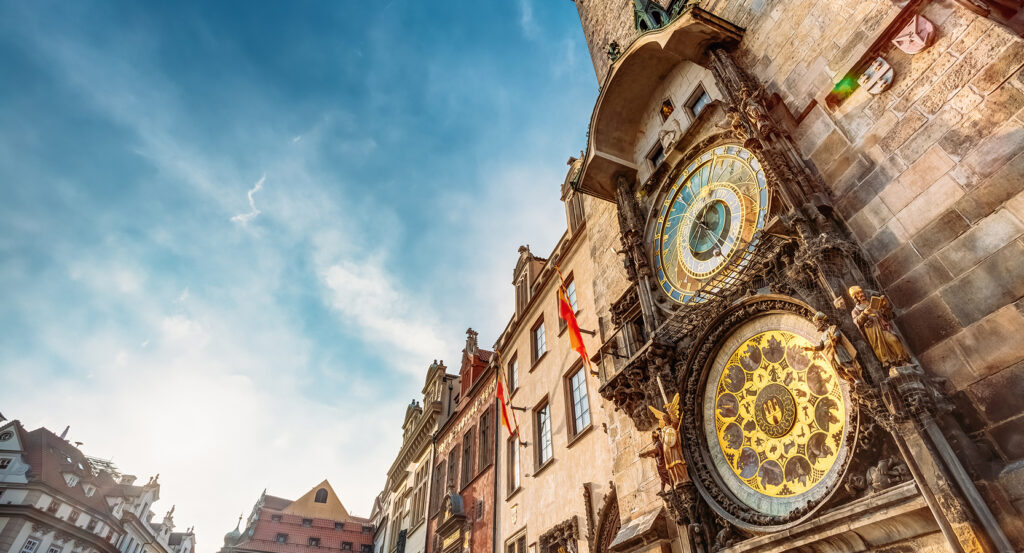
Mounted on the southern façade of the Old Town Hall beside Old Town Square, the clock occupies a vertical section of the medieval civic building, where its astronomical dial, calendar assembly and sculptural figures face the public pavement beneath the hall's Gothic tower. The upper dial displays astronomical information through concentric circles, rotating components and a gilded representation of the Sun. A lower calendar dial incorporates painted medallions arranged around its circumference. Gothic stone ornament frames the clock's principal elements, integrating its machinery into the historic façade. The result is a public astronomical instrument whose mechanical construction connects medieval scientific knowledge with the civic architecture of Prague.
What defines Prague Astronomical Clock.
Prague Astronomical Clock is best known for its astronomical dial dating to 1410, making it among the world's oldest surviving astronomical clocks and the oldest retaining its original astronomical mechanism in operation. The instrument developed during a period when European universities incorporated mathematical astronomy into the study of planetary motion, calendars and timekeeping. Prague had become an important center of scholarship following the establishment of Charles University in 1348. The astronomer and mathematician Jan Šindel contributed the astronomical calculations underlying the clock's original design. Clockmaker Mikuláš of Kadaň constructed the mechanism, combining astronomical theory with the practical requirements of a public municipal timepiece. The instrument incorporated a geocentric representation of celestial movement, corresponding to the astronomical conventions of late medieval Europe. Its installation connected the scientific interests of Prague's scholars with the administrative functions of the Old Town municipality. During the fifteenth century, the clock underwent substantial alterations associated with the development of its calendar and mechanical components. Clockmaker Jan Růže, known as Hanuš, became associated with later work on the instrument, contributing to a persistent historical tradition that incorrectly credited him with its original invention. The clock's decorative and mechanical assemblies continued to change through subsequent centuries as craftsmen repaired worn components and adapted its displays. During the seventeenth and eighteenth centuries, periods of deterioration threatened the instrument's operation. Major repairs during the nineteenth century restored important mechanical functions and renewed portions of its decorative program. In May 1945, fighting during the Prague Uprising severely damaged the Old Town Hall and the clock, destroying wooden figures and affecting the mechanism. Restoration work returned the instrument to operation in 1948, preserving its position within the city's historic civic architecture. A further conservation campaign completed in 2018 addressed mechanical components, decorative surfaces and the astronomical dial.
Jan Šindel's astronomical calculations govern the upper dial's representation of the apparent movements of the Sun and Moon across a stylized celestial background. The Central Earth occupies the fixed position characteristic of the medieval geocentric system, with surrounding elements indicating astronomical relationships through rotating hands and circles. A golden Sun moves around the dial, indicating its position along the ecliptic and its relationship to the horizon. The zodiac ring rotates within the instrument, representing the Sun's apparent annual passage through the twelve zodiacal signs. Blue, orange and black regions distinguish the visible sky, twilight and nighttime, connecting the dial's geometry with the changing conditions of daylight. Roman numerals indicate Central European time, and an outer ring of Gothic numerals displays Old Czech time measured through the hours following sunset. A separate lunar sphere represents the Moon's changing phases through a rotating black-and-silver surface. The clock's lower assembly incorporates a calendar dial painted by Josef Mánes in 1865, with medallions depicting agricultural activities associated with the months of the year. Its outer ring contains the names of saints and other calendar information, connecting astronomical measurement with religious observance. Above the astronomical dial, two small windows open during the hourly performance to reveal a procession of the twelve apostles. Sculptural figures flanking the dial include representations of Vanity, Greed, Death and a figure traditionally associated with Ottoman culture. The skeletal figure of Death activates a bell during the performance, contributing to the medieval imagery of mortality surrounding the timepiece. A gilded rooster above the apostle windows completes the sequence through a mechanical movement and call. The clock's operation combines astronomical calculation, calendar measurement and religious sculpture within a single public instrument, preserving the technical and cultural ambitions of late medieval Prague.
How Prague Astronomical Clock fits.
Prague Astronomical Clock works as the scientific and civic centerpiece for a Prague outing connecting medieval university scholarship, Gothic urban architecture and the historical institutions associated with Bohemia's intellectual development.
Begin at Klementinum, the former Jesuit college complex developed around earlier religious buildings near the eastern approaches to the Vltava. The Jesuits established their Prague college in 1556, expanding the institution into a substantial center of education and scientific activity. Its Baroque Library Hall contains fresco decoration by Jan Hiebl and historic book collections arranged within an elaborate architectural interior. The Astronomical Tower became associated with systematic meteorological observations, including a temperature series extending to 1775. The complex subsequently became the seat of the National Library of the Czech Republic, preserving its relationship with scholarship and the transmission of scientific knowledge. Continue to the House at the Stone Bell, the Gothic residence occupying a prominent position on Old Town Square. Its architectural development dates principally to the fourteenth century, when the building formed part of Prague's substantial urban residential properties. The façade contains pointed windows, sculptural details and carefully worked stone elements associated with Gothic domestic architecture. Restoration during the twentieth century recovered medieval features concealed beneath later alterations. The building's association with the Luxembourg dynasty contributes to its historical importance within the political geography of medieval Prague. Its exhibition spaces are administered by Prague City Gallery, connecting the preserved residence with the city's cultural institutions. Conclude at the Carolinum, the historic university complex associated with Charles University. The institution originated through the foundation issued by Charles IV in 1348, establishing the first university in Central Europe. The Carolinum became the university's principal seat during the fourteenth century, accommodating academic ceremonies and administrative functions. Its surviving Gothic bay chapel and architectural elements preserve portions of the medieval university building. Subsequent alterations incorporated Baroque and later architectural features, maintaining the complex's institutional function through successive periods of Czech history. The progression moves from Jesuit astronomical scholarship through Gothic urban architecture and culminates at the medieval university, connecting Prague Astronomical Clock with the scientific and educational institutions of the Bohemian capital.
Where your story begins.
Foresyte Travel reveals places that feel extraordinary long before you arrive.
Enjoy editorial crafted for luxury travelers.
Foresyte may earn a commission when you book.





































































































