Why you should visit Bradbury Atrium.
You should visit the Bradbury Atrium because it stands as one of Los Angeles’ most mesmerizing architectural treasures, a rare intersection of light, craftsmanship, and cinematic legacy.
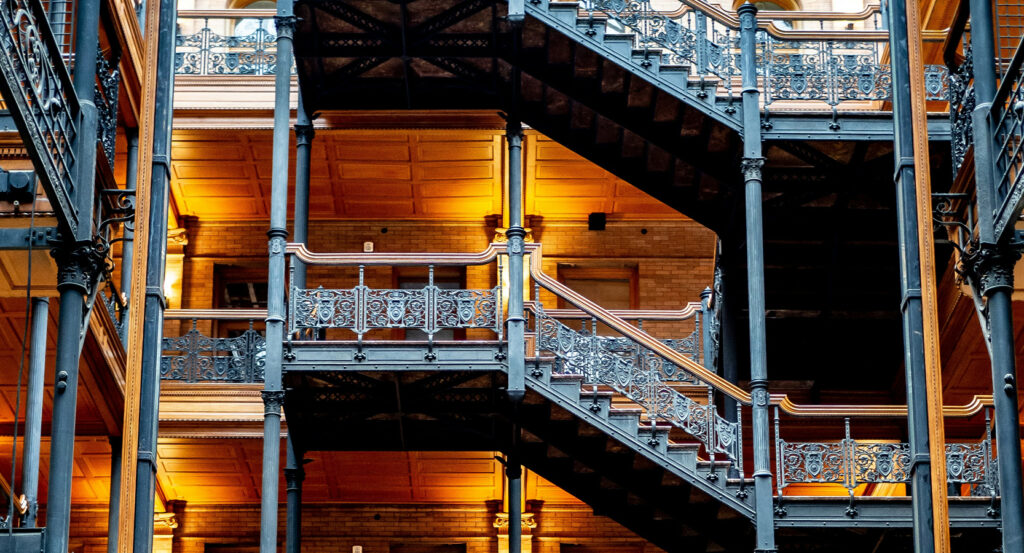
Step inside, and you’re immediately enveloped in a golden glow as sunlight filters through an iron-and-glass skylight, cascading down over ornate wrought-iron railings and terracotta brickwork. The five-story atrium feels almost weightless, suspended between Victorian elegance and industrial innovation. Originally completed in 1893, the Bradbury Building continues to capture imaginations, from architects who revere its structural ingenuity to filmmakers who have immortalized it in works like Blade Runner and 500 Days of Summer. It’s a building that whispers rather than shouts, its beauty unfolding in slow revelation as you ascend the staircases or lean over the iron balustrades. Visiting it feels like entering a lucid dream of old Los Angeles, one where craftsmanship was a philosophy, not a commodity.
What you didn’t know about Bradbury Atrium.
What you didn’t know about the Bradbury Atrium is that its visionary design was inspired not by another building, but by a novel, Edward Bellamy’s Looking Backward: 2000, 1887, a utopian tale of light-filled architecture and social progress.
The building’s developer, Lewis Bradbury, commissioned an untested draftsman, George Wyman, who had no formal architectural training but shared Bradbury’s futuristic imagination. The result was a space decades ahead of its time: open-caged elevators that glide like jewelry boxes, ironwork that fuses French Art Nouveau with Gothic verticality, and a skylight engineered to harness natural illumination long before electricity was widespread. Hidden details abound, from the geometric tile patterns underfoot to the use of Mexican tile and Belgian marble, all symbolizing the cosmopolitan ambitions of early Los Angeles. It’s not just a feat of design; it’s a statement about progress and human aspiration, preserved in iron and light.
How to fold Bradbury Atrium into your trip.
To fold the Bradbury Atrium into your trip, make it one of your morning stops when the natural light is strongest.
The building is still partially occupied by offices, but the public can access the ground floor and gaze upward through the atrium, watching how the light shifts across the balconies and stairwells. Pair your visit with a stroll through nearby Broadway’s architectural landmarks, the Million Dollar Theater and Grand Central Market are within walking distance, to deepen your immersion in the city’s early 20th-century revival. For photography lovers, the Bradbury is a masterpiece of contrast and shadow, best captured with a slow, deliberate eye. And if you happen to be a film aficionado, standing here is like walking into a frame of cinematic history, a timeless intersection where imagination, artistry, and Los Angeles itself converge.
Hear it from the Foresyte community.
Sunlight pours in like it’s on cue, iron staircases curl into the sky, and you suddenly understand why every director falls in love with this place.
Where meaningful travel begins.
Start your journey with Foresyte, where the planning is part of the magic.
Discover the experiences that matter most.