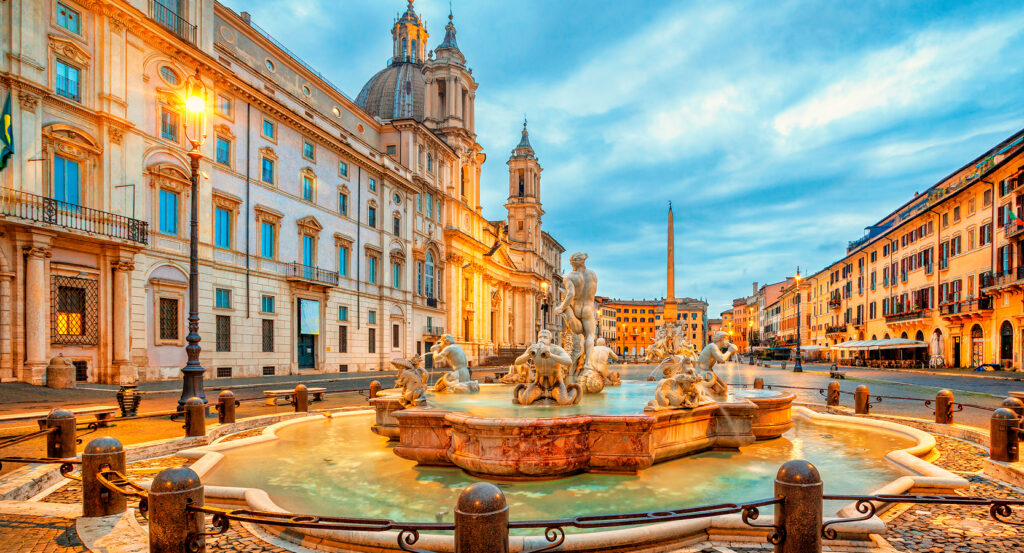
Why you should visit Church of Sant’Agnese in Agone.
Rising like a baroque sigh along Piazza Navona, the Church of Sant’Agnese in Agone is less a building than a revelation in motion, marble drawn upward toward heaven.
Its façade, designed by Francesco Borromini in the mid-17th century, curves like breath itself, a concave sweep that embraces the piazza and mirrors Bernini’s Fountain of the Four Rivers just steps away. Together, they create one of the most spellbinding dialogues in Rome, art as conversation between rivals. The twin bell towers frame a dome that seems to hover, light and ethereal, its lantern piercing the sky in a whisper of gold. Inside, the air glows with candlelight reflected on white stucco and pink marble, the scent of incense mingling with echoes of choral song. The church was built upon the site where Saint Agnes, a 13-year-old martyr, was stripped and humiliated in the ancient Stadium of Domitian, yet it radiates serenity, not sorrow. To enter its nave is to feel a paradox made holy: grace born of suffering, beauty built from defiance.
What you didn’t know about Church of Sant’Agnese in Agone.
What most travelers never realize is that Sant’Agnese in Agone is not just a jewel of baroque architecture, it’s an allegory of rivalry, redemption, and resurrection etched in stone.
Borromini inherited the project from Girolamo Rainaldi, whose original plans he reshaped with audacity and emotion. His genius lay in fluidity: curves that beckon, columns that seem to breathe, walls that dissolve into light. The church became Borromini’s manifesto, geometry softened into spirit. Yet his feud with Bernini across the piazza shaped legend. Locals once joked that the Nile god on Bernini’s fountain covered his face to avoid seeing Borromini’s façade, a story both false and poetic, immortalizing their duel in beauty. Beneath the floor lies the crypt of Saint Agnes, a quiet chamber where her relics rest beneath soft flickering lamps. The walls bear marble reliefs of her martyrdom, not tragic, but luminous. Every inch of Sant’Agnese seems to whisper Borromini’s belief that form could pray, that architecture could kneel.
How to fold Church of Sant’Agnese in Agone into your trip.
To fold Sant’Agnese in Agone into your Roman sojourn, approach it as both sanctuary and stage.
Arrive in the morning when sunlight spills across the façade and the piazza is still half-asleep; from this angle, the dome appears to levitate. Step inside and look upward immediately, the illusion is deliberate, a spiral of gold drawing your eye heavenward, Borromini’s signature act of grace. Sit for a moment in the nave and listen; even silence here feels melodic. Visit the side chapels, where marble angels lean out of shadow, their gestures frozen mid-hymn. Descend to the crypt, where Saint Agnes rests in quiet glory, her story humming beneath your breath. When you emerge into the piazza again, stand between church and fountain, Borromini and Bernini, saint and spectacle, faith and flesh, and let your gaze travel upward once more. You’ll see what they both understood: that in Rome, salvation isn’t confined to heaven. It’s carved into the light.
Hear it from the Foresyte community.
The square feels like rome on display. Fountains exploding, street vendors throwing their splatter balls everywhere, tourists pretending it’s casual when it’s cinematic. Good place to eat overpriced gelato.
Where meaningful travel begins.
Start your journey with Foresyte, where the planning is part of the magic.
Discover the experiences that matter most.