Why you should visit the Crypt of Great Men.
To descend into the Crypt of Great Men is to cross a threshold between reverence and immortality, where the air itself feels denser, charged with the weight of genius and sacrifice.
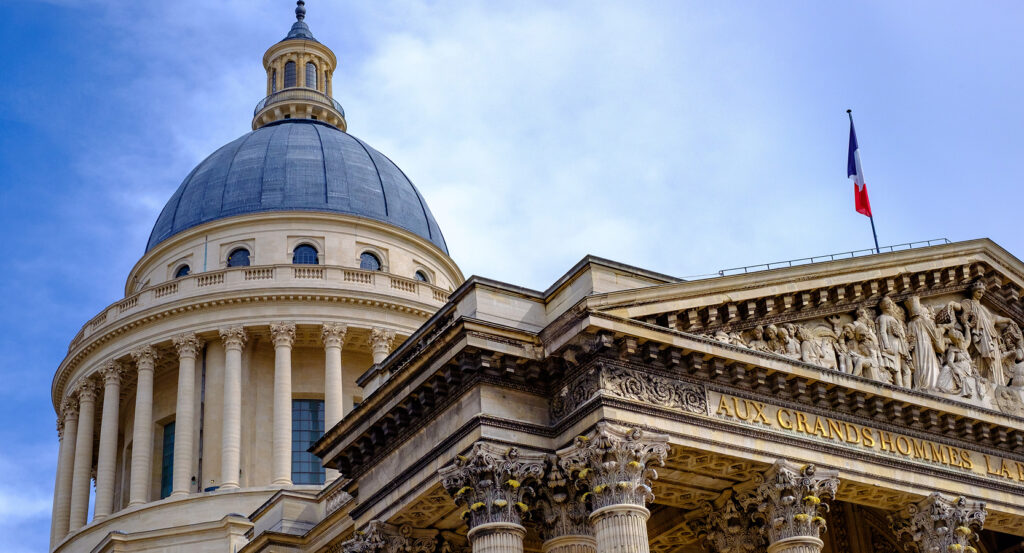
Located beneath the Panthéon’s grand neoclassical dome, this subterranean chamber holds the remains of France’s greatest minds, Voltaire, Rousseau, Victor Hugo, Marie Curie, Alexandre Dumas, each resting in monumental stone vaults that seem to hum with the echoes of their words and discoveries. The architecture alone commands a hush: vast arched corridors of pale limestone, dimly lit and echoing softly beneath the shuffle of feet. This is not a mausoleum of mourning, but of triumph, the republic’s living dialogue with its own ideals. Inscriptions etched into the walls proclaim, Aux grands hommes la patrie reconnaissante (“To great men, the grateful homeland”), and in that declaration lies something profoundly human, the belief that ideas can outlast flesh, that honor can be eternal. For visitors, it’s a rare opportunity to stand face to face with the thinkers who defined Enlightenment, revolution, and modernity, to feel, quite literally, the gravity of legacy beneath your feet.
What you didn’t know about the Crypt of Great Men.
What many travelers overlook is how the crypt beneath the Panthéon evolved through political reinvention, a mirror to France’s shifting sense of self.
The Panthéon began not as a shrine to intellect but as a church dedicated to Saint Geneviève, the city’s patron saint. Yet the French Revolution, with its fiery embrace of secular reason, transformed it into a civic temple celebrating human achievement over divine intervention. Since then, its role has oscillated with each regime: restored to religious use under Napoleon, secularized again under the Third Republic, and continually redefined as France’s political climate shifted. The inclusion of Marie Curie in 1995, the first woman interred on her own merit, marked not only a national milestone but a global one, symbolizing the slow, deliberate widening of the definition of “greatness.” Every tomb added since has carried quiet controversy, debate, and reflection, revealing more about France’s evolving conscience than any speech ever could.
How to fold the Crypt of Great Men into your trip.
To weave the Crypt of Great Men into your Paris itinerary, approach it as both pilgrimage and meditation.
Begin at the Panthéon’s soaring nave, gazing upward at the frescoes depicting the sweep of French history, before descending slowly into the cool, solemn quiet below. Take your time, linger at each vault, read the names carved into stone, and let your thoughts wander through centuries of literature, philosophy, and science. The crypt pairs beautifully with a morning spent exploring the Latin Quarter’s scholarly charm, perhaps starting at the Sorbonne or one of the area’s timeworn cafés where Rousseau and Diderot once debated the essence of freedom. When you emerge again into daylight, walk a few blocks to the Luxembourg Gardens and let the contrast settle in: life’s vitality shimmering above, the memory of immortals resting below. That juxtaposition, light over shadow, life over legacy, is what makes the visit unforgettable.
Hear it from the Foresyte community.
Outside it looks like a fortress, inside it feels like an illusion. The scale makes no sense. You spin in circles like a tourist and don’t even care about it.
Where meaningful travel begins.
Start your journey with Foresyte, where the planning is part of the magic.
Discover the experiences that matter most.