Why you should visit Musée de l’Orangerie.
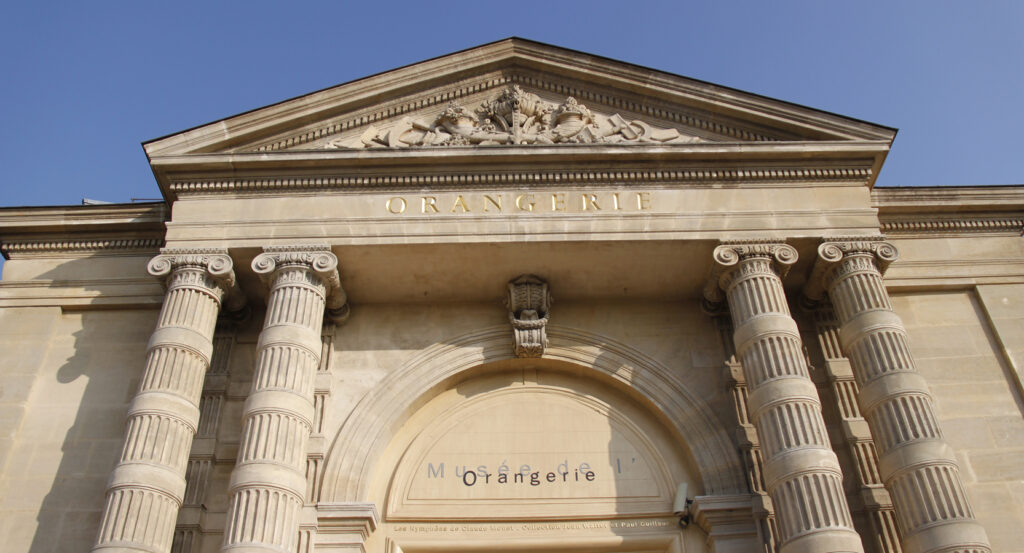
The Musée de l’Orangerie is not just a museum, it’s a sensory immersion, a slow exhale in a city that rarely pauses. Tucked within the Tuileries Gardens, this elegant neoclassical pavilion holds one of the most transcendent art experiences in the world: Monet’s Water Lilies. Stepping inside the oval rooms designed to the artist’s exact specifications feels like entering another realm, where light, color, and reflection dissolve the boundaries of time and thought. The murals stretch across curved walls like living horizons, enveloping you in a dream Monet painted as his own farewell to the visible world. The stillness here is intoxicating; it hushes even the most hurried travelers. Above you, skylights filter Parisian light so softly that each brushstroke seems to breathe. The museum’s intimacy heightens everything, from the scale of the canvases to the emotional quiet they induce. It’s not a gallery to rush through, but to surrender to, letting the hum of the city vanish in favor of Monet’s rhythmic, infinite ripples.
Every glance reveals something new, not a painting to view, but a landscape to inhabit.
What you didn’t know about Musée de l’Orangerie.
Yet what you might not know is that the Orangerie’s story mirrors France’s own transformation, from imperial ambition to artistic modernity. Originally built in 1852 to shelter orange trees from the chill of Parisian winters, the structure became a sanctuary for art decades later, evolving alongside the city’s cultural pulse. Monet himself insisted his Water Lilies be displayed here in the wake of World War I as a gift to the French people, a visual balm for a nation in recovery. The decision was profoundly symbolic: a war-torn country offered healing through beauty. The Orangerie also houses the Jean Walter and Paul Guillaume collection, a remarkable array of 19th and 20th-century masterpieces from Cézanne, Renoir, Matisse, Picasso, and Modigliani. But the space itself remains part of the exhibition, its harmony of proportion, its dialogue between nature and architecture, its whispered reminder that art, like life, thrives in adaptation.
It’s a building that has learned to bloom in all seasons, bearing the weight of history while remaining effortlessly alive.
How to fold Musée de l’Orangerie into your trip.
To fold the Musée de l’Orangerie into your Paris itinerary, plan it as a mid-day reprieve, a meditative counterpoint to the grandeur of the nearby Louvre or the energy of the Champs-Élysées. Enter through the Tuileries, perhaps after a stroll past the gardens’ statues and fountains, and let the atmosphere prepare you for quiet contemplation. Inside, take your time in each of Monet’s oval rooms; stand close, then far, and notice how the paintings change with perspective and light. Afterward, descend to the lower level to explore the Walter-Guillaume collection, its compact scale makes it ideal for absorbing great art without fatigue. Exit onto the terrace facing the Place de la Concorde, where the city resumes its pulse, sharper and somehow more alive. Pair your visit with a late lunch at a nearby café, letting the rhythm of conversation and clinking cups draw you back to reality.
If the Louvre is Paris’ intellect, the Orangerie is its soul, smaller, subtler, and infinitely profound.
Hear it from the Foresyte community.
You think it’s just another museum until you’re swallowed by a wall of color that feels like walking straight into a dream sequence. It’s like the city forgot to add noise here so you just breathe and let it wash over you.
Where meaningful travel begins.
Start your journey with Foresyte, where the planning is part of the magic.
Discover the experiences that matter most.