Why you should visit Napoleon’s Sarcophagus.
Few monuments command silence like Napoleon’s sarcophagus, resting beneath the Dôme des Invalides in solemn grandeur.
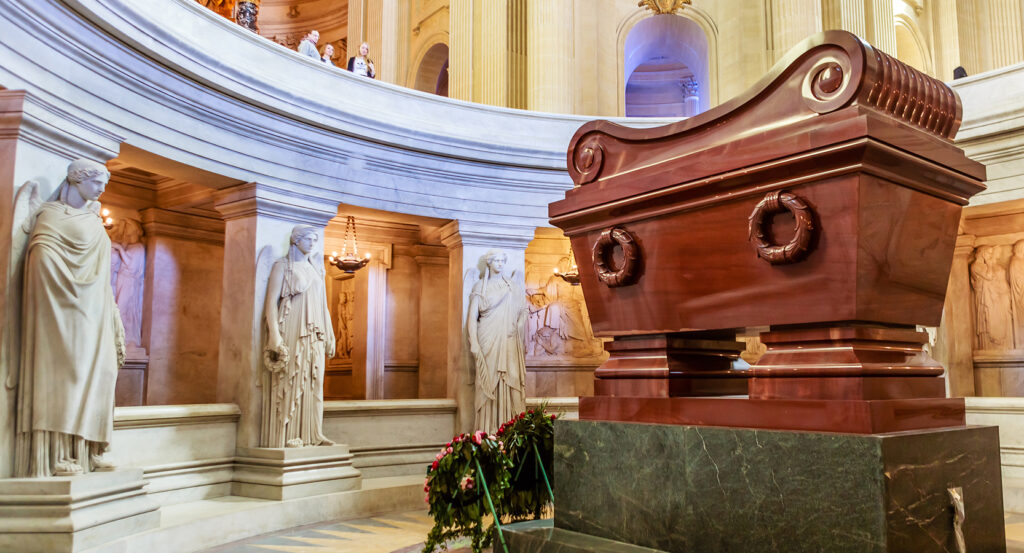
Descending into the circular crypt feels like entering a temple, the light softens, footsteps echo, and time seems to slow. At its center lies a colossal sarcophagus of red quartzite, encircled by laurel wreaths and military victories carved into marble. It is at once intimate and imperial, an emperor laid to rest not in defiance but in ceremony. Designed under Louis-Philippe’s reign in the 1840s, the tomb embodies an uneasy reconciliation between France’s revolutionary past and its imperial pride. Every detail feels deliberate: the twelve marble victory goddesses surrounding the chamber represent Napoleon’s campaigns; the circular descent symbolizes eternity. To stand above the tomb is to feel the gravitational pull of history, not just of the man who crowned himself emperor, but of the myth he forged that still defines France’s relationship with power, ambition, and destiny.
What you didn’t know about Napoleon’s Sarcophagus.
What most don’t know is that Napoleon’s sarcophagus almost didn’t make it home to Paris at all.
After his defeat and exile to Saint Helena, the emperor was buried beneath simple stones marked only by the word Napoléon. It wasn’t until 1840, nearly two decades after his death, that King Louis-Philippe arranged for his remains to be returned in what became known as le retour des cendres (“the return of the ashes”). The French public received his body with near-religious fervor, and architect Louis Visconti designed a tomb worthy of the legend. Yet even the material of the sarcophagus carries intrigue, once thought to be porphyry, the royal stone of ancient emperors, it is actually quartzite imported from Russia, chosen for its deep hue and polished luster. The sarcophagus sits on a granite pedestal from Vosges, surrounded by the names of his greatest battles. Ironically, the crypt’s solemn circular design means visitors must look down upon Napoleon, an architectural humility imposed upon eternal grandeur.
How to fold Napoleon’s Sarcophagus into your trip.
To fold this experience into your Paris visit, allow yourself to linger, the Dôme above and the crypt below are meant to be experienced together, like movement and echo.
Enter through the main chapel and follow the marble ramp that curves gently toward the tomb. Take your time descending; each step feels like a pilgrimage through French identity itself. When you reach the center, pause in silence, not just to honor Napoleon, but to absorb how deeply he still lives in France’s imagination. Nearby exhibits display his iconic bicorne hat, coronation robes, and personal effects, which give texture to the myth. Visit in the late afternoon, when the light filters through the stained glass and strikes the red stone in amber tones, the tomb seems to breathe. Before you leave, circle once more around the chamber; from every angle, the sarcophagus feels different, imperial, tragic, eternal. That, perhaps, is Napoleon’s final victory, not conquest, but permanence.
Hear it from the Foresyte community.
You expect some dusty little grave and instead it’s this massive marble spaceship looking thing. The dude’s been gone for centuries and he’s still posted up in the middle of the room like a boss. Like ok Napoleon we get it you win.
Where meaningful travel begins.
Start your journey with Foresyte, where the planning is part of the magic.
Discover the experiences that matter most.