Why you should visit Nelson’s Column.
Rising with solemn grace from the center of Trafalgar Square, Nelson’s Column is more than a monument, it is a declaration of Britain’s unyielding spirit and maritime supremacy.
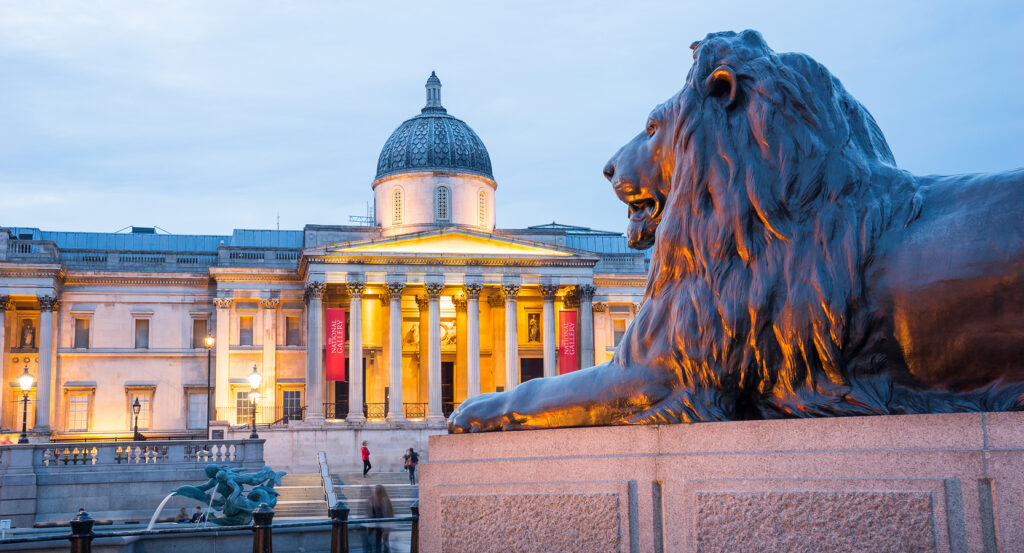
Dedicated to Admiral Horatio Nelson, who perished at the Battle of Trafalgar in 1805, the column stands 169 feet tall, ensuring the hero who once watched over the seas now watches over London itself. The Corinthian column, carved from Dartmoor granite and crowned with Nelson’s statue, captures an elegance that belies its martial inspiration. Around its base, four monumental bronze lions, cast from the cannons of defeated French ships, guard the admiral’s memory with quiet ferocity. The interplay between triumph and restraint defines the site: though a symbol of victory, it invites reverence rather than boast. When the sunlight glints off the bronze and the fountains shimmer nearby, the square takes on a distinctly cinematic quality, a living stage where Londoners and travelers gather to feel history breathe beneath their feet.
What you didn’t know about Nelson’s Column.
Yet behind its polished façade lies a story of ambition, controversy, and resilience that most visitors never learn.
Completed in 1843 after a design competition fraught with political intrigue, the column faced public criticism for its spiraling costs and precarious height. Even its sculptor, Edward Hodges Baily, endured relentless scrutiny, while the original sandstone plans were rejected in favor of stronger granite, a decision that saved the structure from collapse. The lions, now among London’s most photographed icons, were added decades later, delayed by design disputes and technical challenges. Each was sculpted by Sir Edwin Landseer, who studied the musculature of real lions at the London Zoo to achieve their majestic realism. Ironically, Nelson himself never saw Trafalgar Square, the plaza and its fountains came long after his death, making the monument both an act of homage and historical imagination.
How to fold Nelson’s Column into your trip.
To fold Nelson’s Column into your trip, arrive in Trafalgar Square as dawn softens the city’s noise, when the marble façade of the National Gallery glows in the early light.
From here, you can trace Nelson’s legacy through the surrounding landmarks, wander to Admiralty Arch, stroll down the Mall toward Buckingham Palace, or gaze north toward Covent Garden. Pause beneath the column and look upward; even after nearly two centuries, its scale still dwarfs the modern skyline. Whether you linger on the steps, listen to the swirl of street musicians, or simply stand still amid the square’s motion, Nelson’s Column anchors you in the city’s rhythm, a testament to courage, sacrifice, and the eternal human need to look upward.
Hear it from the Foresyte community.
You can grab a sandwich, sit by the fountain, and suddenly you’re starring right at a lion that’s lowkey judging you but in a supportive way. Doesn’t matter what you’re eating, even crisps make it cinematic.
Where meaningful travel begins.
Start your journey with Foresyte, where the planning is part of the magic.
Discover the experiences that matter most.