Why Osaka Castle matters.
Osaka Castle is an expansive Japanese fortress where Osakajo's military heritage meets Toyotomi Hideyoshi's campaign to unify Japan, the architectural ambitions of the Tokugawa shogunate, and the preservation of Osaka's most consequential historical monument.
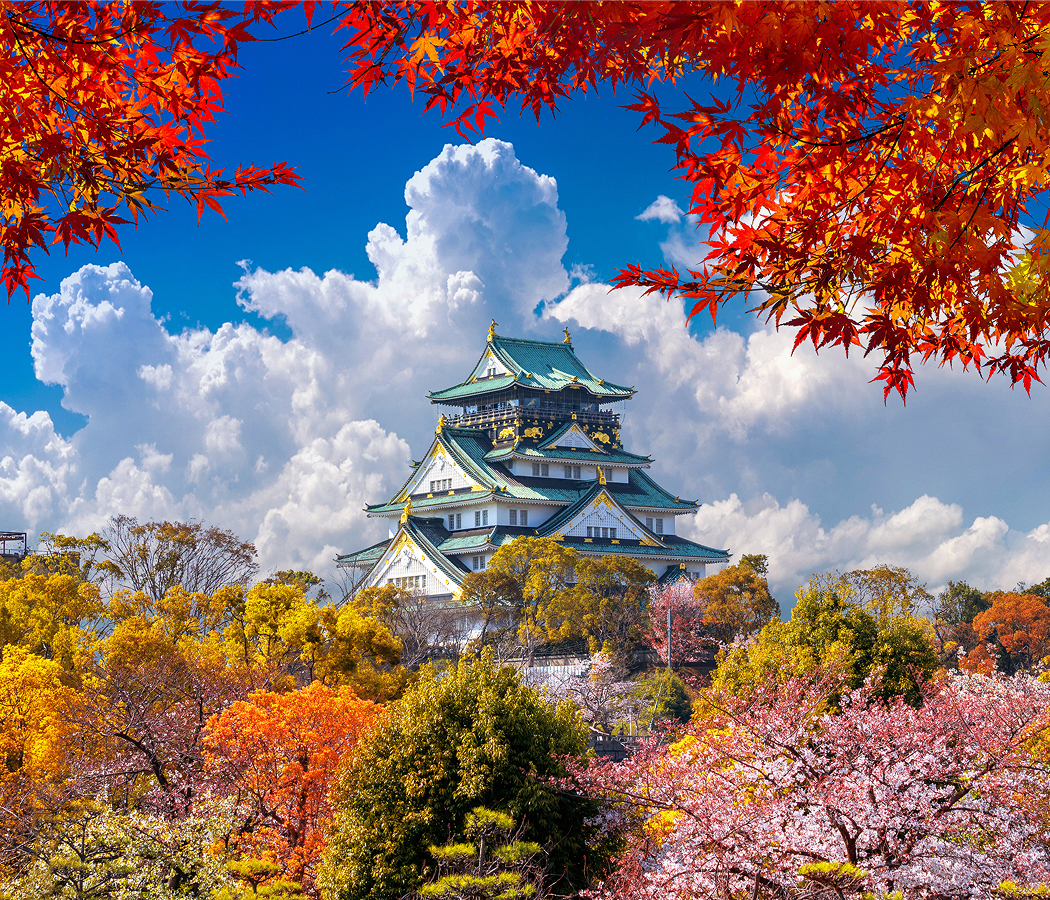
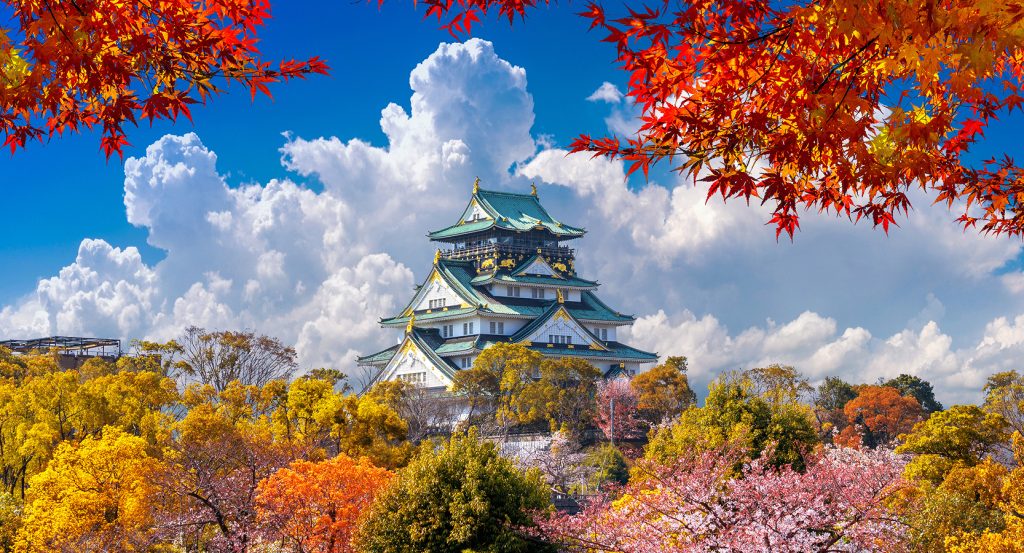
Occupying an elevated plateau above the eastern edge of Central Osaka, Osaka Castle rises within Osaka Castle Park between the Okawa River to the north and the historic districts of Tanimachi and Morinomiya, with the Osaka Business Park skyline extending beyond its northeastern defenses. The central keep rises above massive granite ramparts, surrounded by concentric moats, fortified gateways, and broad landscaped grounds. Its five-tiered exterior combines white plaster walls, dark tiled roofs, green copper ornamentation, and gilded decorative elements. Golden shachihoko crown the upper roof, and sculpted tigers introduce elaborate ornamentation beneath the uppermost galleries. Enormous stone blocks reinforce the surrounding fortifications, with carefully fitted masonry creating steep defensive walls above the water. Historic turrets occupy strategic positions along the outer defenses, preserving substantial portions of the fortress's early modern military architecture. The elevated observation gallery provides extensive views across the surrounding city, connecting the historic stronghold with Osaka's contemporary urban landscape. The result is an imposing fortified complex whose successive architectural layers preserve the military and political transformations that shaped Japan's early modern history.
What defines Osaka Castle.
Osaka Castle is best known for its association with Toyotomi Hideyoshi, the sixteenth-century military leader whose rise from relatively modest origins culminated in the political unification of Japan and the construction of one of the country's most formidable fortresses. The site's earlier history centered on Ishiyama Honganji, a powerful Buddhist temple complex that developed from a religious establishment founded by Rennyo in 1496. Its fortified community became a major center of resistance against Oda Nobunaga, whose campaigns against the temple culminated in its surrender in 1580. Following Nobunaga's death during the Honnō-ji Incident in 1582, Hideyoshi defeated rival forces and consolidated his position among Japan's leading military commanders. Construction of his new Osaka stronghold began in 1583, transforming the former religious precinct into the principal residence and political headquarters of an emerging national ruler. Hideyoshi drew inspiration from Nobunaga's Azuchi Castle, developing an expansive complex whose scale, elaborate decoration, and defensive organization communicated his expanding authority. The principal tower was completed in 1585, becoming the architectural centerpiece of a fortress that continued expanding through successive construction campaigns. Hideyoshi's victories over the Shimazu clan in Kyushu in 1587 and the Hōjō clan at Odawara in 1590 consolidated his control over the Japanese archipelago. His death in 1598 left the Toyotomi succession dependent on his young son Hideyori, creating the conditions for a prolonged struggle with Tokugawa Ieyasu. Ieyasu's victory at the Battle of Sekigahara in 1600 established his military supremacy, although the Toyotomi family retained its position at Osaka. The resulting confrontation culminated in the Winter Campaign of 1614, when Tokugawa forces surrounded the fortress and encountered determined resistance from its defenders. Sanada Yukimura emerged as one of the conflict's most celebrated commanders through his defense of the Sanada Maru, an advanced fortification constructed outside the castle's southern perimeter. The subsequent Summer Campaign of 1615 ended with the destruction of the Toyotomi stronghold and the deaths of Hideyori and his mother Yodo-dono, eliminating the principal remaining challenge to Tokugawa rule. Shogun Tokugawa Hidetada initiated a comprehensive reconstruction in 1620, ordering a new fortress built above the surviving remains of Hideyoshi's original complex. The project buried substantial portions of the Toyotomi fortifications beneath enormous quantities of earth and stone, creating the physical separation between two successive castles that would become important to later archaeological investigations. The reconstructed stronghold served as a strategic administrative and military center for the Tokugawa government's control of western Japan. Its main tower burned following a lightning strike in 1665, leaving the fortress without its principal architectural centerpiece for more than two centuries. The political upheavals surrounding the Meiji Restoration brought further destruction in 1868, and the grounds subsequently passed into military use. The Osaka Army Arsenal developed into a major industrial installation within the former fortress precinct, connecting the site with Japan's expanding modern military infrastructure. In 1931, a reconstruction campaign initiated under Mayor Hajime Seki raised 1.5 million yen through public donations, financing a new reinforced-concrete keep designed to reproduce the historical appearance of the castle. The surrounding military facilities suffered extensive damage during the Allied bombing of Osaka in 1945, although the reconstructed tower survived. A major restoration completed in 1997 renewed the exterior and modernized the museum facilities, establishing the tower's contemporary appearance. The castle's history connects Japan's political unification, the establishment of Tokugawa supremacy, the military industrialization of modern Osaka, and the preservation of a monument repeatedly transformed by conflict.
The Osaka Castle Museum develops this history through a collection centered on Hideyoshi's career, the material culture of Japan's Warring States period, and the political institutions that emerged during the transition to Tokugawa government. Original letters, military equipment, paintings, and decorative objects introduce the relationships between competing commanders, courtly patronage, and the consolidation of national authority. A full-scale reconstruction of Hideyoshi's portable Golden Tea Room demonstrates the extraordinary ceremonial importance of gold within his political and cultural program. The chamber's gilded surfaces connect the aesthetics of tea gatherings with the deliberate display of wealth and status among powerful military rulers. Architectural models of the Toyotomi and Tokugawa fortresses reveal substantial differences in their defensive arrangements, illustrating how successive governments reshaped the same strategic location. The museum's presentation of the Summer Siege of Osaka draws upon a celebrated folding screen depicting the conflict, whose densely populated scenes preserve images of mounted warriors, infantry formations, military banners, and civilians caught within the fighting. Miniature figures and audiovisual presentations develop the relationship between the screen's individual episodes and the larger military confrontation. The collection's personal artifacts introduce another dimension through objects associated with Hideyoshi and his contemporaries, connecting the expansive history of the fortress with the individuals who exercised power within its walls. A particularly consequential development arrived in 2025 with the opening of the Toyotomi Stone Wall Museum, an underground exhibition preserving original masonry discovered during excavations in 1984. The exposed fortifications belonged to the inner defenses of Hideyoshi's castle and survived beneath the massive fill deposited during the subsequent reconstruction. Visitors descend below the contemporary ground level to encounter the buried stonework, gaining a direct understanding of the substantial vertical separation between the two historical structures. The excavation establishes a tangible connection between archaeological investigation and the political determination of the Tokugawa government to replace its predecessor's stronghold. The reconstructed tower received national registration as a tangible cultural property in 1997 and additional designation as an Osaka City tangible cultural property in 2025, recognizing the historical significance of the twentieth-century structure itself. These successive layers of preservation give Osaka Castle an unusual architectural and institutional character, combining original fortifications, buried archaeological remains, and a modern museum dedicated to the political transformations of early modern Japan.
How Osaka Castle fits.
Osaka Castle provides a natural starting point for exploring the religious commemoration of Japan's unification, the archaeological history of the ancient imperial capital, and the cultural institutions preserving Osaka's urban development.
Begin at Hokoku Shrine, the Shinto sanctuary occupying the southern section of the castle grounds near the approach to the inner fortifications. Dedicated to Toyotomi Hideyoshi, Toyotomi Hideyori, and Toyotomi Hidenaga, the shrine commemorates the family whose political achievements shaped the final decades of Japan's Warring States period. Its origins belong to the Meiji government's revival of imperial and national historical commemoration during the nineteenth century. The Osaka sanctuary was originally established at Nakanoshima before relocating to the castle grounds in 1961. A bronze statue of Hideyoshi stands near the entrance, presenting the former ruler in ceremonial dress. The shrine's principal buildings and surrounding trees establish a secluded religious precinct within the larger historical landscape. Continue to Osaka Museum of History, the major cultural institution standing southwest of the castle beside the remains of the ancient Naniwa Palace. Opened in 2001, the museum presents Osaka's development from the Asuka and Nara periods through the merchant culture of the Edo era and the industrial expansion of the modern city. Its upper galleries incorporate full-scale reconstructions of the Naniwa Palace's ceremonial interiors, introducing the architectural setting of the imperial court during the seventh century. Archaeological discoveries, historical models, and reconstructed streetscapes trace the transformation of the surrounding settlement into a major commercial center. Large windows provide views across the palace archaeological site, connecting the museum's interpretation with the surviving urban landscape. Conclude at Nishinomaru Garden, the landscaped precinct occupying the western section of the former castle defenses. The garden extends across a substantial open lawn bordered by historic fortifications, mature trees, and carefully maintained planting. Approximately 300 cherry trees establish one of Central Osaka's most celebrated seasonal landscapes, producing extensive blossoms during spring. The garden's western position provides a broad perspective on the central tower rising beyond the surrounding defensive walls. Its open grounds preserve the spatial character of a former fortified enclosure, connecting the historic military landscape with the recreational development of the modern city. The progression moves from Hokoku Shrine's commemoration of the Toyotomi family through Osaka Museum of History's interpretation of the ancient capital and culminates at Nishinomaru Garden's preserved fortress landscape, connecting the political history of Osaka Castle with the broader cultural development of the city.
Where your story begins.
Foresyte Travel reveals places that feel extraordinary long before you arrive.
Enjoy editorial crafted for luxury travelers.
Foresyte may earn a commission when you book.