Why you should visit Piazza di Spagna.
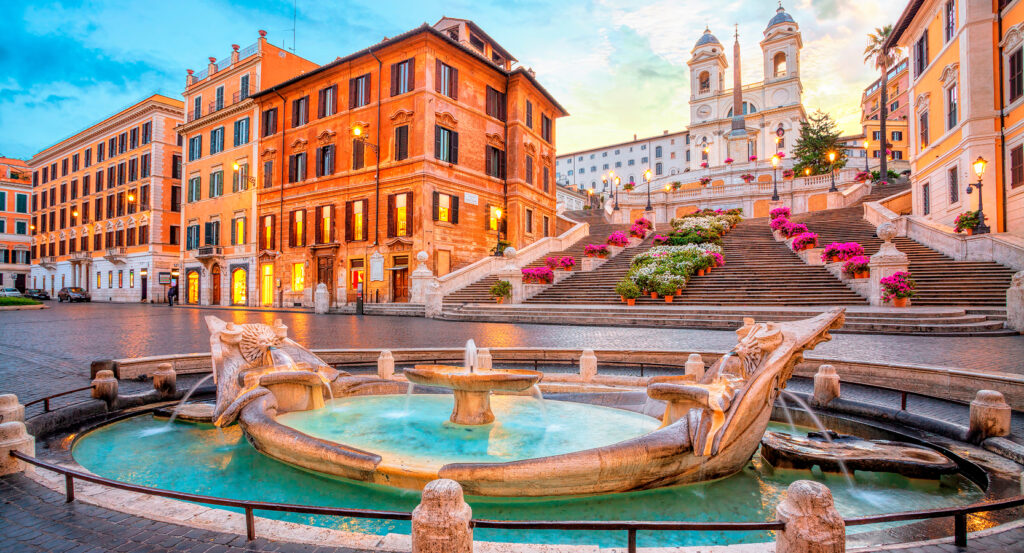
Piazza di Spagna is where Rome exhales, a sunlit amphitheater of elegance where art, commerce, and human theater intertwine.
Framed by ochre façades and the sweeping ascent of the Spanish Steps, the square has been seducing travelers for centuries. Its name derives from the Spanish Embassy to the Holy See, yet its soul is entirely Roman, a fusion of flirtation and faith, spectacle and repose. At the center lies Bernini’s Fontana della Barcaccia, carved like a half-sunken boat drifting through marble waves, its trickling water a lullaby beneath the city’s pulse. Around it, cafés murmur with conversation, shutters glow in afternoon light, and the air smells faintly of espresso and perfume. The piazza’s geometry feels cinematic, wide enough for grandeur, intimate enough for stolen glances. To stand here is to watch time slow into rhythm; the architecture becomes choreography, the people its dancers. This is not a place you pass through, it’s one you inhabit, one heartbeat at a time.
What you didn’t know about Piazza di Spagna.
What most travelers don’t realize is that Piazza di Spagna has long been Rome’s crossroads of worlds, a stage for diplomacy, devotion, and decadence alike.
During the 17th and 18th centuries, it became the nucleus of the Grand Tour, where artists, aristocrats, and writers converged in pursuit of beauty. Keats drew his final breaths in the small house at the foot of the Spanish Steps, now a museum that preserves his fragile immortality. The piazza also carried spiritual weight: it linked the Spanish Embassy’s Catholic authority below to the French church of Trinità dei Monti above, a delicate balance of power made physical through architecture. Beneath its charm lies a blueprint of Europe’s shifting alliances and Rome’s enduring seduction. Even its fountain, commissioned by Pope Urban VIII, commemorates survival, legend says it marks the spot where a boat washed ashore after a 1598 flood, turned forever into marble. Every element here, political, poetic, or mythic, converges in perfect, sun-drenched symmetry.
How to fold Piazza di Spagna into your trip.
To fold Piazza di Spagna into your Roman journey, arrive not to see, but to soak.
Come in the early morning when the cobblestones glisten with dew and only the pigeons keep company; this is when the square belongs to you. Sit on the lower steps with coffee in hand and watch the city wake, street musicians tuning, shopkeepers unlocking shutters, the first beams of sunlight striking the church towers above. By midday, join the current of visitors drifting through designer boutiques and flower stalls, each terrace spilling fragrance into the square. Stay through dusk if you can; as the crowds thin, the light warms to amber, and the fountain’s murmurs become almost hypnotic. The Spanish Steps glow like molten gold, and the square itself seems to hold its breath. This is the hour when Rome feels eternal, suspended between elegance and emotion, between the living and the legends who once sat exactly where you are now.
Hear it from the Foresyte community.
You sit down ‘just for a minute’ and somehow lose an hour watching people parade past like it’s rome’s unofficial runway. The fountain looks like a boat sinking but everyone around it is just vibing like that’s normal.
Where meaningful travel begins.
Start your journey with Foresyte, where the planning is part of the magic.
Discover the experiences that matter most.