Why you should visit Rotunda de Chartres.
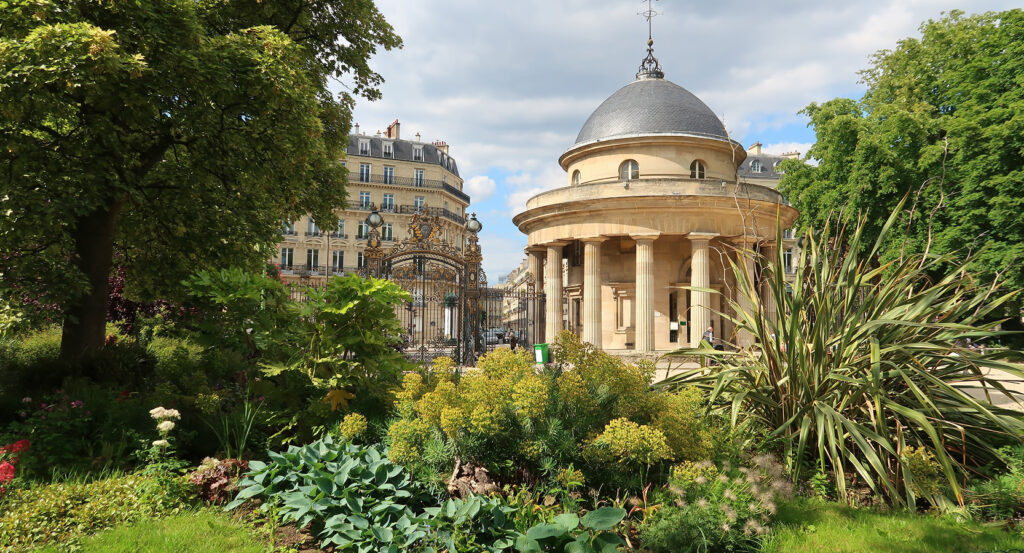
The Rotunda de Chartres, tucked within the lush expanse of Parc Monceau, is one of Paris’s most quietly poetic architectural relics, an 18th-century rotunda that once guarded the park’s original entrance.
Its classical columns and domed silhouette immediately evoke the refined elegance of pre-Revolutionary France, a period when aristocrats came here to promenade, gossip, and be seen. The structure, designed by architect Claude Nicolas Ledoux, was part of a grand urban vision commissioned by the Duke of Chartres, cousin to Louis XVI, who wanted his private garden to feel like a painter’s dream, half-real, half-theatrical. To stand before the Rotunda de Chartres today is to feel suspended between those worlds: the symmetry and proportion of Enlightenment geometry juxtaposed against the wild softness of the park’s modern greenery. It’s a living reminder that beauty, in Paris, often hides in plain sight, dignified, understated, and infinitely timeless.
What you didn’t know about Rotunda de Chartres.
What many visitors never realize is that the Rotunda de Chartres wasn’t originally conceived as mere decoration, it was a toll pavilion.
Before the park became public, this rotunda marked one of the forty-two customs gates of the Farmers-General Wall, a barrier designed to tax goods entering the city. Ledoux’s design elevated what could have been utilitarian into something philosophical: a monument to balance and order, its circular plan echoing ideals of harmony and reason that defined the Enlightenment era. Ironically, the very wall it served would later be torn down during the Revolution, making the rotunda both relic and survivor. Its endurance adds a layer of poignancy to its neoclassical serenity, the grace of a bygone era preserved amidst the hum of modern Parisian life. When you step beneath its portico and trace your hand along its weathered stone, you’re touching the pulse of Paris’s evolution: aristocratic opulence yielding to civic openness, guarded gates giving way to public joy.
How to fold Rotunda de Chartres into your trip.
To fold the Rotunda de Chartres into your Paris itinerary, begin your stroll through Parc Monceau from this entrance, the experience is transformative.
The moment you pass through the rotunda’s archway, the city fades into a reverie of curved paths, sculpted ruins, and whispering fountains. This park doesn’t shout its beauty, it murmurs it, wrapping you in a soft dialogue between man-made art and organic form. Sit on a nearby bench and admire how the rotunda aligns with the park’s circular layout, guiding your gaze like a compass toward fragments of Roman columns and mirrored ponds beyond. Bring a sketchbook, a novel, or simply a sense of wonder, because this isn’t just an entryway, it’s an initiation into the Paris of quiet moments and cultivated grace. The best time to visit? Late morning, when the sunlight slants through the columns and dapples the gravel in shades of honey and gold.
Hear it from the Foresyte community.
Walk in and it feels like you’ve stumbled into Paris’s best-kept secret. Families, artists, and dreamers all sharing one pocket of calm.
Where meaningful travel begins.
Start your journey with Foresyte, where the planning is part of the magic.
Discover the experiences that matter most.