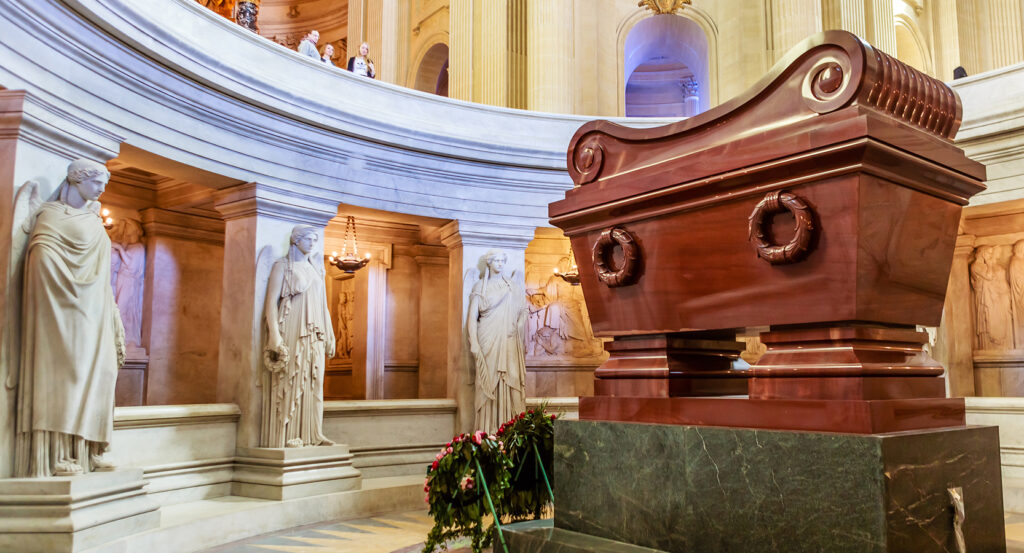
Why you should visit the Royal Chapel of Saint Louis des Invalides.
Step into the Royal Chapel of Saint Louis des Invalides, and you step into a vision of divine theater where military glory and sacred devotion share the same stage.
The moment you cross its threshold, light pours down in disciplined columns through the tall windows, illuminating gilded cornices and marble pilasters with an almost celestial precision. Built under the reign of Louis XIV, the chapel was designed to be more than a place of worship, it was a cathedral to the king’s divine right, a declaration that faith and power were inseparable. The symmetry is hypnotic, the acoustics transcendent, the air tinged with the faint scent of incense and centuries-old wood polish. When the organ begins to play, it doesn’t simply fill the space, it animates it, reverberating against the domed ceiling with an echo that lingers like an afterthought of heaven. To stand here is to understand why even Napoleon, later entombed beneath the same complex, sought to merge spiritual grandeur with imperial might.
What you didn’t know about the Royal Chapel of Saint Louis des Invalides.
Yet beneath its radiant calm lies a story of adaptation, and quiet defiance.
The Royal Chapel was conceived in two halves: one for the king and his court, and another for the soldiers of the Hôtel des Invalides, separated by an archway that allowed both to share a single altar while maintaining their hierarchy. This architectural duality embodied France’s complex social order, unity and division made visible in stone. Over centuries, the chapel became a place of national memory, hosting funeral masses for generals and leaders whose names echo through history. Its baroque dome, adorned with golden laurel and military emblems, was an act of sacred patriotism, a promise that service to France was also service to God. Even today, the flags of victorious regiments hang solemnly from its walls, their colors faded but their presence commanding. Every symbol here speaks of continuity, from monarch to republic, from battlefield to sanctuary, from ambition to remembrance.
How to fold the Royal Chapel of Saint Louis des Invalides into your trip.
To weave the Royal Chapel into your Paris itinerary, approach it not as an afterthought but as an awakening.
Enter during mid-morning, when sunlight penetrates the high arched windows and splashes gold across the choir stalls. Sit for a few minutes before walking further, let your eyes adjust to the light and your mind to the silence. If your visit coincides with an organ rehearsal or choir performance, linger longer; the acoustics render even the simplest hymn into something cosmic. Afterward, step outside and gaze upward at the gilded dome that crowns the entire complex, its brilliance is no illusion but the result of real gold leaf meticulously restored over centuries. Combine your visit with Napoleon’s tomb below or a stroll through the Musée de l’Armée to see how France’s spiritual and martial histories remain forever intertwined. The chapel is not a monument you simply view, it’s one you feel reverberate within you long after leaving.
Hear it from the Foresyte community.
You expect some dusty little grave and instead it’s this massive marble spaceship looking thing. The dude’s been gone for centuries and he’s still posted up in the middle of the room like a boss. Like ok Napoleon we get it you win.
Where meaningful travel begins.
Start your journey with Foresyte, where the planning is part of the magic.
Discover the experiences that matter most.