Why Schönbrunn Palace matters.
Schönbrunn Palace is an eighteenth-century Habsburg summer residence where Hietzing's imperial heritage meets Maria Theresa's transformation of the Austrian court, the Baroque landscape traditions of Central Europe and the political ceremonies of the Habsburg monarchy.
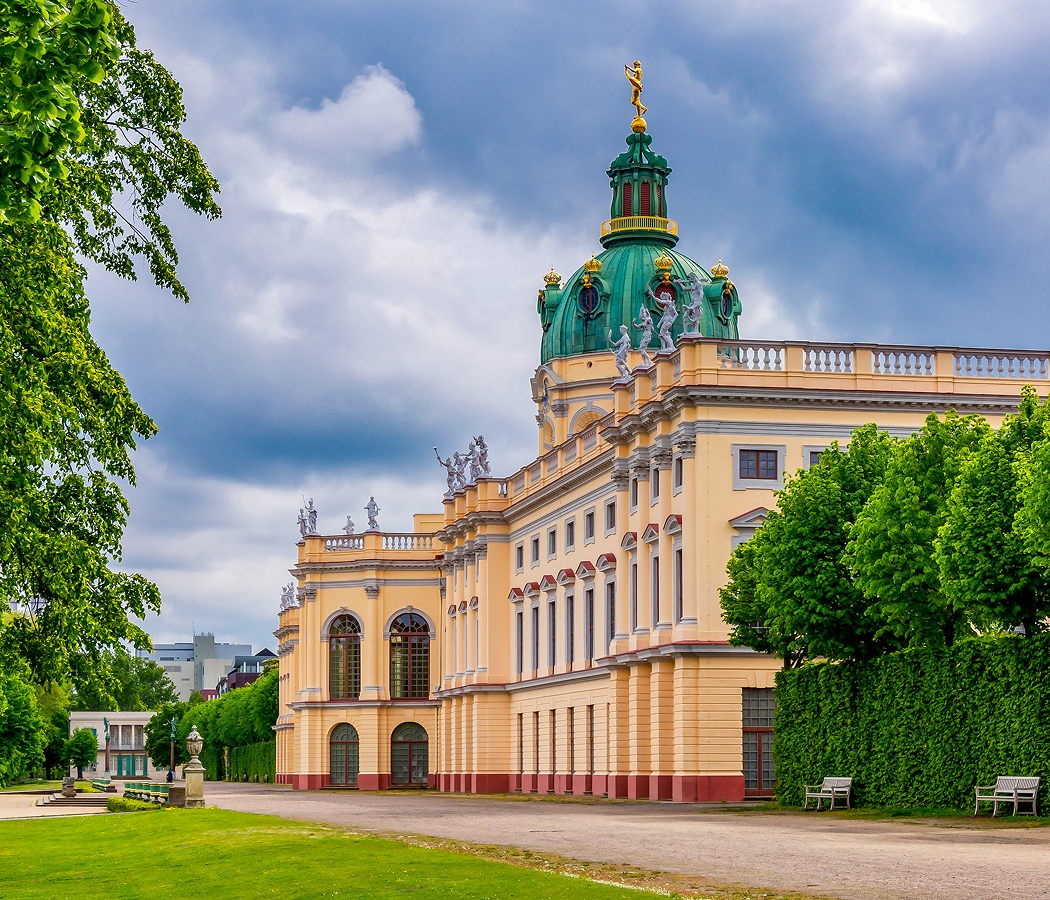
Standing southwest of Vienna's historic center at the eastern edge of Hietzing, the palace occupies a landscaped estate between Schönbrunner Schloßstraße and the rising terrain of the Schönbrunn gardens, where its elongated Baroque façade faces a ceremonial forecourt and a sequence of terraced grounds. The principal building contains symmetrical wings arranged around a central residential block. Ochre-painted façades, regularly spaced windows and restrained stucco ornament establish its eighteenth-century exterior character. Formal gardens extend southward toward wooded slopes, fountains and elevated architectural structures. The result is an imperial residence whose spatial arrangement preserves the relationship between Habsburg court ceremony, dynastic domestic life and Baroque landscape planning.
What defines Schönbrunn Palace.
Schönbrunn Palace is best known as the principal summer residence of the Habsburg rulers and the setting for major political and dynastic events during the Austrian monarchy. The estate entered Habsburg possession in 1569, when Emperor Maximilian II acquired the property for hunting and recreation. Its wooded grounds subsequently supported court activities associated with the imperial household. Emperor Leopold I commissioned Johann Bernhard Fischer von Erlach to develop a substantial palace following damage sustained during the Ottoman siege of Vienna in 1683. Fischer von Erlach prepared an ambitious architectural scheme in 1693, drawing upon the ceremonial traditions of European Baroque court architecture. Construction began during the 1690s, producing the foundations of the surviving residential complex. The palace acquired greater importance during the reign of Maria Theresa, who inherited the Habsburg territories in 1740 and established Schönbrunn as a principal setting for court life. Architect Nikolaus Pacassi directed extensive alterations, adapting the building to accommodate the imperial family, ceremonial apartments and administrative functions. The reconstruction introduced substantial Rococo interiors and expanded the residential facilities required by the growing court. Schönbrunn became associated with diplomatic receptions, dynastic celebrations and the upbringing of Maria Theresa's children, including the future French queen Marie Antoinette. In 1762, the young Wolfgang Amadeus Mozart performed before the imperial family during a visit to Vienna. Napoleon Bonaparte occupied the palace during his campaigns against Austria, using its apartments during the French military presence in 1805 and 1809. The Congress of Vienna period reinforced the importance of Habsburg ceremonial representation following the Napoleonic Wars. Emperor Franz Joseph I was born at Schönbrunn in 1830 and subsequently maintained a close association with the residence throughout his reign. The emperor died there in 1916, shortly before the dissolution of the Austro-Hungarian monarchy. Following the establishment of the Austrian Republic in 1918, the palace passed into state ownership and became a public heritage institution. UNESCO inscribed the Palace and Gardens of Schönbrunn on the World Heritage List in 1996, recognizing the architectural and landscape ensemble developed under Habsburg patronage.
Nikolaus Pacassi's eighteenth-century interior alterations organized the palace around ceremonial rooms and private apartments distinguished by Rococo decoration. The Great Gallery extends through a substantial central hall decorated with gilded stucco, mirrors and ceiling frescoes by Gregorio Guglielmi. Its proportions accommodated imperial receptions, court festivities and formal gatherings associated with the monarchy. The adjoining Small Gallery contains decorative surfaces and painted ornament developed for more intimate ceremonial occasions. The Millions Room incorporates rosewood paneling and Indo-Persian miniature paintings, preserving the Habsburg court's interest in imported luxury objects and Asian artistic traditions. The Vieux-Laque Room contains black lacquer panels and gilded decoration associated with East Asian craftsmanship. Its decorative program was developed under Maria Theresa following the death of Emperor Francis I in 1765, creating a memorial interior within the residential apartments. The Porcelain Room incorporates blue-and-white decorative surfaces and framed drawings associated with members of the imperial family. The Mirror Room preserves Rococo wall decoration and substantial reflective panels that enlarge the apparent dimensions of its interior. The Chinese Cabinets contain lacquerwork, porcelain and decorative objects assembled through the court's international collecting practices. The private apartments of Franz Joseph preserve furnishings associated with the emperor's daily administrative routine and residential arrangements. Empress Elisabeth's rooms contain decorative features connected with her position within the imperial household. The palace's gardens extend the architectural composition through symmetrical avenues, sculptural groups and carefully organized planting beds. The Neptune Fountain occupies the southern end of the principal garden axis, incorporating a sculptural composition associated with classical mythology. Above the fountain, the Gloriette stands on an elevated ridge, providing a formal architectural termination to the landscaped vista. The palace's interiors and grounds preserve the relationship between ceremonial representation, dynastic residence and the artistic patronage of the Habsburg court.
How Schönbrunn Palace fits.
Schönbrunn Palace works as the Habsburg summer residence centerpiece for a Vienna outing connecting imperial zoological collections, eighteenth-century botanical architecture and the scientific institutions developed within the former royal estate.
Begin at Tiergarten Schönbrunn, the zoological garden established in 1752 under Emperor Francis I Stephen, husband of Maria Theresa. The original menagerie was organized around a central pavilion surrounded by animal enclosures arranged in a radial plan. Its development belonged to the Enlightenment-era interest in natural history and the systematic collection of animals from different regions. The surviving Baroque pavilion preserves the original architectural organization of the imperial menagerie. Subsequent expansions introduced larger habitats and specialized conservation facilities, maintaining the site's zoological functions within the historic garden complex. Continue to the Palm House, the nineteenth-century greenhouse constructed during the reign of Franz Joseph I. Designed by architect Franz Xaver Segenschmid and completed in 1882, the structure incorporates an iron structure and extensive glazing arranged across three principal sections. Its interior environments accommodate tropical, subtropical and temperate plant collections, continuing the botanical interests associated with Habsburg scientific patronage. The building's curved roofline and substantial glass surfaces preserve the engineering principles of nineteenth-century conservatory architecture. Its position within the former imperial grounds connects botanical cultivation with the architectural development of the landscaped estate. Conclude at the Desert House, the botanical and zoological exhibition facility occupying a historic greenhouse building near the Palm House. The structure originated as the Sundial House, constructed during the early twentieth century to accommodate specialized plant collections. Its later adaptation introduced environments devoted to arid-region vegetation and animals, including cacti, succulents and species associated with desert ecosystems. The building's exhibition spaces preserve the relationship between historic greenhouse architecture and the scientific interpretation of specialized habitats. Its collections extend the former imperial estate's association with natural history and botanical cultivation. The progression moves from eighteenth-century zoological collecting through nineteenth-century greenhouse engineering and culminates at the Desert House's arid-region collections, connecting Schönbrunn Palace with the scientific and horticultural institutions of the Habsburg estate.
Where your story begins.
Foresyte Travel reveals places that feel extraordinary long before you arrive.
Enjoy editorial crafted for luxury travelers.
Foresyte may earn a commission when you book.