Fun facts about Vienna, Austria.
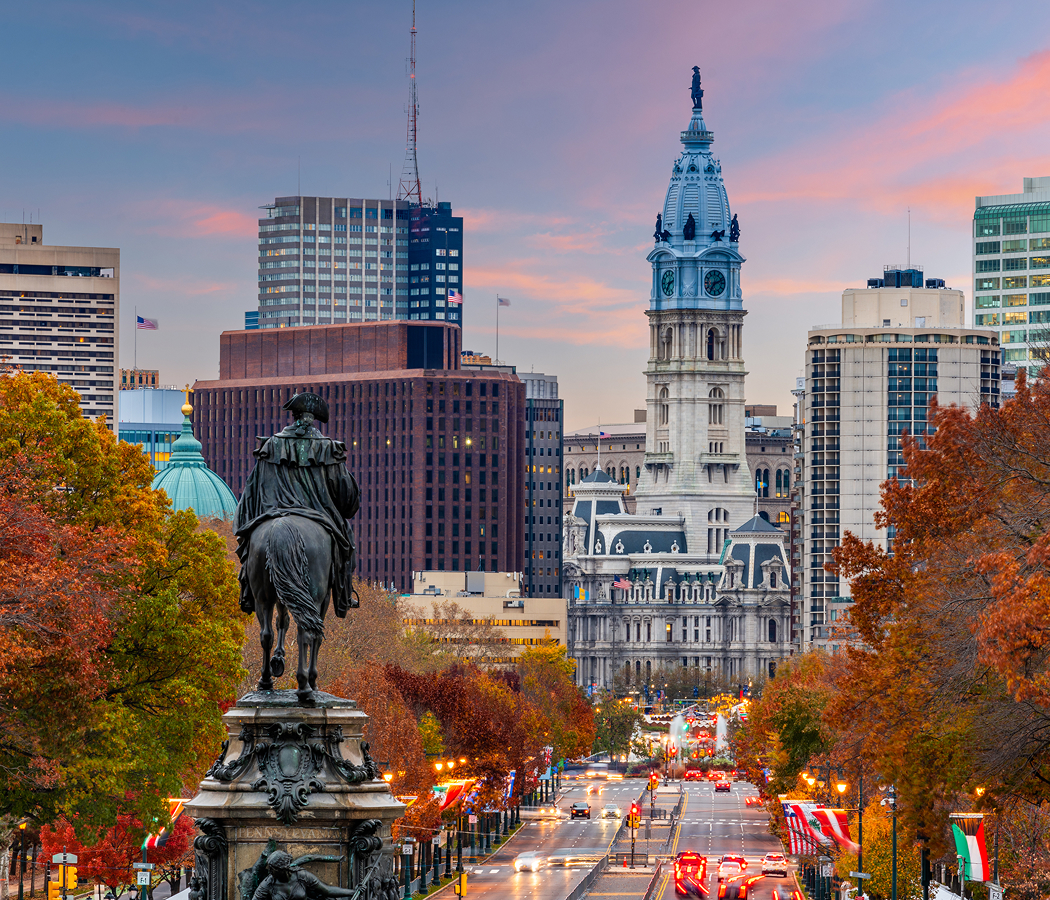
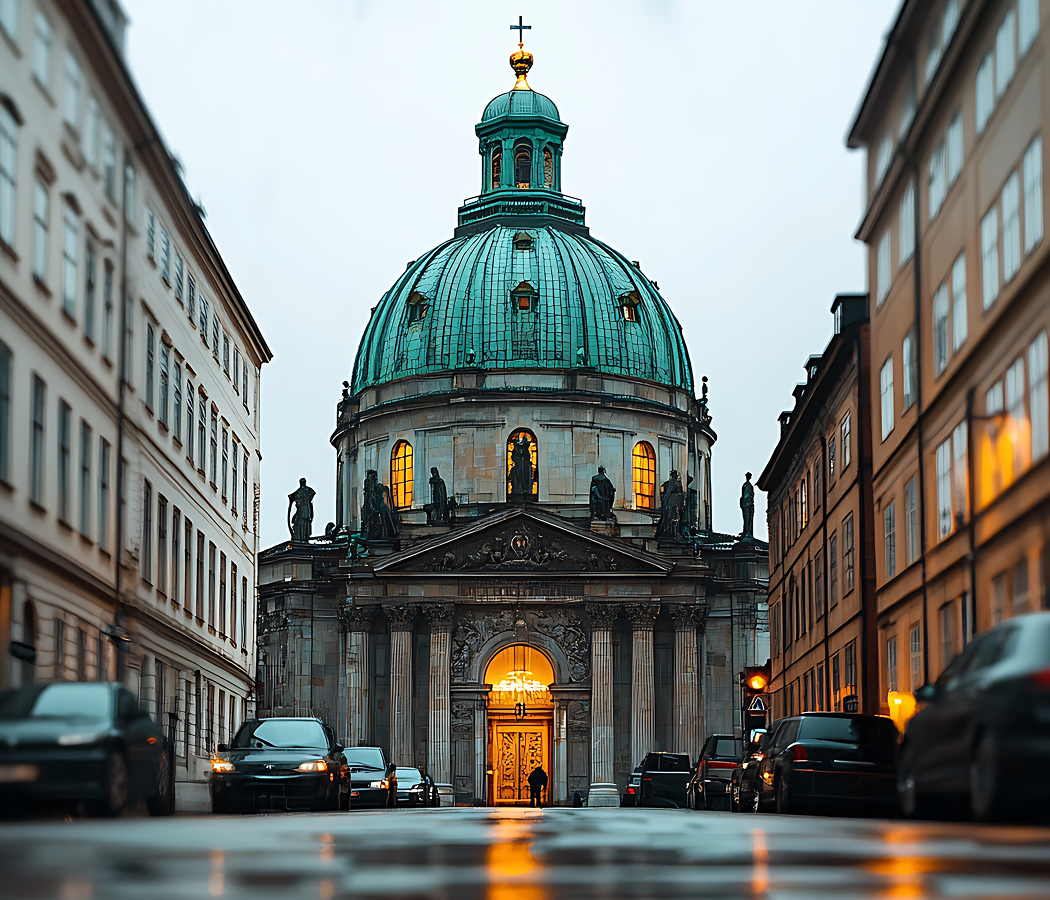
Vienna extends along the Danube at the eastern edge of the Vienna Woods, where broad ceremonial boulevards, imperial palace complexes, expansive churches, and carefully preserved residential districts reflect centuries of Habsburg patronage and metropolitan planning. The historic center developed around the Roman settlement and medieval fortified town, with its dense network of streets preserving the spatial organization of successive periods of urban expansion. Stephansdom dominates the central district through its soaring Gothic spire, elaborate stonework, and steeply pitched roof decorated with colorful glazed tiles. The cathedral's architectural development extended across several centuries, establishing it as the principal religious landmark of the Austrian capital. Nearby, the Hofburg Palace encompasses an immense collection of courtyards, ceremonial halls, museums, and residential wings developed through successive Habsburg building campaigns. Its architectural layers range from medieval foundations to Renaissance, Baroque, and nineteenth-century additions, expressing the accumulated ambitions of imperial government. The Spanish Riding School occupies part of the Hofburg complex, preserving an important ceremonial environment associated with classical horsemanship and the training of Lipizzaner horses. The adjacent Heldenplatz introduces an expansive public square framed by imperial buildings and connected to the extensive landscape of the Burggarten and Volksgarten. Vienna's most consequential urban transformation occurred during the nineteenth century, when Emperor Franz Joseph ordered the demolition of the medieval fortifications and their replacement with the Ringstrasse. Developed from the 1860s onward, this grand boulevard encircles the historic center through an exceptional sequence of civic and cultural monuments. The Vienna State Opera, completed in 1869, established a major architectural landmark through its Renaissance Revival design and elaborate ceremonial interiors. The Austrian Parliament Building, designed by Theophil Hansen, presents an expansive Greek Revival composition reflecting the political aspirations of constitutional government. The Vienna City Hall, designed by Friedrich von Schmidt, introduces an imposing Neo-Gothic structure distinguished by its central tower and elaborate stone façades. Across the Ringstrasse, the Kunsthistorisches Museum and Naturhistorisches Museum occupy symmetrical expansive buildings facing Maria-Theresien-Platz, establishing one of Europe's most distinguished museum ensembles. The nearby MuseumsQuartier combines historic imperial structures with contemporary cultural institutions, including the Leopold Museum and mumok. South of the center, the Belvedere Palace complex presents an exceptional Baroque landscape developed for Prince Eugene of Savoy, with the Upper and Lower Belvedere connected by formal gardens, sculptural terraces, and ornamental fountains. Farther west, Schönbrunn Palace extends across an immense landscaped estate through its expansive Baroque and Rococo architecture, formal gardens, and elevated Gloriette. The palace served as a principal summer residence of the Habsburg court, preserving ceremonial interiors associated with Maria Theresa and Franz Joseph. Vienna's residential districts introduce additional architectural traditions, particularly through the elegant apartment buildings of the late nineteenth century and the municipal housing complexes developed during the interwar period. Karl-Marx-Hof, completed in 1930, became an influential example of socially oriented urban housing through its expansive courtyards, communal facilities, and extensive residential organization. The Secession Building, designed by Joseph Maria Olbrich and completed in 1898, introduces a contrasting architectural language through its restrained geometric forms and celebrated gilded laurel-leaf dome. Along the Danube Canal, contemporary waterfront development connects historic neighborhoods with modern commercial and recreational spaces. Vienna's architectural distinction arises from the disciplined relationship between medieval urban fabric, imperial expansive planning, Baroque landscape design, and the innovative architectural movements that transformed European cities during the nineteenth and twentieth centuries.
Austrian cultural history reached an exceptional concentration in Vienna, where classical composition, modernist painting, psychological inquiry, literature, and the traditions of the coffeehouse developed into internationally influential expressions of European intellectual life. During the eighteenth century, Vienna became a principal center of Western classical music through the patronage of the imperial court and aristocratic families. Joseph Haydn helped establish foundational forms of the symphony and string quartet, developing compositional techniques that profoundly influenced subsequent generations. Wolfgang Amadeus Mozart settled in Vienna in 1781, composing major operas, concertos, and chamber works that transformed the expressive possibilities of classical music. Ludwig van Beethoven subsequently made the city his principal home, producing symphonies, piano sonatas, and string quartets that expanded the resonant and structural ambitions of European composition. Franz Schubert developed another distinctive musical language through his songs, chamber works, and symphonies, contributing substantially to the emergence of Romantic musical expression. During the nineteenth century, the Strauss family established Vienna's international association with the waltz, particularly through Johann Strauss II, whose compositions became enduring symbols of the city's ballroom culture. Johannes Brahms and Anton Bruckner further strengthened Vienna's position within European musical life, followed by Gustav Mahler, whose symphonies and leadership of the Vienna Court Opera helped redefine the ambitions of late Romantic composition. Arnold Schoenberg introduced revolutionary approaches to musical structure during the early twentieth century, developing atonality and the twelve-tone method through the intellectual environment associated with the Second Viennese School. Vienna's visual arts underwent comparable transformation through the Vienna Secession, founded in 1897 by artists seeking greater independence from established academic institutions. Gustav Klimt became its most celebrated figure through paintings combining symbolic imagery, ornamental pattern, and sophisticated explorations of human intimacy. His The Kiss, preserved at the Belvedere, became one of the defining images of European modernism. Egon Schiele subsequently developed an intensely expressive approach to portraiture and the human figure, challenging conventional representations of sexuality and psychological experience. Architect Otto Wagner and designer Josef Hoffmann contributed to the development of modern architecture and decorative arts, emphasizing geometric clarity, functional organization, and integrated design. Vienna's intellectual environment also transformed modern understandings of human consciousness through Sigmund Freud, whose development of psychoanalysis introduced influential theories concerning dreams, memory, repression, and the unconscious. The city's philosophical traditions included the Vienna Circle, whose members advanced logical empiricism and influential approaches to scientific reasoning during the interwar period. Writers including Arthur Schnitzler, Stefan Zweig, and Robert Musil explored the psychological and political tensions of a society confronting the collapse of imperial certainty. Vienna's coffeehouses became essential institutions of literary and intellectual exchange, providing settings where writers, journalists, artists, and political thinkers gathered for conversation, reading, and debate. Establishments including Café Central became closely associated with the city's early twentieth-century intellectual culture. Viennese culinary traditions developed through the influences of the former Habsburg territories, incorporating elements of Austrian, Hungarian, Bohemian, and Balkan cooking. Wiener schnitzel, tafelspitz, goulash, and elaborate pastries reflect the city's historical position within a multinational empire. The Sachertorte, created in 1832, became an internationally recognized symbol of Viennese confectionery, and the city's cafés preserve a longstanding tradition of carefully prepared coffee accompanied by cakes and pastries. Vienna's cultural importance lies in the sustained blend between musical invention, artistic modernism, philosophical experimentation, and the social institutions that made the Austrian capital a defining center of European intellectual history.
Five fascinations.
5. Vienna's Ringstrasse replaced the defensive walls that once enclosed the old city.
For centuries, massive fortifications separated Vienna's historic core from its expanding suburbs. Emperor Franz Joseph I ordered the walls demolished in 1857, opening an enormous band of land for one of Europe's most ambitious nineteenth-century urban projects. The resulting Ringstrasse became an expansive boulevard lined with institutions including the Vienna State Opera, Parliament, City Hall, the University of Vienna, and major museums. Architects employed Gothic, Renaissance, Classical, and other historicizing styles to express each building's function. Vienna transformed obsolete military infrastructure into the ceremonial architectural structure of a modern imperial capital.
4. Vienna created one of the world's most influential experiments in public housing.
After World War I, severe housing shortages confronted a rapidly changing Vienna. The municipal government responded during the period known as Red Vienna by constructing tens of thousands of affordable apartments during the 1920s and early 1930s. These Gemeindebauten incorporated courtyards and communal facilities into large residential complexes intended to improve everyday urban life. Karl-Marx-Hof became the most famous example, extending for more than a kilometer through the city's nineteenth district. Vienna turned housing policy into architecture at expansive scale, creating a municipal building tradition that remains fundamental to the city's international reputation for social housing.
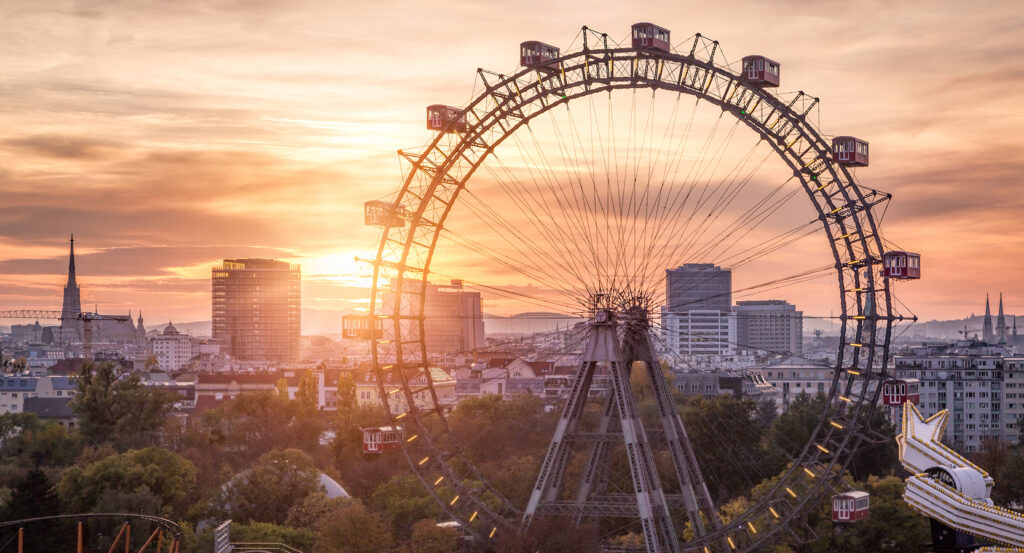
3. Vienna's giant Ferris wheel is a survivor from the nineteenth century.
The Wiener Riesenrad opened in the Prater in 1897 as part of celebrations marking Emperor Franz Joseph I's Golden Jubilee. British engineers Walter Bassett Basset and Harry Hitchins designed the immense wheel during the international enthusiasm for giant observation wheels that followed George Washington Gale Ferris Jr.'s celebrated structure at the 1893 Chicago exposition. Vienna's wheel survived into the twentieth century, suffered severe damage during World War II, and returned to operation after reconstruction. Most early giant wheels disappeared long ago, leaving the Riesenrad as an extraordinary working artifact from the first generation of expansive amusement engineering.
2. Vienna transformed a branch of the Danube into an enormous flood-control system.
The Danube repeatedly threatened Vienna with destructive flooding as the city expanded along its banks. During the twentieth century, engineers developed an extraordinary solution alongside the regulated river: the Neue Donau, or New Danube, a parallel flood-relief channel separated from the main river by the long artificial Donauinsel. Construction during the 1970s and 1980s created both major hydraulic infrastructure and an expansive recreational landscape through the city. Beaches, cycling routes, green space, and gathering areas now occupy land integral to Vienna's flood defenses, making one of its largest leisure environments simultaneously part of a vast civil-engineering system.
1. Vienna's central cathedral contains a roof covered with 230,000 glazed tiles.
St. Stephen's Cathedral dominates Vienna's historic center with a steep roof whose geometric patterns are formed from 230,000 glazed tiles. The medieval cathedral evolved across centuries, combining Romanesque elements with the immense Gothic structure that came to define the city skyline. Fire severely damaged the building during the final weeks of World War II in 1945, causing the roof to collapse and destroying major portions of the interior. Reconstruction restored the cathedral and recreated its brilliantly patterned roof. Vienna's most recognizable medieval landmark also captures the city's postwar reconstruction, with its vivid surface rising above the rebuilt historic center.
Where your story begins.
Foresyte Travel reveals places that feel extraordinary long before you arrive.
Enjoy editorial crafted for luxury travelers.
Foresyte may earn a commission when you book.