Fun facts about Florence, Italy.
Florence unfolds along the Arno beneath the surrounding Tuscan hills, its historic center preserving an exceptional concentration of medieval streets, Renaissance palaces, grand churches, and public spaces shaped by the wealth of merchants and ruling dynasties. The Cathedral of Santa Maria del Fiore dominates the skyline through its immense masonry dome, engineered by Filippo Brunelleschi during the fifteenth century. Construction of the cathedral began in 1296 under Arnolfo di Cambio, with its Gothic structure subsequently crowned by Brunelleschi's revolutionary double-shell dome, completed in 1436. The adjoining Giotto's Campanile rises through a richly ornamented composition of colored marble, sculptural panels, and pointed Gothic openings. Across the cathedral square, the Baptistery of San Giovanni preserves one of Florence's most important religious monuments, distinguished by its octagonal form and celebrated bronze doors. Lorenzo Ghiberti's eastern doors, later known as the Gates of Paradise, introduced sophisticated experiments in perspective and narrative relief sculpture. Southward, Piazza della Signoria developed as the ceremonial heart of Florentine republican government, dominated by the fortress-like Palazzo Vecchio and its prominent Arnolfo Tower. The Loggia dei Lanzi contributes an open-air collection of Renaissance and Mannerist sculpture, establishing a direct relationship between civic space and artistic patronage. The adjoining Uffizi complex, commissioned by Cosimo I and designed by Giorgio Vasari, originally accommodated the administrative offices of the Tuscan state before becoming one of the world's most celebrated art museums. A short distance away, the Ponte Vecchio crosses the Arno through a distinctive arrangement of shops constructed along the bridge, preserving a commercial tradition associated with goldsmiths and jewelers. Above the storefronts, the Vasari Corridor historically connected the Palazzo Vecchio with the Pitti Palace, allowing the ruling family to move between governmental and residential quarters. On the southern bank, the Oltrarno district retains an intimate network of artisan workshops, neighborhood squares, and historic residences extending toward the slopes of San Miniato al Monte. The Pitti Palace developed into a grand ducal residence, with the adjoining Boboli Gardens introducing terraces, fountains, sculpture, and carefully organized landscapes that influenced European garden design. The Basilica of Santa Croce preserves a grand Gothic interior associated with the tombs of Michelangelo, Galileo, and Machiavelli, connecting the city's religious architecture with the commemoration of intellectual achievement. Across the historic center, the Basilica of Santa Maria Novella presents a celebrated Renaissance façade designed by Leon Battista Alberti, whose proportional relationships express the influence of classical architectural theory. The Palazzo Medici Riccardi, designed by Michelozzo, established an influential model for Renaissance urban residences through its rusticated masonry, restrained classical detailing, and central courtyard. Florence's streets and public monuments form a remarkably coherent expression of the relationship between medieval civic government, Renaissance architectural experimentation, and the ceremonial ambitions of Tuscan dynastic power.
Tuscan intellectual and artistic innovation reached a defining moment in Florence, where the recovery of classical learning encouraged dramatic new approaches to representation, individual achievement, scientific observation, and the relationship between humanity and the natural world. The city's early literary inheritance developed through Dante Alighieri, whose use of the Tuscan style helped establish the foundations of modern literary Italian. Francesco Petrarch and Giovanni Boccaccio subsequently contributed to the emergence of Renaissance humanism, with Boccaccio's Decameron offering an influential exploration of social behavior, storytelling, and life during the plague. The fifteenth century brought an exceptional concentration of painters, sculptors, and architects whose investigations into perspective, anatomy, and classical proportion transformed European visual culture. Masaccio introduced a new sense of spatial realism through his frescoes in the Brancacci Chapel, employing linear perspective and naturalistic figures to create an unprecedented impression of physical depth. Donatello developed influential approaches to freestanding sculpture, including his bronze David, whose classical inspiration challenged established medieval conventions. Sandro Botticelli's Birth of Venus and Primavera reflected the intellectual environment of the Medici court, connecting mythological subjects with the philosophical interests of Florentine humanism. Leonardo da Vinci received his early artistic training in Florence under Andrea del Verrocchio, developing interests in painting, engineering, anatomy, and natural observation that would define his subsequent career. Michelangelo Buonarroti produced his grand marble David between 1501 and 1504, creating one of the most celebrated sculptures of the High Renaissance and an enduring symbol of Florentine civic identity. The city's artistic influence continued through the work of Giorgio Vasari, whose Lives of the Most Excellent Painters, Sculptors, and Architects helped establish the foundations of modern art history. Florence also contributed to the development of political philosophy through Niccolò Machiavelli, whose The Prince examined the acquisition and exercise of power with a realism that transformed European political thought. The Accademia delle Arti del Disegno, founded in 1563, strengthened the institutional status of painting, sculpture, and architecture as intellectual disciplines. The emergence of early opera in late sixteenth-century Florence reflected experiments by musicians and humanists seeking to recreate the dramatic possibilities of ancient Greek performance. Florentine craftsmanship developed equally influential traditions in leatherworking, goldsmithing, textiles, and decorative arts, preserving the relationship between artistic invention and specialized manual skill. The city's culinary inheritance draws upon the agricultural traditions of Tuscany through bistecca alla fiorentina, ribollita, pappa al pomodoro, and the region's celebrated olive oils and wines. Historic markets, neighborhood trattorias, and artisan workshops continue to connect these traditions with everyday Florentine life. Florence stands at the center of the Renaissance's enduring legacy because its writers, thinkers, patrons, and makers fundamentally altered how Europeans understood artistic excellence, political authority, classical knowledge, and the creative possibilities of human intelligence.
Five fascinations.
5. Florence's cathedral dome was built.
Filippo Brunelleschi transformed architecture when he devised a way to construct the enormous dome of Florence Cathedral without the full wooden centering traditionally used to support masonry arches during construction. Work began in 1420 on a double-shell structure strengthened by stone and timber chains, with bricks arranged in patterns that helped stabilize the rising masonry. Brunelleschi also developed specialized hoisting machinery for the project. Completed in 1436, the dome became an engineering breakthrough of the Renaissance and still dominates Florence nearly six centuries later.
4. Michelangelo's David originally stood outside Florence's city hall.
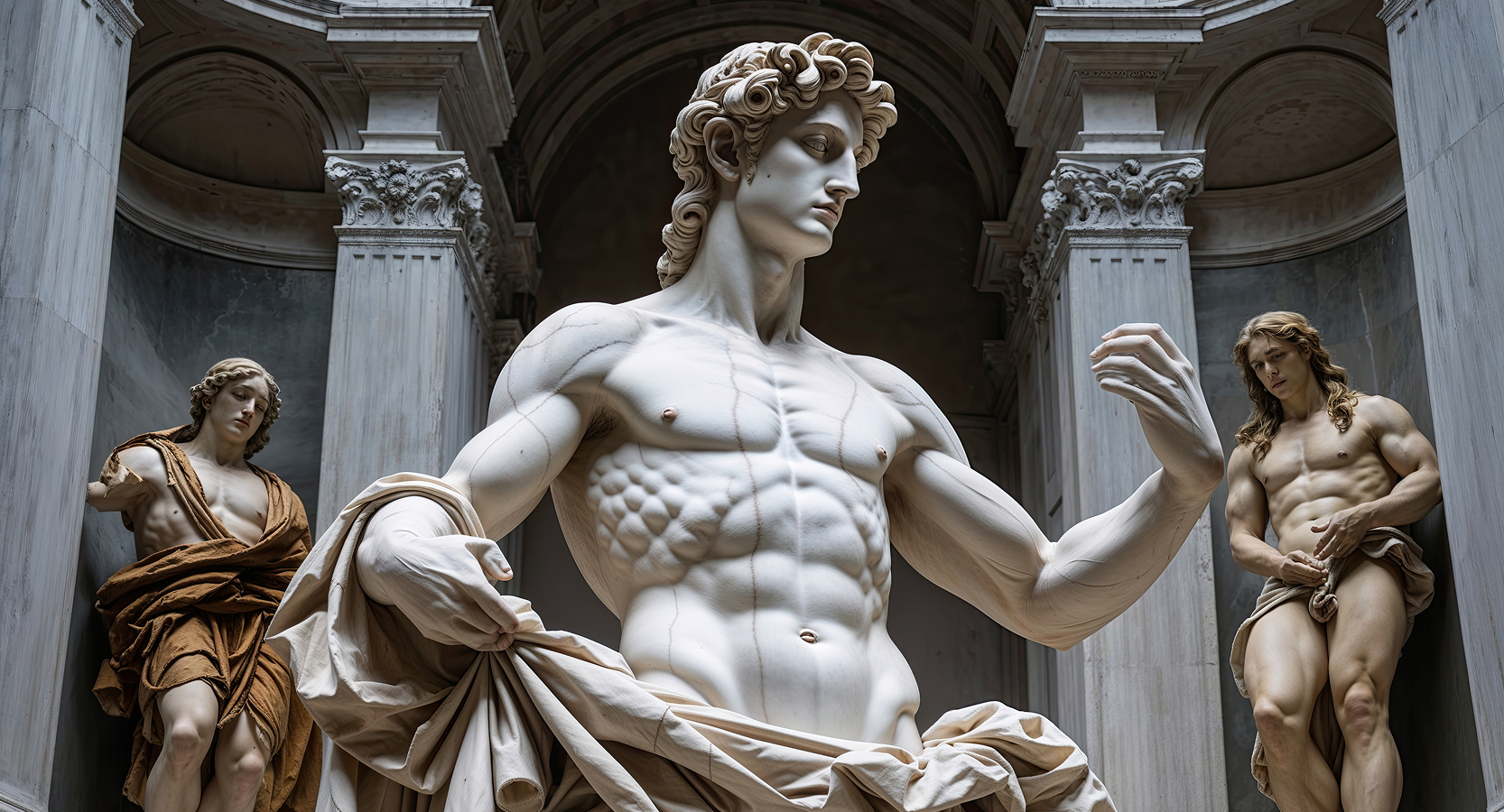
Michelangelo carved David from a massive block of marble that earlier sculptors had abandoned after unsuccessful attempts to work it. Completed in 1504, the statue was originally intended for Florence Cathedral but acquired powerful civic meaning as the Florentine Republic associated the biblical hero with its own political independence. Officials instead placed David beside the entrance to Palazzo Vecchio in Piazza della Signoria, where it stood for centuries. The original moved to the Galleria dell'Accademia in the nineteenth century, and a replica now occupies its former position in Florence's political heart.
3. The Ponte Vecchio survived World War II when Florence's other bridges were destroyed.
As German forces withdrew from Florence in August 1944, bridges across the Arno were demolished to impede the Allied advance. The medieval Ponte Vecchio escaped destruction, although buildings and streets at both ends were devastated to block access to the crossing. Its survival preserved one of Florence's most distinctive structures: a fourteenth-century bridge lined with shops and later connected to the elevated Vasari Corridor. The episode left the Ponte Vecchio standing as an extraordinary architectural survivor amid the wartime destruction inflicted on the city's river crossings.
2. The Medici built a private elevated passage almost a kilometer long through Florence.
Giorgio Vasari designed the Vasari Corridor for Cosimo I de' Medici in 1565, creating an elevated route between Palazzo Vecchio and the family's residence at Palazzo Pitti. The passage crosses the Arno above the shops of the Ponte Vecchio and continues through or alongside existing buildings on its journey across the historic center. It allowed the ruling family to travel between political and residential spaces with exceptional privacy and security. What appears from street level as a series of architectural connections is actually one continuous expression of Medici power threaded directly through Florence.
1. Florence helped rescue masterpieces from a catastrophic flood with an international army of volunteers.
On November 4, 1966, the Arno burst through Florence, inundating streets, churches, libraries, museums, and archives with water, mud, and fuel oil. Countless paintings, sculptures, manuscripts, and books were damaged as the flood swept through the historic center. Volunteers arrived from Italy and around the world to recover cultural treasures from the wreckage, earning the name “Mud Angels.” The disaster accelerated advances in art conservation and created restoration campaigns that continued for decades, turning Florence's darkest modern natural catastrophe into an extraordinary international effort to preserve the material inheritance of the Renaissance.
Where your story begins.
Foresyte Travel reveals places that feel extraordinary long before you arrive.
Enjoy editorial crafted for luxury travelers.
Foresyte may earn a commission when you book.