Fun facts about Sedona, Arizona.
Sedona occupies a remarkable transition zone between the high forests of the Colorado Plateau and the lower desert environments of Central Arizona, where immense sandstone formations rise above the winding course of Oak Creek in a landscape shaped by hundreds of millions of years of geological change. The region's celebrated red rocks developed through the accumulation of ancient sedimentary deposits, with iron-rich minerals contributing the vivid coloration that distinguishes the cliffs, buttes, and mesas surrounding the city. The Schnebly Hill Formation, named for the area's early settler family, preserves extensive layers of reddish sandstone and siltstone deposited during the Permian Period, forming an important component of the region's exposed geological sequence. Subsequent uplift of the Colorado Plateau and prolonged erosion by streams, wind, and seasonal weathering carved these deposits into dramatic towers, steep escarpments, and deeply incised canyons. Cathedral Rock rises southwest of the central city through a grand arrangement of sandstone spires and buttresses, creating one of Arizona's most recognizable natural landmarks. Nearby, Bell Rock presents a contrasting geological profile through its broad, rounded mass and terraced slopes, dominating the landscape south of the principal urban districts. Courthouse Butte introduces another imposing formation, its steep walls and extensive summit plateau reflecting the differential erosion of layered sedimentary rock. The landscape surrounding Airport Mesa provides elevated views across the city's principal formations, revealing the close relationship between developed neighborhoods and the surrounding geological amphitheater. Northward, Oak Creek Canyon extends through a dramatic corridor of towering cliffs, wooded slopes, and riparian vegetation, connecting Sedona with the higher elevations near Flagstaff. The canyon's ecological diversity reflects substantial changes in elevation, temperature, and moisture, supporting communities of ponderosa pine, oak, juniper, and deciduous trees along the creek. Slide Rock State Park preserves a celebrated section of this environment, where naturally smoothed sandstone channels and flowing water create distinctive swimming areas within a former apple orchard. The park's historic agricultural buildings and cultivated grounds reflect the region's early orchard economy, adding another layer of human history to the natural setting. West of the city, Boynton Canyon penetrates deeply into the surrounding sandstone formations, with its sheltered interior supporting a mixture of desert vegetation, wooded slopes, and towering rock walls. The nearby Enchantment Resort occupies a secluded setting beneath the canyon's cliffs, illustrating the architectural emphasis on landscape integration that has influenced Sedona's hospitality development. Within the city, the Chapel of the Holy Cross rises from a rocky hillside through a striking modernist composition designed by architects Richard Hein and August K. Strotz. Its grand cross, angular concrete forms, and extensive glazing establish a dramatic relationship between religious architecture and the surrounding sandstone landscape. Sedona's commercial districts developed along State Route 89A and State Route 179, with Uptown Sedona forming a principal concentration of galleries, restaurants, and visitor-oriented businesses. Tlaquepaque Arts & Shopping Village introduces another distinctive architectural environment through its courtyards, arcades, fountains, and buildings inspired by traditional Mexican village design. The surrounding Coconino National Forest protects extensive areas of the region's red-rock terrain, sustaining a network of trails, scenic corridors, and natural habitats that define the broader landscape. Sedona's physical character arises from the striking interaction between ancient sedimentary geology, canyon ecology, carefully situated architecture, and the limited corridors of development within an immense natural amphitheater.
Southwestern cultural traditions acquired a distinctive contemporary expression in Sedona, where Indigenous heritage, landscape painting, independent craftsmanship, alternative spirituality, and a longstanding relationship with the American film industry developed into an unusually concentrated creative environment. The region's Indigenous cultural inheritance remains essential to understanding its historical and spiritual significance, particularly through the ancestral traditions of the Yavapai and Apache peoples and the archaeological legacy of earlier communities associated with the Verde Valley. Ancient rock art at sites including Palatki and Honanki preserves visual expressions of human presence across the surrounding sandstone country, with pictographs and petroglyphs reflecting complex relationships between settlement, ceremonial practice, and the natural environment. These archaeological landscapes contribute to a broader cultural history extending far beyond Sedona's modern development as an artistic and recreational destination. During the twentieth century, the city's dramatic scenery attracted painters, sculptors, photographers, and craftspeople whose work explored the colors, textures, and grand forms of the American Southwest. The establishment of the Sedona Arts Center in 1958 strengthened the development of a permanent artistic community through exhibitions, workshops, educational programs, and support for regional artists. The center became an important institution for painters and sculptors working within traditions of Western landscape art, contemporary abstraction, and Indigenous-inspired visual expression. Sedona's gallery environment subsequently expanded through commercial districts and artist communities, with works encompassing painting, ceramics, jewelry, sculpture, and photography. The influence of Native American artistic traditions is particularly visible in regional jewelry and decorative arts, although the cultural significance of these forms depends upon the distinct histories and practices of the Indigenous communities from which they originate. The city's association with Western filmmaking contributed another powerful element to its cultural identity, with the surrounding red-rock formations providing a dramatic visual language for stories of frontier conflict, migration, and the American West. Sedona's film history includes productions featuring major Hollywood performers and directors, establishing the region as an influential outdoor setting during the classical Western era. The Sedona International Film Festival, established in 1994, extended this cinematic inheritance through independent film screenings, filmmaker discussions, and programs celebrating contemporary storytelling. Sedona also became internationally associated with the modern vortex movement, which interprets particular landscape formations as locations of concentrated spiritual energy. Sites including Cathedral Rock, Bell Rock, Boynton Canyon, and Airport Mesa acquired particular significance within this belief system, encouraging the development of meditation practices, spiritual retreats, and alternative wellness services. These traditions reflect a contemporary spiritual interpretation of the landscape, distinct from the ancestral religious practices of the region's Indigenous peoples. The city's wellness culture subsequently expanded through yoga, therapeutic bodywork, contemplative retreats, and hospitality experiences emphasizing the relationship between personal well-being and natural surroundings. Sedona's culinary environment reflects the agricultural traditions of northern Arizona and the broader influences of Southwestern cooking, with regional ingredients including chiles, corn, beans, and locally cultivated produce contributing to contemporary restaurant menus. The nearby Verde Valley developed an emerging wine industry through vineyards and tasting rooms associated with the region's varied elevations and growing conditions, adding another dimension to the area's agricultural identity. Sedona's public cultural life extends through seasonal art festivals, gallery exhibitions, outdoor performances, and community celebrations that connect local creative traditions with the surrounding landscape. The Sedona Heritage Museum preserves aspects of the community's ranching, orchard, and filmmaking history, contributing to the interpretation of the city's transformation during the twentieth century. Sedona's cultural significance rests upon the remarkable convergence of Indigenous historical depth, artistic experimentation, cinematic heritage, and contemporary spiritual exploration within a landscape whose geological forms have inspired generations of creative interpretation.
Five fascinations.
5. Sedona's red rocks owe their color to iron minerals deposited hundreds of millions of years ago.
Sedona's striking cliffs, buttes, and mesas expose layers of sedimentary rock formed when ancient seas, rivers, dunes, and floodplains repeatedly transformed northern Arizona. Iron-bearing minerals within several formations oxidized over immense spans of geological time, producing the reds and oranges that define the landscape today. Subsequent uplift of the Colorado Plateau and prolonged erosion carved those layers into formations including Cathedral Rock, Bell Rock, and Courthouse Butte. Sedona's signature color is the visible result of chemistry operating across deep time, preserved within a landscape shaped by hundreds of millions of years of environmental change.
4. Sedona was named after a woman whose mother invented her name.
When Theodore Carlton Schnebly sought a name for the community's new post office in the early twentieth century, several proposed names proved too long for postal authorities. He ultimately submitted the first name of his wife, Sedona Arabella Miller Schnebly, and the settlement became Sedona in 1902. Her unusual name had been created by her mother, Amanda Miller, rather than inherited from an established place or traditional naming convention. One of Arizona's most recognizable geographic names originated with a single resident whose distinctive given name became permanently attached to an internationally famous landscape.
3. Sedona became a Hollywood stand-in for the American West.
Beginning in the silent-film era and accelerating through Hollywood's mid-century Western boom, filmmakers repeatedly used Sedona's red-rock landscape as a dramatic natural set. Productions brought stars including John Wayne, James Stewart, Elvis Presley, and Joan Crawford into the region, with the surrounding formations appearing as cinematic versions of frontier America. More than sixty feature films were ultimately associated with the Sedona area across decades of production. Before tourism and wellness culture became dominant parts of its identity, Sedona had already entered popular imagination through movies that broadcast its extraordinary geology to audiences far beyond Arizona.
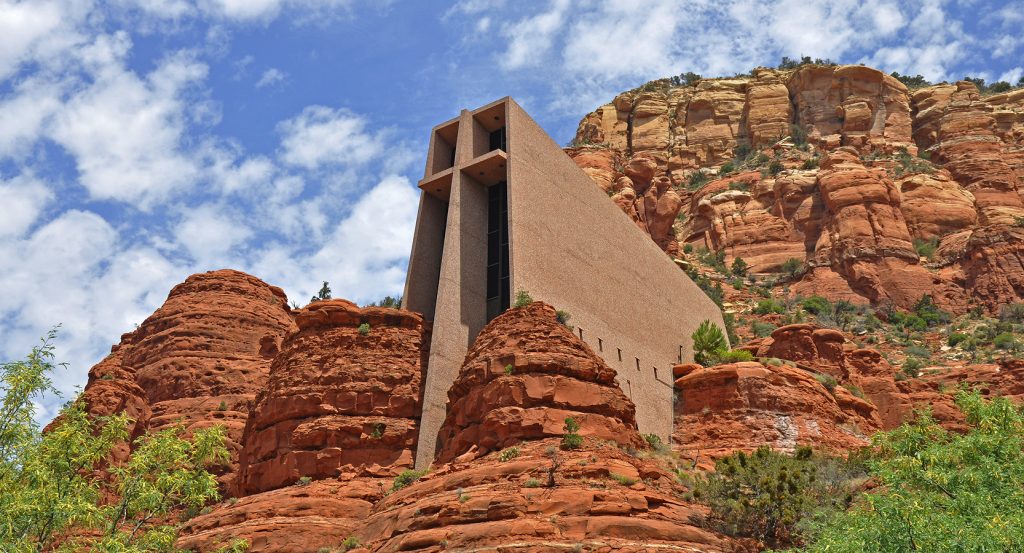
2. The Chapel of the Holy Cross rises directly from Sedona's red rock.
Sculptor Marguerite Brunswig Staude conceived the idea for a grand modern chapel after being inspired by the form of a cross within architecture. Completed in 1956, the Chapel of the Holy Cross was designed to emerge from the surrounding red-rock terrain, with an immense cross dominating its glass façade. Its elevated position between dramatic formations turned a relatively compact religious building into one of Sedona's defining architectural landmarks. The chapel demonstrates how twentieth-century design responded directly to the landscape, using the surrounding geology as an essential part of the building's visual and spiritual composition.
1. Sedona's famous “vortexes” helped transform a small Arizona community into a global spiritual destination.
Sedona became internationally associated with vortex sites during the late twentieth century as New Age practitioners identified locations around formations including Bell Rock, Cathedral Rock, Boynton Canyon, and Airport Mesa with concentrated spiritual energy. The idea attracted healers, meditation practitioners, metaphysical businesses, and travelers seeking transformative experiences, creating a cultural character distinct from Sedona's earlier ranching, agricultural, and filmmaking eras. The vortex phenomenon ultimately became inseparable from the city's international reputation, demonstrating how an interpretation of landscape developed into an entire tourism culture layered onto the region's extraordinary physical geology.
Where your story begins.
Foresyte Travel reveals places that feel extraordinary long before you arrive.
Enjoy editorial crafted for luxury travelers.
Foresyte may earn a commission when you book.