Fun facts about Helsinki, Finland.
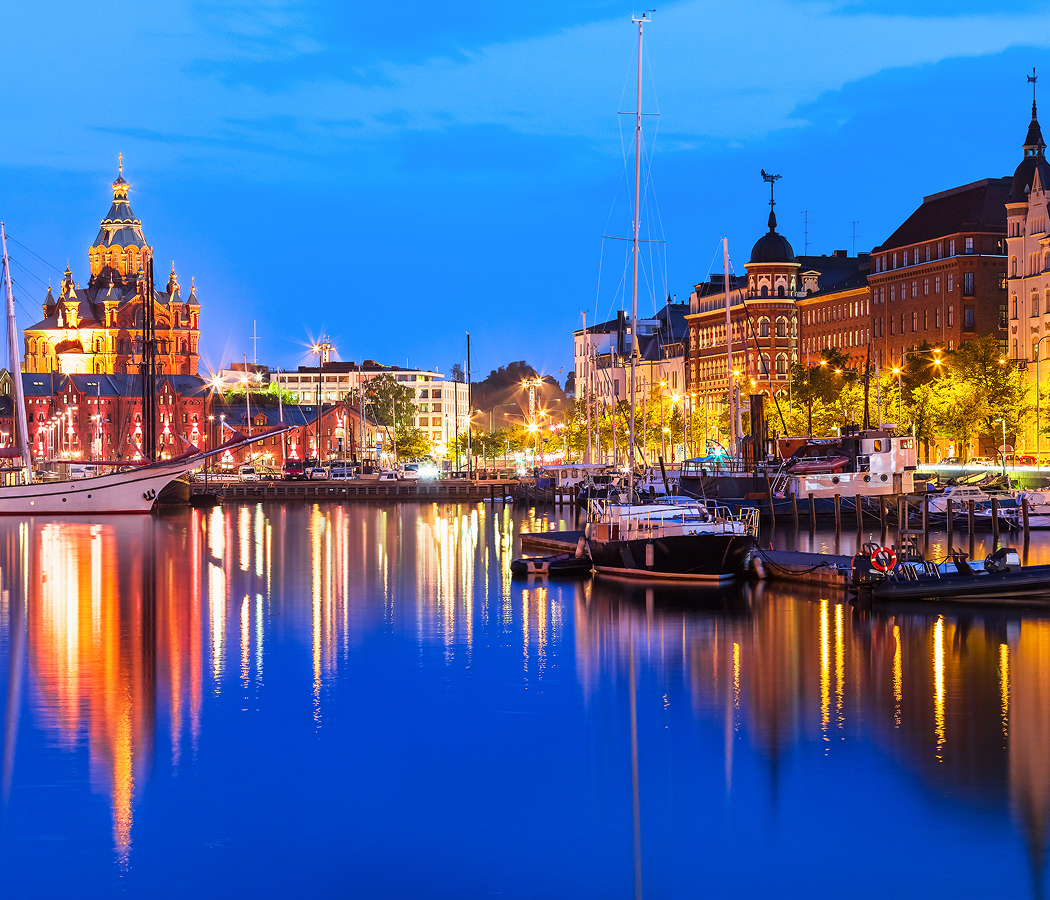
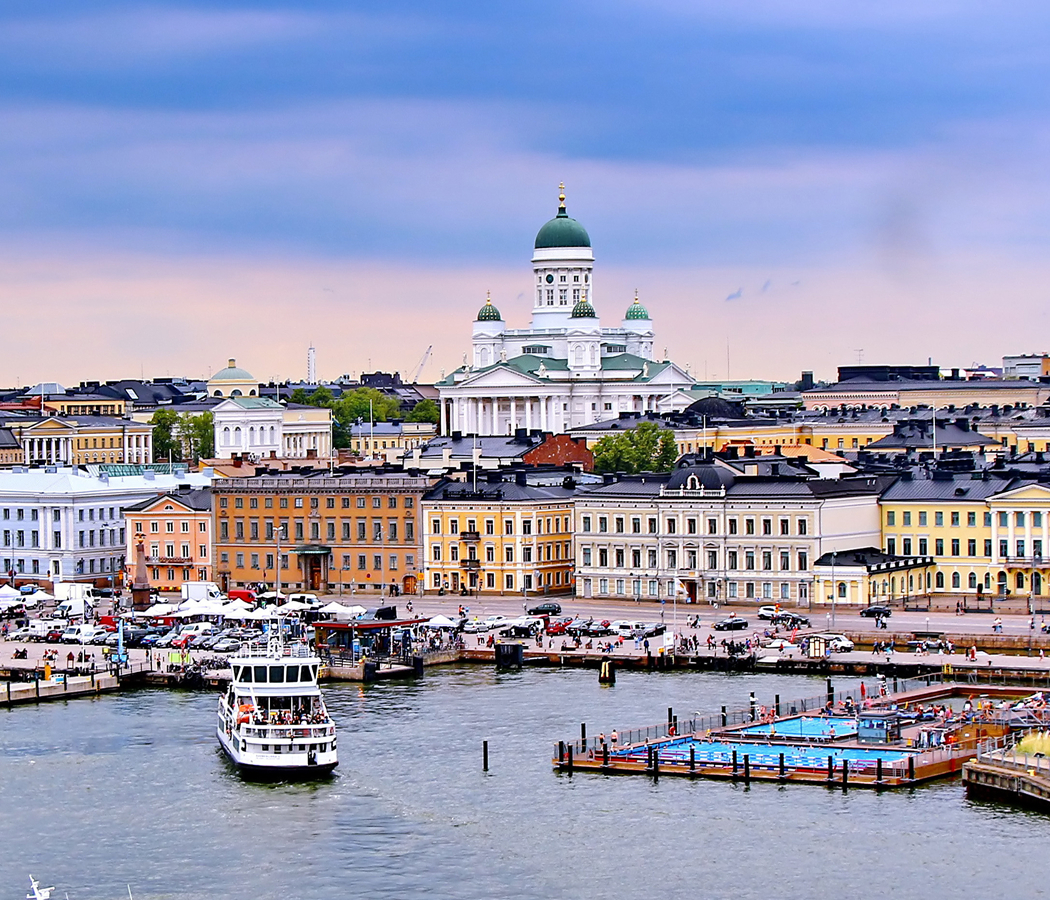
Helsinki extends across a deeply indented coastline on the northern shore of the Gulf of Finland, where granite outcrops, wooded islands, sheltered bays, and extensive waterfront districts shape an urban landscape closely connected to the Baltic Sea. The city occupies a series of peninsulas and adjoining islands, with bridges, causeways, ferries, and coastal transportation routes linking neighborhoods across its fragmented shoreline. Its underlying bedrock belongs to the ancient Fennoscandian Shield, producing exposed granite formations and gently undulating terrain shaped by successive periods of glaciation. The historic center occupies the southern peninsula, where a regular street grid connects grand civic buildings with commercial streets, harbor facilities, and landscaped public squares. Senate Square forms the principal neoclassical ensemble, surrounded by the Government Palace, the University of Helsinki's main building, and Helsinki Cathedral. Completed in 1852, the cathedral rises above the square through a grand white façade, green central dome, and symmetrical composition that dominates views toward the harbor. The surrounding buildings reflect Carl Ludvig Engel's vision of a capital whose architecture expressed administrative authority through restrained classical forms. South of Senate Square, Market Square occupies an important waterfront position beside the South Harbour, connecting historic commercial streets with ferry terminals and public promenades. The nearby Old Market Hall, opened in 1889, preserves an elegant brick market building associated with the city's food trade. The Presidential Palace overlooks the harbor from an imposing neoclassical structure originally developed as a merchant residence before its conversion to imperial use. Westward, Esplanadi forms a landscaped boulevard connecting Market Square with the commercial center, bordered by nineteenth-century buildings, cafés, and substantial retail streets. Mannerheimintie extends north through the principal civic and cultural districts, passing major institutions including the Parliament House, whose grand granite façade and classical columns reflect the architecture of Finland's early independence period. Nearby, Helsinki Central Library Oodi introduces a contrasting contemporary landmark through its sweeping timber exterior, expansive public spaces, and innovative structural design. The Finlandia Hall, designed by Alvar Aalto, stands beside Töölönlahti Bay through a distinctive modernist composition clad in white marble. The adjacent Töölö district contains substantial early twentieth-century apartment buildings, broad streets, and cultural institutions developed during the capital's rapid expansion. Helsinki Central Railway Station, designed by Eliel Saarinen and completed in 1919, presents one of the city's most influential architectural landmarks through its granite façade, grand entrance sculptures, and prominent clock tower. East of the center, the Katajanokka peninsula preserves a concentration of Jugendstil architecture, with ornate apartment buildings reflecting Finland's distinctive interpretation of Art Nouveau. The Uspenski Cathedral rises above the waterfront through red-brick walls and gilded onion domes, recalling the Orthodox heritage associated with the Russian imperial period. Across the harbor, Suomenlinna occupies a group of fortified islands containing eighteenth-century ramparts, bastions, historic buildings, and residential neighborhoods. Its extensive defensive works form a UNESCO World Heritage Site and preserve an important chapter of Baltic military engineering. West of Central Helsinki, the Temppeliaukio Church occupies an excavated granite formation, its circular interior enclosed by exposed rock walls beneath a copper dome. Farther north, the Sibelius Monument stands within a landscaped park overlooking the shoreline, its abstract arrangement of steel pipes commemorating Finland's celebrated composer. Helsinki's contemporary residential districts include Kalasatama and Jätkäsaari, former industrial and port areas transformed through waterfront redevelopment, high-density housing, and modern transportation infrastructure. The city's broader landscape incorporates extensive coastal forests, public parks, and islands accessible through seasonal ferry services. Helsinki's physical distinction comes from the close relationship between neoclassical imperial planning, Finnish modernist architecture, exposed granite landscapes, and a maritime geography that integrates the Baltic shoreline into everyday urban life.
Finnish design acquired international prominence through the architects, artists, and manufacturers associated with Helsinki, whose work helped define twentieth-century modernism through functional clarity, natural materials, and a close relationship with the Nordic environment. Architect Alvar Aalto developed an influential approach to modern design through buildings, furniture, lighting, and interiors that combined technological innovation with organic forms and human-centered spaces. His work contributed to the international reputation of Finnish architecture, alongside figures including Eliel Saarinen and contemporary designers whose buildings continue to shape Helsinki's urban environment. The city's design heritage also includes Marimekko, founded in 1951, whose bold textiles and graphic patterns became internationally recognizable expressions of Finnish modern design. Iittala and Arabia contributed influential traditions of glassmaking, ceramics, and industrial craftsmanship, supporting the development of a distinctive national design culture. Helsinki's Design District brings together studios, galleries, workshops, and independent retailers within the central neighborhoods, reflecting the continuing importance of creative industries. The Design Museum preserves substantial collections of Finnish furniture, textiles, industrial objects, and graphic design, connecting historical craftsmanship with contemporary innovation. Helsinki's musical history is closely associated with Jean Sibelius, whose symphonies and tone poems contributed profoundly to the development of Finnish national consciousness during the late nineteenth and early twentieth centuries. His composition Finlandia, premiered in 1899, acquired particular symbolic importance during the period of Russian imperial rule. The Helsinki Philharmonic Orchestra, founded in 1882, became a major institution in Finnish musical life, supporting the performance of national and international orchestral repertoire. The Finnish National Opera and Ballet contributes another important institution through productions staged at its modern theater beside Töölönlahti Bay. The city's contemporary music culture extends from classical performance to heavy metal, electronic music, and independent rock, reflecting Finland's substantial influence within several international musical genres. Helsinki's literary heritage includes the broader Finnish-language movement associated with Elias Lönnrot's compilation of the Kalevala, whose publication during the nineteenth century helped establish a shared national literary tradition. The city subsequently became a major center of Finnish publishing, journalism, and intellectual debate. The Ateneum Art Museum preserves an extensive collection of Finnish painting and sculpture, including works by Akseli Gallen-Kallela, whose interpretations of Kalevala mythology contributed to the development of Finnish national romantic art. The Museum of Contemporary Art Kiasma, designed by Steven Holl, presents modern and contemporary artistic practices through an architecturally distinctive building near the central railway district. The Helsinki Festival contributes an important annual program of music, theater, dance, and visual arts, bringing international and Finnish performers into the city's public spaces and cultural institutions. Helsinki's everyday social customs remain closely associated with sauna culture, a practice embedded in Finnish domestic life, public bathing traditions, and communal recreation. Historic public saunas and contemporary waterfront facilities preserve the ritual of alternating intense heat with cooling periods, frequently including immersion in the Baltic Sea. The city's culinary traditions draw upon Finland's forests, lakes, agricultural regions, and coastal waters, emphasizing seasonal ingredients and preparations adapted to northern climates. Baltic herring, salmon, rye bread, potatoes, mushrooms, berries, and root vegetables occupy important positions in regional cooking. Lohikeitto, a creamy salmon soup prepared with potatoes and dill, represents a familiar Finnish domestic dish. Karjalanpiirakka, a traditional Karelian pastry filled with rice or other grains, has become a widely enjoyed element of Finnish food culture. The annual Baltic Herring Market, held at Market Square, preserves a longstanding maritime trading tradition through the sale of fish products and regional foods. Contemporary Helsinki restaurants increasingly explore Nordic ingredients through modern techniques, connecting traditional preservation methods with seasonal cooking. Helsinki's influence on international culture is particularly evident in the enduring reach of Finnish modernist design, its distinguished musical institutions, and a civic environment where architecture, public space, and access to nature occupy central places in metropolitan life.
Five fascinations.
5. Helsinki was founded to compete with another Baltic trading city.
King Gustav I of Sweden founded Helsinki in 1550 partly to challenge the commercial power of Tallinn across the Gulf of Finland. The original settlement stood at the mouth of the Vantaa River before Helsinki was relocated closer to the open sea during the seventeenth century. For generations it remained comparatively modest beside older Baltic centers. Its fortunes changed dramatically after Russia conquered Finland and Emperor Alexander I made Helsinki capital of the autonomous Grand Duchy of Finland in 1812. A city created as a strategic competitor in Baltic commerce became the political center from which modern Finland developed.
4. Helsinki rebuilt its center to resemble a grand imperial capital.
After Helsinki became Finland's capital, an ambitious reconstruction transformed its urban core. German-born architect Carl Ludvig Engel designed an extraordinary Neoclassical ensemble around Senate Square, including Helsinki Cathedral, the Government Palace, and the principal building of the University of Helsinki. Broad façades and carefully coordinated public spaces gave the young capital a ceremonial architecture suited to its new political status within the Russian Empire. The resulting district remains one of Europe's most coherent Neoclassical cityscapes. Central Helsinki acquired much of its defining architectural character through a deliberate nineteenth-century effort to turn a relatively small port into a national capital.
3. Suomenlinna was built across islands to defend Helsinki from the sea.
Sweden began constructing the immense sea fortress now known as Suomenlinna in 1748 across islands at the entrance to Helsinki's harbor. Engineer Augustin Ehrensvärd directed the project, creating bastions, defensive walls, docks, tunnels, and military facilities intended to strengthen Sweden's position against Russian expansion. The fortress surrendered to Russian forces in 1808 and subsequently served another empire before becoming part of independent Finland. Today its fortifications, residences, museums, and working maritime spaces form an inhabited district accessible by ferry. Helsinki's harbor contains a complete fortified landscape shaped by successive Swedish, Russian, and Finnish eras.
2. Helsinki carved one of its most famous churches directly into bedrock.
Architect brothers Timo and Tuomo Suomalainen won the competition for Temppeliaukio Church with a design that treated the rocky site itself as the building's defining material. Completed in 1969, the church was excavated into exposed granite, leaving rugged rock walls surrounding the interior beneath a broad copper-lined dome. A ring of glazing admits daylight between the rock and roof, creating a dramatic contrast between geological mass and modern engineering. The unconventional sanctuary became a landmark of Finnish architecture by making excavation itself part of the design, embedding a major public building directly into Helsinki's ancient bedrock.
1. Helsinki turned an old industrial harbor into an entire waterfront neighborhood.
Jätkäsaari spent much of the twentieth century as a major cargo port immediately west of Central Helsinki. When container operations shifted to the new Vuosaari Harbour in 2008, an enormous tract of waterfront land became available for redevelopment. Helsinki began transforming former docks, warehouses, and logistics territory into a dense residential district with parks, tram lines, schools, businesses, and new streets extending toward the Baltic. Passenger ferries still use part of the waterfront, preserving its maritime function alongside the new neighborhood. A landscape once engineered almost entirely for freight became one of Helsinki's largest contemporary urban expansions.
Where your story begins.
Foresyte Travel reveals places that feel extraordinary long before you arrive.
Enjoy editorial crafted for luxury travelers.
Foresyte may earn a commission when you book.