Fun facts about Istanbul, Türkiye.
Istanbul has captivated travelers for millennia by bridging Europe and Asia, creating one of the world's most extraordinary cities where empires, religions, and civilizations have shaped an unmistakable cultural landscape. Iconic landmarks including Hagia Sophia, the Blue Mosque, Topkapı Palace, and the Bosphorus have become enduring symbols of the city, while neighborhoods such as Sultanahmet, Beyoğlu, Karaköy, and Balat each reveal a distinct chapter of Istanbul's remarkable history. Every district contributes to a destination where Byzantine, Ottoman, and modern Turkish influences continue to coexist in extraordinary harmony.
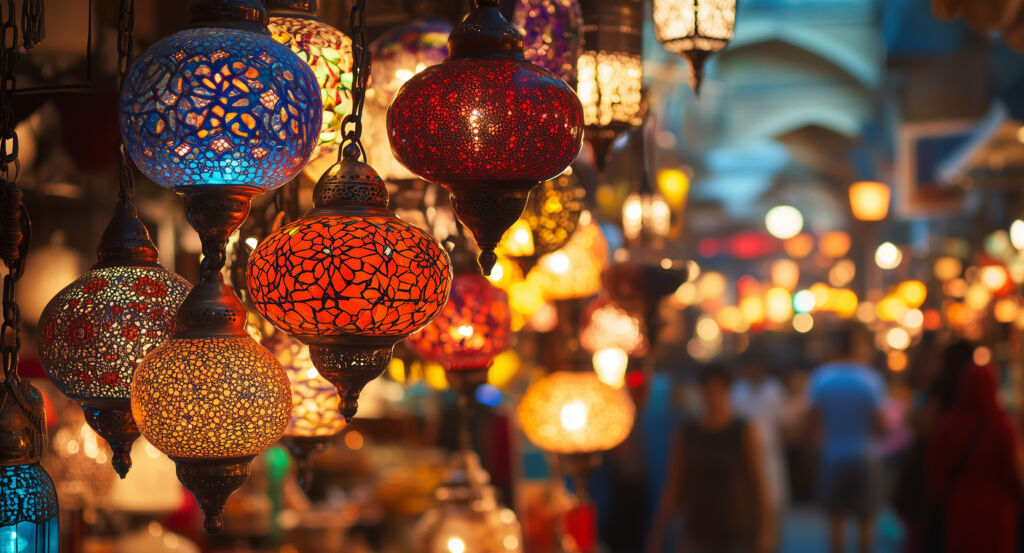
Beyond its celebrated skyline, Istanbul fascinates through an unparalleled concentration of historic monuments, thriving markets, and energetic waterfronts. Visitors can browse thousands of shops within the Grand Bazaar, experience the aromas of the Spice Bazaar, descend into the atmospheric Basilica Cistern, or admire panoramic city views from the Galata Tower. Cruises along the Bosphorus, peaceful courtyards surrounding the Süleymaniye Mosque, and lively squares such as Taksim Square demonstrate how Istanbul continually balances centuries of heritage with the energy of one of Europe's and Asia's largest metropolitan centers.
Perhaps Istanbul's greatest fascination is its remarkable ability to preserve its imperial past while continually evolving as a global cultural capital. Ancient city walls, grand mosques, and Ottoman palaces stand beside contemporary galleries, acclaimed restaurants, and thriving neighborhoods that continue to redefine the city's identity. Whether wandering the historic streets of Sultanahmet, exploring the colorful waterfront around Ortaköy, crossing the Galata Bridge, or watching ferries glide between two continents across the Bosphorus, visitors quickly discover that Istanbul's enduring appeal lies in its extraordinary position at the crossroads of history, culture, and geography.
Five fascinations.
5. Istanbul's Grand Bazaar grew from an Ottoman commercial complex into a city within the city.
Soon after conquering Constantinople in 1453, Sultan Mehmed II established a covered market near the center of his new imperial capital. The commercial district expanded across subsequent centuries as shops, workshops, warehouses, inns, mosques, fountains, and covered streets accumulated around its original core. Fires and earthquakes repeatedly damaged the complex, prompting cycles of rebuilding that helped shape its present form. The Grand Bazaar ultimately developed into an enormous interconnected marketplace containing thousands of shops, preserving an urban commercial system whose origins reach directly into the formative decades of Ottoman Istanbul.
4. Hagia Sophia's enormous dome transformed architecture more than 1,400 years ago.
Emperor Justinian I commissioned Hagia Sophia after the Nika revolt devastated an earlier church on the site in 532. Mathematicians and designers Anthemius of Tralles and Isidore of Miletus created an extraordinary structure whose central dome appears to hover above a ring of windows. Completed in 537, the building became a defining achievement of Byzantine engineering and profoundly influenced later religious architecture. Its subsequent lives as an Orthodox cathedral, Catholic cathedral, Ottoman mosque, museum, and mosque again embody Istanbul's extraordinary succession of empires, religions, and political transformations within a single grand structure.
3. The Basilica Cistern was built with hundreds of columns, including two mysterious Medusa heads.
Beneath Istanbul's historic peninsula lies an immense Byzantine reservoir constructed during the reign of Justinian I in the sixth century. The Basilica Cistern contains 336 marble columns supporting a vaulted underground chamber that stored water for the imperial center. Many architectural elements were reused from older structures, producing striking variations among the columns. Two bases incorporate ancient stone carvings of Medusa, one positioned sideways and another upside down. Their original source and the precise reason for their unusual orientation remain uncertain, making the cistern an extraordinary fusion of Roman material, Byzantine engineering, and later Istanbul history.
2. The Bosphorus helped make Istanbul the capital of two enormous empires.
Istanbul occupies one of the world's most consequential geographic positions, where the Bosphorus connects the Black Sea with the Sea of Marmara and ultimately the Mediterranean. Constantinople exploited this position as the capital of the Byzantine Empire, controlling strategic movement between maritime regions and commanding routes between Europe and Asia. The Ottoman conquest of 1453 transferred that geographic advantage to another imperial power, and Istanbul remained the Ottoman capital for centuries. Few major cities possess such an intimate relationship between physical geography and geopolitical power: the narrow waterway dividing Istanbul also helped make it one of history's great imperial centers.
1. Istanbul built one of the world's earliest underground railways beneath a notoriously steep neighborhood.
The Tünel opened in 1875, connecting the waterfront district of Karaköy with the elevated area around Beyoğlu and Galata. Its short underground route solved a distinctly Istanbul problem: moving passengers efficiently up the severe slope separating commercial activity near the Golden Horn from neighborhoods above. Built as a subterranean funicular, the line ranks among the oldest underground urban railways in the world, following London's Underground by little more than a decade. More than 150 years later, the Tünel still carries passengers beneath Beyoğlu, preserving a pioneering transportation solution inside the contemporary city.
Where your story begins.
Foresyte Travel reveals places that feel extraordinary long before you arrive.
Enjoy editorial crafted for luxury travelers.
Foresyte may earn a commission when you book.