
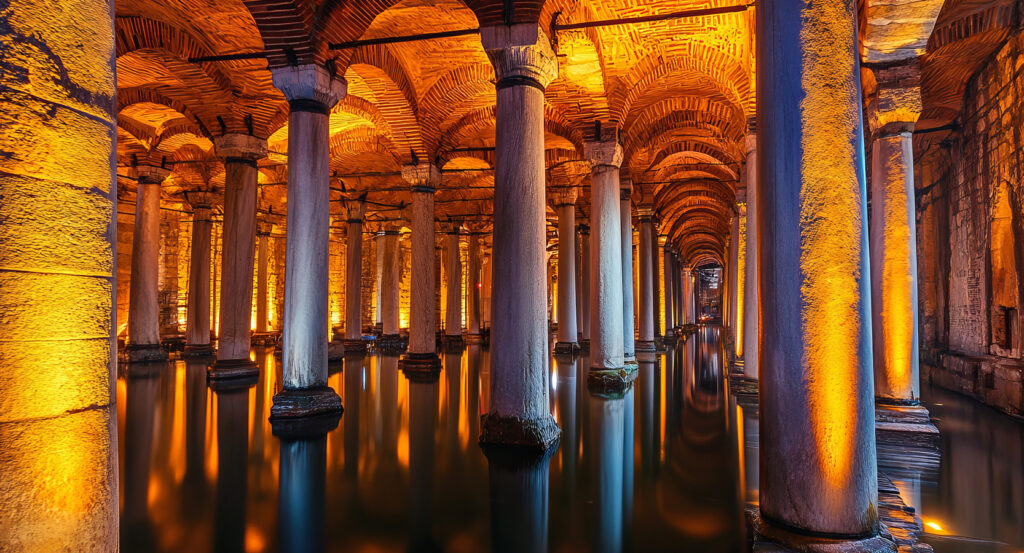
Why Basilica Cistern matters.
Basilica Cistern is a vast subterranean reservoir where Sultanahmet's Byzantine heritage, imperial engineering, architectural ingenuity, and centuries of Constantinople's resilience survive beneath the historic heart of Istanbul.
Set along Alemdar Street near Yerebatan Caddesi and just steps from Hagia Sophia, this underground chamber unfolds through soaring marble columns, vaulted brick ceilings, tranquil reflecting pools, and softly illuminated walkways where the engineering vision of the Byzantine Empire emerges beneath the streets of the former imperial capital. Rhythmic colonnades, shimmering water, ancient masonry, and carefully balanced lighting reveal a hidden world built to sustain one of history's greatest cities. Engineering, history, and architectural mastery resonate throughout every aisle of the reservoir.
What defines Basilica Cistern.
Basilica Cistern is best known for serving as Constantinople's largest surviving underground reservoir after Emperor Justinian I commissioned its construction in 532 following the Nika Revolt, creating an immense hydraulic system measuring 138 meters by 65 meters with the capacity to store 80,000 cubic meters of water supported by 336 marble columns arranged in twelve rows that supplied the Great Palace of Constantinople and surrounding imperial complexes through one of the ancient world's most sophisticated urban water networks. Constructed by thousands of craftsmen using brick masonry sealed with waterproof Horasan mortar, the reservoir received water through the Vaview and Hadrian aqueduct systems extending 250 kilometers from springs and forests northwest of the capital, ensuring reliable water reserves during sieges, droughts, and periods of rapid population growth. The majority of its marble columns were repurposed from earlier Roman buildings, incorporating Corinthian, Ionic, and composite capitals that reflect the Byzantine practice of architectural spolia while reducing construction time and material costs. Two enigmatic Medusa column bases, positioned sideways and upside down beneath corner supports, remain among the structure's most studied archaeological features, with scholars attributing their placement to the practical reuse of earlier Roman sculpture. Rediscovered in 1545 by French scholar Petrus Gyllius after local residents drew water and caught fish through openings in nearby houses, the cistern later underwent repairs under Sultan Ahmed III before receiving comprehensive conservation campaigns during the twentieth and twenty-first centuries. Extensive structural rehabilitation completed in 2022 introduced advanced seismic reinforcement, environmental monitoring systems, elevated visitor platforms, improved drainage, conservation lighting, and carefully integrated exhibition spaces while preserving one of the Byzantine Empire's greatest surviving feats of civil engineering within Istanbul's UNESCO World Heritage Site.
Advanced hydraulic planning, structural precision, and disciplined architectural repetition reveal how Byzantine engineers created an infrastructure system capable of sustaining an imperial capital for centuries. Endless rows of marble columns, restored brick vaults, archaeological interpretation, controlled lighting, and carefully managed water levels demonstrate the successful balance between long-term preservation and public access while emphasizing the reservoir's original engineering function. Continuing archaeological research, structural monitoring, masonry conservation, and environmental management ensure the cistern remains one of the world's finest surviving examples of ancient urban infrastructure. Imperial engineering, architectural sophistication, and historical continuity combine to create one of Istanbul's most compelling cultural experiences.
How Basilica Cistern fits.
Basilica Cistern works as the centerpiece of an exploration through Sultanahmet's celebrated Byzantine and Ottoman treasures.
Begin at Hagia Sophia, where centuries of imperial history establish the cultural significance of the surrounding district before descending into Basilica Cistern. Continue to Blue Mosque, whose refined Ottoman architecture provides a compelling counterpart to the Byzantine engineering beneath the streets. Conclude at Topkapı Palace, where the residence of Ottoman sultans provides a memorable finale tracing Istanbul's evolution from Byzantine capital to imperial Ottoman seat. The progression moves naturally from sacred architecture to subterranean engineering before concluding through centuries of royal history, revealing why Sultanahmet remains one of the world's greatest historic districts.
Where your story begins.
Foresyte Travel reveals places that feel extraordinary long before you arrive.
Enjoy editorial crafted for luxury travelers.
Foresyte may earn a commission when you book.





































































































