
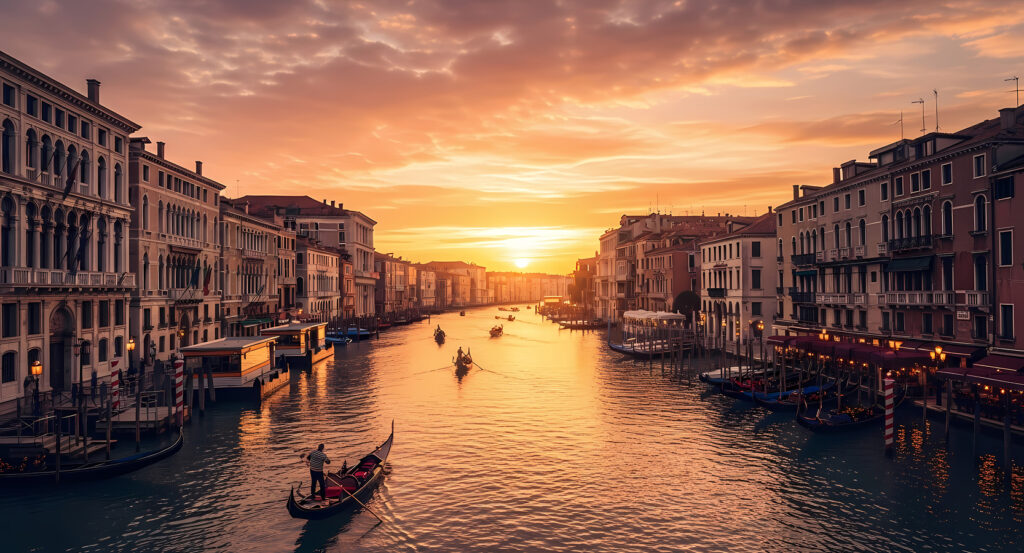
Top places to stay in Venice, Italy.
Venice established one of Europe's most enduring traditions of hospitality through the maritime wealth of the Venetian Republic, the commercial exchange of the eastern Mediterranean, and the cultural patronage of its merchant aristocracy, welcoming generations of diplomats, traders, artists, and Grand Tour travelers to a city of palaces, canals, and extraordinary architectural splendor. Established among the islands of the Venetian Lagoon during the early Middle Ages, the settlement developed into a major trading center through its command of maritime routes linking Constantinople, Alexandria, and the Italian mainland. By the thirteenth century, Venetian merchants maintained commercial networks extending across the Mediterranean and Black Sea, bringing foreign traders, diplomats, and pilgrims into a city whose prosperity depended upon international exchange. The Fourth Crusade of 1204 strengthened Venetian commercial influence in the eastern Mediterranean, accelerating the accumulation of wealth that financed grand palaces and religious institutions. The establishment of the Fondaco dei Tedeschi near the Rialto provided German merchants with accommodation, storage, and commercial facilities, illustrating the sophistication of the republic's hospitality infrastructure. Venice also became a principal departure point for pilgrims traveling to the Holy Land, supporting an established network of inns and lodging houses near its maritime terminals. During the Renaissance, aristocratic households developed elaborate traditions of ceremonial reception within palaces overlooking the Grand Canal, where visiting dignitaries encountered the architectural magnificence of the Venetian patriciate. The expansion of European aristocratic travel during the seventeenth and eighteenth centuries transformed Venice into an essential destination on the Grand Tour, attracting visitors drawn to its painting, music, architecture, and celebrated Carnival festivities. The fall of the Venetian Republic in 1797 ended more than a millennium of independent government, introducing political upheaval that gradually redirected the city's economy toward cultural tourism. The opening of the railway bridge connecting Venice with the mainland in 1846 transformed access to the lagoon, encouraging the development of prestigious hotels serving international travelers. The Hotel Danieli, established in 1822 within the historic Palazzo Dandolo, became an important institution of aristocratic hospitality near St. Mark's Square. The opening of the Grand Hotel des Bains on the Lido in 1900 introduced a distinguished seaside resort associated with European high society and the growing fashion for Adriatic bathing. The inauguration of the Venice International Film Festival in 1932 strengthened the Lido's international reputation, bringing prominent filmmakers and performers into its prestigious hotels. The conversion of the Gritti Palace into a luxury hotel during the twentieth century introduced another celebrated expression of hospitality within a historic Grand Canal residence. Postwar tourism subsequently encouraged the restoration of substantial palaces, former monasteries, and aristocratic residences as distinguished accommodation. The establishment of the Belmond Hotel Cipriani on Giudecca in 1958 introduced an influential model of secluded lagoon luxury, combining landscaped grounds with panoramic views toward the historic center. Contemporary Venetian hospitality continues to draw upon the architectural inheritance of the maritime republic, preserving the relationship between aristocratic palaces, international cultural travel, and the extraordinary urban environment of the lagoon.
Foresyte Travel's top five choices.
5. Palazzo Venart Luxury Hotel
Palazzo Venart Luxury Hotel occupies a sixteenth-century palace on the Grand Canal in Santa Croce, where generations of Venetian aristocratic development produced residences organized around water entrances, internal courtyards and richly decorated ceremonial rooms. The building became associated with the Bacchini delle Palme family and preserves architectural elements spanning centuries of alteration, including frescoes, marble fireplaces, terrazzo floors and carved details. An extensive restoration preceded its 2016 opening as a hotel, reviving decorative surfaces and historic interiors alongside a secluded garden extending toward the canal. Palazzo Venart translates the domestic architecture of Venice's patrician culture into an unusually intimate hotel whose physical structure retains the scale and spatial hierarchy of a private palazzo.
4. Hotel Cipriani, A Belmond Hotel, Venice
Hotel Cipriani, A Belmond Hotel, Venice opened in 1958 after Giuseppe Cipriani, founder of Harry's Bar, developed a hotel on Giudecca with British partners beside the lagoon opposite San Marco. Cipriani had already transformed Venetian dining culture through Harry's Bar, whose international clientele and association with Ernest Hemingway established his name far beyond the city before the hotel project began. The Giudecca site allowed the new property to combine immediate access to Central Venice with gardens and open lagoon frontage unavailable within the dense fabric surrounding Piazza San Marco. The hotel later became a foundational property within the portfolio that evolved into Belmond, extending Giuseppe Cipriani's influence from one celebrated Venetian restaurant into the international luxury-hospitality industry.
3. The St. Regis Venice
The St. Regis Venice occupies a group of historic buildings on the Grand Canal beside Piazza San Marco, including the former Grand Hotel Britannia that emerged during Venice's nineteenth-century development as an international destination. Claude Monet stayed at the hotel in 1908 and painted multiple views across the Grand Canal during his only visit to Venice, tying the property directly to one of the most consequential artistic interpretations of the city's light and architecture. A major transformation preceding the 2019 St. Regis opening unified the complex through contemporary interiors by Sagrada while preserving its exceptional waterfront relationship with Santa Maria della Salute and Punta della Dogana. The property connects Venice's grand-hotel era, Monet's late career and the Astor-founded St. Regis tradition within one of the Grand Canal's most culturally charged settings.
2. Hotel Danieli
Hotel Danieli occupies the Palazzo Dandolo, a Venetian Gothic palace associated with the Dandolo family and transformed into a hotel by Giuseppe Dal Niel during the nineteenth century. Its principal building preserves an extraordinary internal courtyard surrounded by pointed arches, columns, staircases and richly ornamented galleries that translate the spatial drama of a medieval Venetian residence into the hotel's central architectural composition. Charles Dickens, Honoré de Balzac, Marcel Proust and other major cultural figures became associated with the property as Venice developed into a central destination of nineteenth- and early-twentieth-century European travel. Successive expansion into neighboring buildings created a hotel complex whose architectural layers connect patrician Venice with the city's later emergence as one of Europe's great centers of international hospitality.
1. The Gritti Palace, a Luxury Collection Hotel, Venice
The Gritti Palace, a Luxury Collection Hotel, Venice occupies a Grand Canal residence whose history reaches into the fifteenth century and whose name derives from the powerful Gritti family, including Andrea Gritti, doge of Venice from 1523 to 1538. The building later served diplomatic functions before becoming a hotel in the late nineteenth century, carrying a patrician residence into the era when Venice's palaces were increasingly adapted for international visitors. Ernest Hemingway, W. Somerset Maugham and Peggy Guggenheim became closely associated with the property, extending its role from aristocratic architecture into the cultural life of twentieth-century Venice. An extensive restoration completed in 2013 preserved Rubelli textiles, Murano glass, antique furnishings and historic decorative work, sustaining the palace as a concentrated expression of Venetian craftsmanship, political history and Grand Canal domestic architecture.
Where your story begins.
Foresyte Travel reveals places that feel extraordinary long before you arrive.
Enjoy editorial crafted for luxury travelers.







































































































