Top places to stay in Portland, Oregon.
Portland emerged from a Pacific Northwest trading city whose fortunes were shaped by river commerce, transcontinental railroads, timber wealth, and a growing appetite for urban sophistication. Founded in 1845 near the confluence of the Willamette and Columbia rivers, the settlement occupied land traditionally inhabited by Indigenous peoples, including the Multnomah and other Chinookan communities. Its early boardinghouses accommodated merchants, sailors, and settlers arriving through the Columbia River corridor. Portland's incorporation in 1851 coincided with expanding agricultural exports and commercial shipping, establishing the waterfront as the center of its lodging economy. The completion of the Northern Pacific Railroad's transcontinental connection in 1883 accelerated commercial travel and strengthened the city's position as a regional gateway. The Portland Hotel opened in 1890, financed by prominent local investors and designed by McKim, Mead & White. Its imposing presence occupied an entire downtown block and made the city's ambitions visible to visiting industrialists and political figures. The Lewis and Clark Centennial Exposition of 1905 attracted national attention and encouraged further investment in visitor accommodation. The Benson Hotel opened in 1913, commissioned by timber magnate Simon Benson and designed by Doyle, Patterson & Beach. Its elaborate interiors and prominent downtown location established another enduring landmark of Portland hospitality. The Heathman Hotel followed in 1927, becoming closely associated with the city's performing arts community and literary culture. The Great Depression and subsequent changes in transportation reshaped the downtown hotel market, and the original Portland Hotel was demolished in 1951. During the later twentieth century, downtown revitalization and the expansion of Oregon's convention economy supported new hospitality investment. The opening of the Oregon Convention Center in 1990 strengthened Portland's position as a regional meeting center. Boutique hotel development subsequently became an important feature of the city's urban renewal, drawing upon restored commercial buildings and Portland's growing reputation for independent design. The conversion of the former Meier & Frank department store building into The Nines, which opened in 2008, connected contemporary luxury accommodation with a major downtown architectural landmark. Portland's lodging industry now reflects a succession of commercial eras, from nineteenth-century river trade and timber wealth to contemporary creative enterprise, regional tourism, and an influential culture of adaptive reuse.
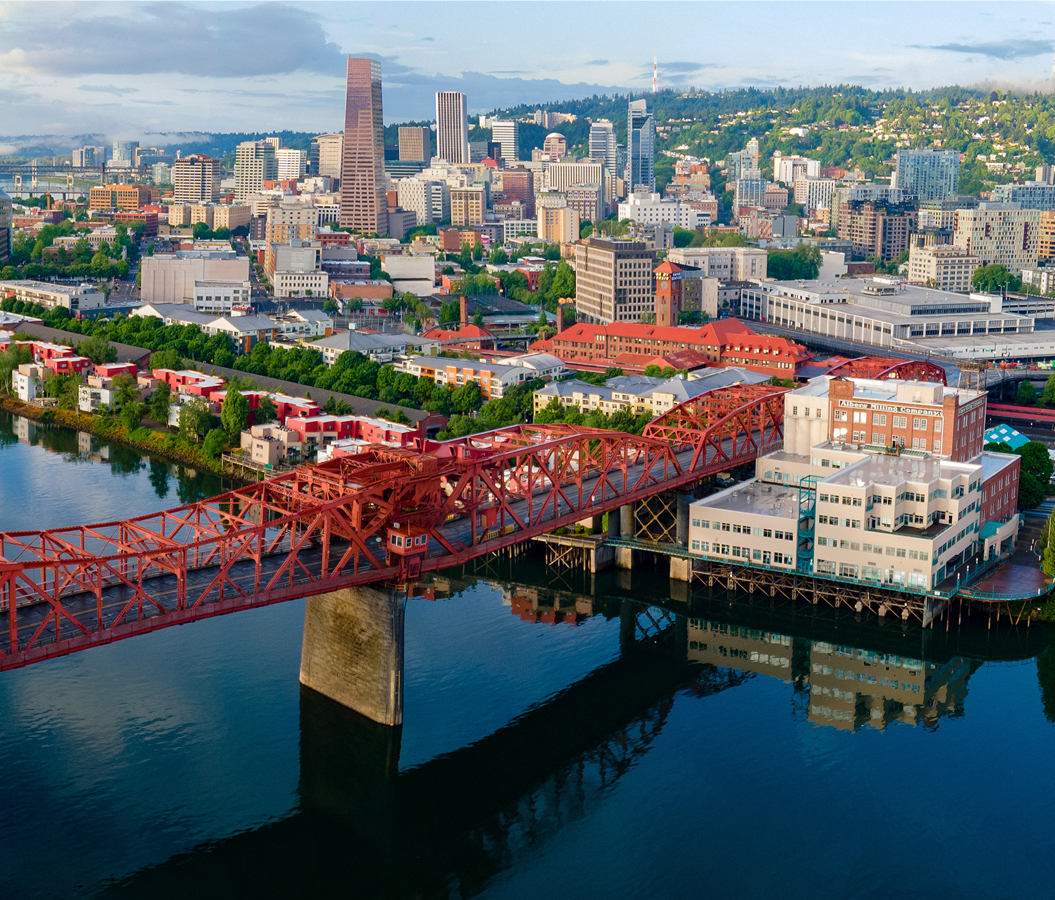
Portland occupies a broad valley along the Willamette River, with wooded hills rising west of downtown and an extensive network of bridges connecting distinct urban neighborhoods. Downtown remains the principal concentration of substantial hotels, with historic commercial buildings, contemporary towers, and landscaped public squares forming a compact pedestrian environment. Accommodation around Pioneer Courthouse Square provides convenient access to shopping streets, cultural venues, and the MAX light-rail network. The surrounding architecture combines substantial masonry façades, early skyscrapers, and contemporary structures, creating a varied metropolitan setting. Immediately north, the Pearl District occupies former warehouse and industrial land transformed into an established neighborhood of galleries, restaurants, parks, and sophisticated residential buildings. Boutique hotels occupy converted commercial properties and contemporary developments, with brick warehouses and expansive industrial windows contributing to the district's architectural identity. Nearby, the Old Town Chinatown district preserves some of Portland's earliest commercial streets through historic cast-iron buildings, traditional storefronts, and compact urban blocks. Its accommodation offers convenient access to the riverfront and central entertainment districts. West of downtown, the West End presents a more intimate environment through independent shops, cafés, and traditional commercial buildings. Smaller hotels and design-oriented properties benefit from the neighborhood's walkability and proximity to established cultural institutions. The adjoining Goose Hollow neighborhood rises toward the West Hills through historic residences, substantial apartment buildings, and wooded streets. Accommodation here offers a quieter setting near Washington Park and the surrounding recreational landscape. Southward, the South Waterfront district presents a striking contemporary environment through residential towers, landscaped promenades, and modern hotels overlooking the Willamette River. The Portland Aerial Tram provides a distinctive connection between the waterfront and the elevated medical campus above the city. Across the river, the Central Eastside occupies a former industrial landscape of warehouses, workshops, and contemporary creative businesses. Boutique accommodation and smaller hotels provide access to independent restaurants, breweries, and the district's extensive network of converted commercial buildings. Northward, the Lloyd District combines substantial business hotels, contemporary office buildings, and major entertainment facilities near the eastern approaches to downtown. The area's transportation connections make it a convenient base for convention visitors. Farther east, the neighborhoods surrounding Hawthorne Boulevard and Belmont Street offer a more residential atmosphere through traditional Portland houses, independent shops, and lively commercial corridors. Vacation rentals and intimate accommodation provide access to neighborhood restaurants and established local businesses. Northwest of downtown, the Nob Hill district presents elegant Victorian residences, tree-lined streets, and refined commercial avenues near the forested slopes of the West Hills. Its smaller lodging properties offer a distinctive residential setting. Beyond the central neighborhoods, the Columbia River corridor provides additional accommodation near the airport, waterfront recreation areas, and regional transportation routes. Portland's hotels range from restored historic landmarks and sophisticated downtown towers to intimate neighborhood properties and contemporary waterfront accommodation, with the city's wooded hills, extensive parkland, and river geography creating an unusually strong connection between urban hospitality and the surrounding natural environment. Foresyte may earn a commission when you book.
Foresyte Travel's top five choices.
5. Kimpton RiverPlace Hotel
Kimpton RiverPlace Hotel occupies the Willamette riverfront beside Tom McCall Waterfront Park, where Portland spent the late twentieth century reclaiming land previously dominated by industrial uses and transportation infrastructure. The hotel opened in 1985 as RiverPlace Hotel within a broader waterfront development that extended the downtown core southward along the river. Its low-rise brick architecture, pitched roofs, landscaped courtyards, and marina relationship established a residential scale distinct from Portland's central high-rise hotels. Kimpton Hotels later incorporated RiverPlace into the boutique company founded by Bill Kimpton in San Francisco in 1981. RiverPlace captures Portland's conversion of its central waterfront into a pedestrian-oriented district organized around parks, housing, hospitality, and direct access to the Willamette.
4. Hotel Lucia
Hotel Lucia occupies a 1909 building on Southwest Broadway in Portland's historic downtown commercial core. The property began as the Imperial Hotel Annex, extending the hotel enterprise associated with businessman Phil Metschan during the city's early twentieth-century growth. Provenance Hotels transformed the building into Hotel Lucia in 2002, establishing a contemporary boutique property inside its preserved masonry shell. A defining artistic component came from Pulitzer Prize-winning Oregon photographer David Hume Kennerly, whose extensive collection of photographs connects the interiors with decades of American political and cultural history. Hotel Lucia joins an early Portland hotel building with one of the state's most accomplished photojournalists, giving the property a cultural lineage extending far beyond conventional decorative art.
3. Sentinel Hotel
Sentinel Hotel occupies two adjoining historic structures on Southwest 11th Avenue, including the former Seward Hotel and the building created for Portland's Elks organization. Architect William C. Knighton designed the Seward, completed in 1909 with an elaborate exterior drawing from Arts and Crafts and related early twentieth-century influences. The neighboring Elks Temple arrived in the 1920s as a substantial social and institutional building during Portland's continuing downtown expansion. Provenance Hotels combined the structures into Sentinel in 2014, preserving architectural elements from both buildings within a unified hotel. Sentinel concentrates two distinct chapters of Portland's early twentieth-century civic and hospitality development within a property shaped by the adaptive reuse of its downtown architectural fabric.
2. The Ritz-Carlton, Portland
The Ritz-Carlton, Portland opened in 2023 within Block 216, a 35-story mixed-use tower occupying an entire downtown block near Pioneer Courthouse Square. GBD Architects designed the tower as one of the largest private developments in Portland history, combining hospitality, residences, offices, and street-level commercial space within a single vertical project. The development replaced a long-standing surface parking lot, inserting substantial new density into a central site surrounded by the city's retail and cultural core. The Ritz-Carlton occupies the tower's upper levels, making Portland the setting for the brand's first property in the Pacific Northwest. Block 216 represents a major twenty-first-century investment in Downtown Portland and a significant shift from underused central land toward dense mixed-use development.
1. The Nines, a Luxury Collection Hotel, Portland
The Nines, a Luxury Collection Hotel, Portland occupies the upper floors of the former Meier & Frank department store overlooking Pioneer Courthouse Square at the center of Downtown Portland. Architect A.E. Doyle designed the building's defining early twentieth-century expansion, creating a terra-cotta-clad commercial structure for the locally founded retailer that became one of the Pacific Northwest's dominant department stores. Meier & Frank operated at the site for generations before changes in American retail ultimately ended the company's independent presence downtown. The upper floors were subsequently transformed into The Nines, which opened in 2008 as part of the building's broader redevelopment following Macy's acquisition of the retail operation. The Nines gives Portland's great department-store building a second civic life at the intersection of the city's historic retail district and Pioneer Courthouse Square.
Where your story begins.
Foresyte Travel reveals places that feel extraordinary long before you arrive.
Enjoy editorial crafted for luxury travelers.
Foresyte may earn a commission when you book.