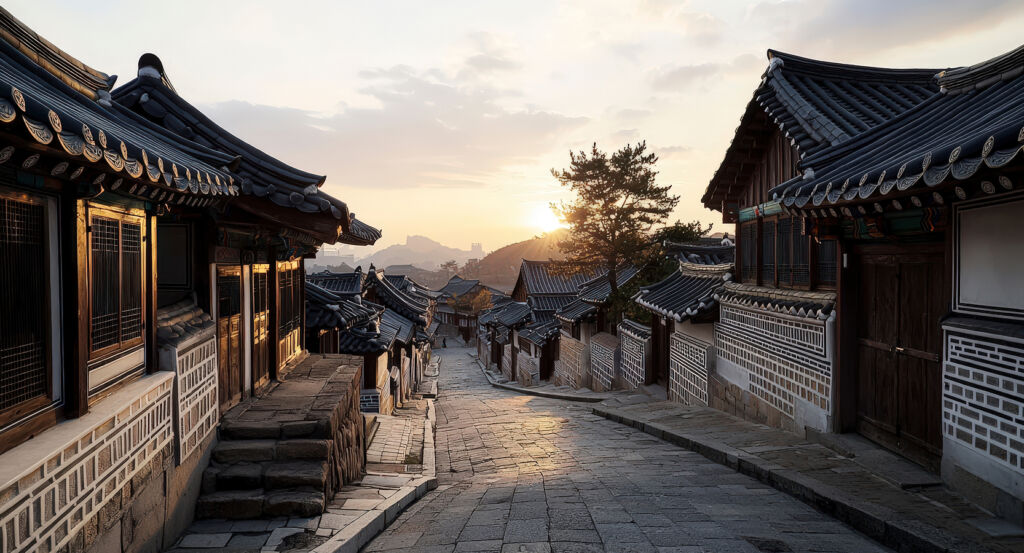
Top places to stay in Seoul, South Korea.
Seoul carries the legacy of Joseon royal court culture into a modern hospitality industry shaped by South Korea's rapid industrialization, international commerce, and global cultural influence, bringing traditional Korean craftsmanship and contemporary design into the experience of visiting the capital. Established as the capital of the Joseon dynasty in 1394 under King Taejo, Hanyang occupied a strategic position along the Han River, surrounded by mountains that shaped the city's defensive boundaries and ceremonial geography. The construction of Gyeongbokgung Palace and the development of the principal administrative avenues established a capital organized around royal authority, Confucian institutions, and the residential compounds of aristocratic families. Official guesthouses and diplomatic residences accommodated envoys and visiting dignitaries, reflecting the importance of formal reception within the political culture of the Joseon court. The establishment of the Daehan Empire in 1897 introduced a period of modernization under Emperor Gojong, whose efforts to strengthen Korea's international position encouraged the construction of Western-style institutions and the development of modern urban infrastructure. The Sontag Hotel, established near Deoksugung Palace in the early twentieth century by Antoinette Sontag, became an important gathering place for diplomats and foreign visitors, introducing European-style accommodation into the imperial capital. Japanese colonial rule from 1910 to 1945 brought extensive changes to the city's political institutions and commercial development, including the construction of the Chosen Hotel in 1914 near the present-day City Hall district. The Korean War devastated much of Seoul following the outbreak of hostilities in 1950, destroying substantial portions of the urban fabric and severely disrupting commercial life. The subsequent reconstruction of South Korea's capital accelerated during the 1960s and 1970s, as industrialization, export manufacturing, and international investment supported the development of modern transportation networks and metropolitan accommodation. The opening of the Walkerhill resort complex in 1963 introduced a prominent leisure destination overlooking the Han River, reflecting the growing importance of international visitors and organized entertainment within the recovering city. The opening of the Lotte Hotel Seoul in 1979 established a major luxury institution in the commercial heart of Myeongdong, connecting prestigious hospitality with the expanding influence of South Korea's corporate economy. The 1986 Asian Games and 1988 Summer Olympics brought unprecedented international attention to Seoul, encouraging substantial investment in hotels, convention facilities, and urban infrastructure. The opening of the Seoul Olympic Park and the redevelopment of major transportation corridors strengthened the city's capacity to accommodate international sporting delegations, business travelers, and leisure visitors. The expansion of Gangnam as a center of corporate headquarters, financial institutions, and prestigious residential development subsequently introduced a new geography of metropolitan luxury, with international hotels occupying prominent positions along Teheran-ro and the surrounding commercial avenues. The opening of Park Hyatt Seoul in 2005 established a contemporary interpretation of luxury accommodation through minimalist architecture and a prominent location in Samseong-dong. The development of the Dongdaemun Design Plaza, completed in 2014 to designs by Zaha Hadid Architects, reinforced Seoul's growing international reputation for ambitious contemporary architecture and creative enterprise. The completion of Lotte World Tower in 2017 introduced a grand vertical landmark in Jamsil, with Signiel Seoul occupying the upper floors and establishing a distinguished expression of high-rise luxury hospitality. Seoul's international prominence subsequently expanded through the global influence of Korean popular music, cinema, fashion, and gastronomy, bringing visitors whose interests extended across the city's historic institutions and contemporary cultural districts. The capital's hotel industry captures the relationship between royal ceremony, twentieth-century reconstruction, industrial prosperity, and the extraordinary cultural influence of modern South Korea.
Seoul unfolds across the Han River basin through a striking succession of royal precincts, established commercial neighborhoods, and contemporary high-rise districts, creating distinctive settings for accommodation within one of Asia's largest metropolitan centers. North of the river, Jongno preserves the historic administrative and ceremonial heart of the Joseon capital, where traditional streets and substantial modern buildings occupy the approaches to Gyeongbokgung Palace, Changdeokgung Palace, and the principal royal institutions. The neighborhood's historic geography supports intimate boutique properties near established cultural landmarks, with accommodation integrated into a dense network of traditional markets, commercial streets, and restored residential buildings. Bukchon Hanok Village occupies the slopes between the principal royal palaces, preserving traditional Korean houses distinguished by timber construction, tiled roofs, enclosed courtyards, and carefully arranged interior spaces. Selected hanok guesthouses provide a distinctive residential experience within this historic environment, connecting contemporary visitors with the architectural traditions of Seoul's former aristocratic neighborhoods. The neighboring district of Insadong retains an established association with Korean art, antiques, and traditional craftsmanship, supporting intimate hotels near galleries, tea houses, and historic pedestrian streets. South toward the metropolitan center, Myeongdong developed into one of Seoul's principal commercial districts, with substantial hotels occupying prominent positions among department stores, international retail institutions, and densely organized shopping streets. The adjoining City Hall district presents a more grand urban environment through its concentration of government buildings, substantial office towers, and historic institutions surrounding Seoul Plaza. The streets near Deoksugung Palace connect prestigious accommodation with the architectural contrasts of the former imperial precinct and the modern commercial center. Eastward, Dongdaemun occupies a distinctive position within the city's fashion and wholesale economy, where contemporary hotels stand among major retail complexes, historic market buildings, and ambitious architectural developments. The district's concentration of late-night commercial activity establishes an urban hospitality environment closely associated with Seoul's fashion industry. West of the historic center, Hongdae developed around Hongik University into an influential district of independent music, contemporary art, and youth culture, supporting design-oriented accommodation within a dense network of cafés, galleries, and entertainment venues. The neighboring Yeonnam-dong district preserves a more intimate residential character through low-rise buildings, landscaped pedestrian routes, and independent cultural establishments. Across the Han River, Gangnam introduces a contrasting metropolitan landscape through broad commercial avenues, substantial corporate headquarters, and contemporary luxury towers. The district's architecture reflects the planned development of southern Seoul during the late twentieth century, establishing prestigious hotels near international business institutions, department stores, and major transportation connections. Samseong-dong forms an important center of this environment through the COEX convention complex, whose exhibition facilities and commercial institutions support a concentration of sophisticated business accommodation. Farther west, Sinsa-dong and Apgujeong retain a prestigious association with fashion, contemporary design, and affluent residential life, with boutique properties occupying prominent positions near the tree-lined streets of Garosu-gil and established luxury shopping districts. East of Gangnam, Jamsil developed around the substantial recreational and commercial institutions surrounding Seokchon Lake, with contemporary luxury hotels integrated into grand mixed-use developments. The district's high-rise skyline establishes a distinctive setting for accommodation overlooking the Han River and the expanding eastern metropolitan area. Along the northern riverbank, Yongsan occupies a strategic position between the historic center and southern Seoul, where major transportation infrastructure and extensive urban redevelopment have introduced substantial contemporary buildings and prestigious hotels. The adjoining Itaewon district preserves an internationally diverse commercial environment shaped by decades of foreign residential settlement, supporting boutique accommodation near restaurants, galleries, and established nightlife institutions. Farther west, Yeouido developed as Seoul's principal financial and parliamentary district, with broad boulevards, landscaped parks, and substantial commercial towers occupying an island within the Han River. Its contemporary hotels serve international business travelers and visitors attracted by the riverfront environment and major metropolitan institutions. These districts reveal the architectural contrasts that distinguish Seoul, from intimate hanok residences and historic commercial streets to grand corporate towers, sophisticated design hotels, and elevated luxury properties overlooking the Han River. Foresyte may earn a commission when you book.
Foresyte Travel's top five choices.
5. Josun Palace, a Luxury Collection Hotel, Seoul Gangnam
Josun Palace, a Luxury Collection Hotel, Seoul Gangnam extends a hospitality lineage that began with the 1914 Chosun Hotel, among the formative institutions of modern hotel culture in Korea. The property opened in 2021 inside Centerfield, a major mixed-use development in Gangnam's Teheran-ro business corridor, translating that century-old institutional heritage into a contemporary skyscraper setting. Humbert & Poyet shaped the interiors through Art Deco geometry, Korean decorative references, sculptural lighting and richly patterned stone, creating a deliberate connection between the glamour of early twentieth-century grand hotels and contemporary Seoul. Its name and design turn Josun's historical character into the foundation of a new luxury property within the commercial district that captures South Korea's extraordinary postwar economic transformation.
4. The Shilla Seoul
The Shilla Seoul opened in 1979 under Samsung founder Lee Byung-chul, who conceived the hotel as a Korean institution capable of receiving international dignitaries through an architectural and service culture rooted in the country itself. Its name invokes the Silla kingdom, whose rule produced one of the great periods of Korean art and state formation, giving the property a historical reference extending far beyond conventional hotel branding. The grounds contain Yeong Bin Gwan, a traditional Korean guesthouse built in 1967 for state visitors and later incorporated into the hotel estate, preserving a direct connection with South Korea's twentieth-century diplomatic history. The Shilla occupies an unusual position in Seoul hospitality, joining Samsung's corporate development, Korean historical symbolism and the architecture of state reception within an institution created during the country's rapid emergence onto the international stage.
3. Park Hyatt Seoul
Park Hyatt Seoul opened in 2005 within a purpose-built glass tower in Gangnam, establishing Hyatt's most design-focused luxury brand directly opposite the COEX commercial complex in one of Seoul's principal business districts. Japanese firm Super Potato, led by Takashi Sugimoto, conceived the interiors through granite, oak, natural stone and extensive glazing, applying the restrained material language that made the studio influential across Asian hospitality and retail design. The arrival sequence reverses conventional hotel planning by placing the principal lobby near the top of the building, turning Seoul's dense urban landscape into an architectural component of the interior before circulation descends toward accommodations below. That vertical organization and Sugimoto's material discipline gave Park Hyatt Seoul a distinct place in the generation of internationally designed hotels that accompanied Gangnam's consolidation as a global commercial center.
2. Four Seasons Hotel Seoul
Four Seasons Hotel Seoul opened in 2015 near Gwanghwamun Square, placing the company's first Korean property within the historic civic core that developed around the principal gate of Gyeongbokgung Palace. Heerim Architects & Planners designed the contemporary tower, and LTW Designworks developed interiors incorporating Korean materials, patterns and artistic references across spaces conceived for an international hotel within the capital's historic center. A substantial collection of contemporary Korean art became integral to the property, extending works by artists including Lee Bae and Choi Byung Hoon through public spaces and establishing local artistic production as a central component of the interior program. The project inserted a major international luxury hotel into a district shaped by Joseon royal power, twentieth-century government institutions and modern civic life, connecting contemporary Seoul hospitality with one of the city's most historically consequential urban axes.
1. Signiel Seoul
Signiel Seoul occupies the upper levels of Lotte World Tower, the 555-meter skyscraper designed by Kohn Pedersen Fox that became South Korea's tallest building upon completion in 2017. KPF developed the tower's tapered form from references to traditional Korean ceramics, calligraphy brushes and the curvature of historic decorative arts, translating Korean visual culture into the profile of a 123-story supertall structure. The engineering required a massive foundation, high-strength concrete, belt trusses and an aerodynamic form designed to control structural forces at extraordinary height, making the tower a defining achievement of South Korean high-rise construction. Signiel's position within that structure ties the hotel directly to Lotte's decades-long development of the Jamsil district and to the building that permanently altered Seoul's skyline and announced a new scale of Korean architectural ambition.
Where your story begins.
Foresyte Travel reveals places that feel extraordinary long before you arrive.
Enjoy editorial crafted for luxury travelers.
Foresyte may earn a commission when you book.