Top places to stay in Palm Beach, Florida.
Palm Beach emerged from the barrier islands of southeastern Florida as one of America's most influential winter retreats, shaped by railroad expansion, Gilded Age wealth, and the architectural ambitions of an international resort society. The island's subtropical landscape had attracted Indigenous communities long before European settlement, and its coastal geography later supported maritime trade and small agricultural settlements. Henry Morrison Flagler transformed the region during the 1890s by extending the Florida East Coast Railway southward and developing an ambitious network of luxury accommodations. The Royal Poinciana Hotel opened in 1894 beside Lake Worth Lagoon, becoming an immense wooden resort that attracted wealthy seasonal visitors from the Northeast. Flagler commissioned the nearby Palm Beach Inn in 1896, later renamed The Breakers, establishing an oceanfront counterpart to the lakeside establishment. A devastating fire destroyed the original Breakers in 1903, prompting construction of a larger successor that opened the following year. Another fire in 1925 led to the present Italian Renaissance-inspired building, completed in 1926 by the architectural firm Schultze & Weaver. Its grand façade, twin towers, and lavish interiors established an enduring architectural character for American luxury hospitality. The arrival of prominent industrialists, financiers, and social figures encouraged the construction of elaborate winter estates, transforming Palm Beach into an exclusive seasonal community. Addison Mizner became a defining architectural figure during the 1920s, introducing Mediterranean Revival designs inspired by Spanish and Italian precedents. His work influenced private residences, clubs, commercial buildings, and the broader visual character of the island. The Palm Beach Hotel opened in 1925, contributing to the expansion of seasonal accommodation during the Florida land boom. The Great Depression curtailed speculative development, although established resort institutions continued attracting affluent winter residents. Following the Second World War, improved highways and commercial aviation broadened access to South Florida, supporting a more diverse hospitality economy. The Colony Hotel opened in 1947 near Worth Avenue, developing a distinctive character through intimate accommodations and a fashionable social atmosphere. Subsequent decades brought extensive restoration of historic properties and renewed investment in sophisticated boutique hospitality. Palm Beach retains the architectural inheritance of its founding resort era, with historic landmarks and carefully preserved commercial streets sustaining its reputation for refined coastal living.
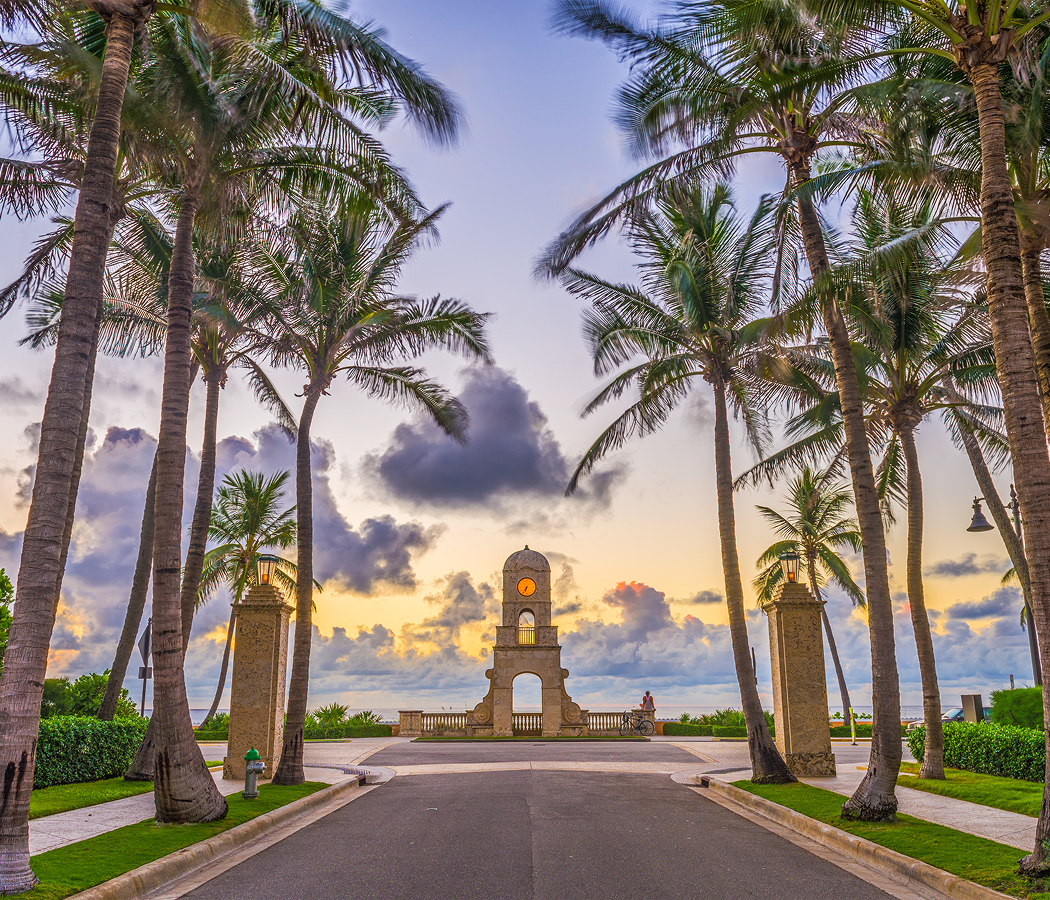
Palm Beach occupies a narrow barrier island between the Atlantic Ocean and Lake Worth Lagoon, creating a distinctive landscape of oceanfront estates, tropical gardens, landscaped avenues, and historic resort architecture. The central oceanfront forms the island's most prestigious lodging environment, where substantial luxury properties overlook broad beaches and the Atlantic horizon. The Breakers occupies an expansive landscaped estate north of the principal commercial district, combining grand Mediterranean-inspired architecture with formal gardens, recreational grounds, and direct beach access. Its distinctive silhouette remains one of the most recognizable architectural landmarks on Florida's eastern coast. Southward, the Worth Avenue district presents an intimate environment of Mediterranean Revival storefronts, shaded courtyards, decorative fountains, and elegant pedestrian passages. Boutique accommodation provides convenient access to designer shops, galleries, restaurants, and the surrounding residential streets. The avenue's celebrated vias introduce a particularly distinctive architectural character through narrow walkways, ornamental staircases, and secluded garden spaces. Nearby South Ocean Boulevard follows the Atlantic shoreline through a landscape of substantial private estates, mature palms, and carefully maintained coastal vegetation. Smaller luxury properties and residential accommodations occupy select locations along this prestigious corridor. Westward, the Lake Trail provides a scenic pedestrian and cycling route beside Lake Worth Lagoon, passing historic residences, landscaped gardens, and waterfront vistas toward West Palm Beach. The surrounding neighborhoods preserve an exceptionally refined residential atmosphere through substantial Mediterranean Revival houses, classical estates, and dense tropical landscaping. North of the central commercial area, the island becomes quieter and more residential, with elegant homes, private clubs, and established condominium properties occupying the narrow coastal landscape. The northern shoreline offers a more secluded environment through broad beaches, mature vegetation, and expansive ocean views. Farther south, the residential districts surrounding the Society of the Four Arts preserve a distinguished architectural setting through formal gardens, historic homes, and carefully composed public spaces. The nearby Royal Palm Way corridor connects the oceanfront with the lagoon through landscaped medians and substantial commercial buildings. Across the Intracoastal Waterway, Downtown West Palm Beach provides a complementary urban lodging environment through contemporary towers, restored commercial buildings, and waterfront public spaces. Properties near Clematis Street offer access to restaurants, galleries, entertainment venues, and the waterfront promenade. The adjoining CityPlace district introduces a pedestrian-oriented landscape of contemporary Mediterranean-inspired architecture, public squares, and substantial retail destinations. Farther north, the Northwood area presents historic residential streets and independent commercial establishments within a more relaxed urban setting. Across the greater Palm Beach area, accommodation ranges from grand oceanfront resorts and intimate historic boutique hotels to sophisticated urban properties and private residential retreats, with the barrier island's coastal geography shaping an atmosphere of privacy, architectural refinement, and tropical elegance. Foresyte may earn a commission when you book.
Foresyte Travel's top five choices.
5. The Brazilian Court Hotel & Beach Club
The Brazilian Court Hotel opened in 1926 on Brazilian Avenue during the building boom that established Palm Beach as one of America's defining winter enclaves. Architect Rosario Candela, celebrated for the apartment houses he designed along Park and Fifth avenues in Manhattan, created the original Mediterranean Revival complex around intimate courtyards and loggias. Maurice Fatio subsequently designed an expansion, adding the work of another architect deeply associated with Palm Beach's interwar residential architecture. The property underwent a major restoration in the early twenty-first century that preserved its tiled roofs, arcades, courtyards, and residential scale near Worth Avenue. The Brazilian Court concentrates two influential architects and the island's 1920s development into one of Palm Beach's most architecturally distinguished small hotels.
4. The Colony Hotel
The Colony Hotel opened in 1947 near Worth Avenue as Palm Beach entered a postwar period that extended the island's established winter social culture into a new generation. Architects Simonson and Holley designed the building in the British Colonial mode, creating a vertical counterpoint to the Mediterranean Revival estates and commercial buildings that had defined earlier Palm Beach development. The hotel became closely associated with the island's seasonal social circuit, drawing generations of prominent residents, designers, entertainers, and visitors to its location between Worth Avenue and the Atlantic. Sarah and Andrew Wetenhall acquired the property in 2016 and initiated a series of transformations that brought extensive collaborations with fashion and design figures into its interiors and public spaces. The Colony translates Palm Beach's postwar social history into a hotel whose architecture and design have evolved alongside the island's enduring culture of seasonal residence.
3. Palm House Hotel Palm Beach
Palm House opened in 2024 on Royal Palm Way after a long-stalled hotel project on one of the principal routes connecting Central Palm Beach with the Atlantic. London-based L+R Hotels completed the property and introduced it as the first United States member of its Iconic Luxury Hotels collection. Cooper Carry shaped the architecture around the established Mediterranean influences of Palm Beach, and Muza Lab developed interiors combining elaborate decorative surfaces, custom furnishings, and references to the island's tropical setting. The opening returned a prominent site to active hospitality use after years of interrupted construction and changing ownership. Palm House represents a new cycle of investment in Palm Beach hospitality built within the architectural style established during the island's formative twentieth-century development.
2. Four Seasons Resort Palm Beach
Four Seasons Resort Palm Beach occupies an Atlantic shoreline site in the town's quieter southern reaches, beyond the dense concentration of historic hotels, estates, and retail surrounding Worth Avenue. The property originated as the Inn on the Ocean before joining Four Seasons, placing its evolution within the broader expansion of Palm Beach hospitality beyond the island's early resort core. A major transformation completed in 2019 introduced interiors by Martin Brudnizki and landscape work by Fernando Wong, recasting the property through a distinctly residential interpretation of Palm Beach design. Low-rise buildings, gardens, and direct ocean frontage preserve a physical scale closely aligned with the surrounding coastal environment. Four Seasons represents the southward evolution of Palm Beach resort development from the grand architectural statements of the early twentieth century toward a lower, garden-oriented model of oceanfront hospitality.
1. The Breakers Palm Beach
The Breakers Palm Beach traces its origin to Henry Morrison Flagler, the Standard Oil co-founder whose Florida East Coast Railway transformed the state's Atlantic coastline and made Palm Beach accessible to wealthy winter travelers. Flagler opened the Royal Poinciana Hotel beside Lake Worth in 1894 and the Palm Beach Inn on the ocean in 1896, with the latter eventually taking The Breakers name from its shoreline location. Fires destroyed earlier versions of the hotel, leading to the completion of the present Italian Renaissance Revival building in 1926 under architects Schultze & Weaver, later designers of major hotels including New York's Waldorf Astoria. Its soaring lobby, arcaded spaces, frescoed ceilings, and oceanfront composition translated the scale of European palaces into the architecture of the Florida resort era. The Breakers remains under the ownership of Flagler's descendants, preserving an extraordinary institutional connection to the railroad entrepreneur whose investments fundamentally shaped Palm Beach and modern Florida tourism.
Where your story begins.
Foresyte Travel reveals places that feel extraordinary long before you arrive.
Enjoy editorial crafted for luxury travelers.
Foresyte may earn a commission when you book.