Why The Breakers Palm Beach matters.
The Breakers Palm Beach is an Italian Renaissance Revival oceanfront resort where Palm Beach's Gilded Age heritage meets Henry Flagler's railroad-financed development of Florida's Atlantic coast, the architectural craftsmanship of Schultze and Weaver, and a family-owned hospitality enterprise sustained through successive generations.
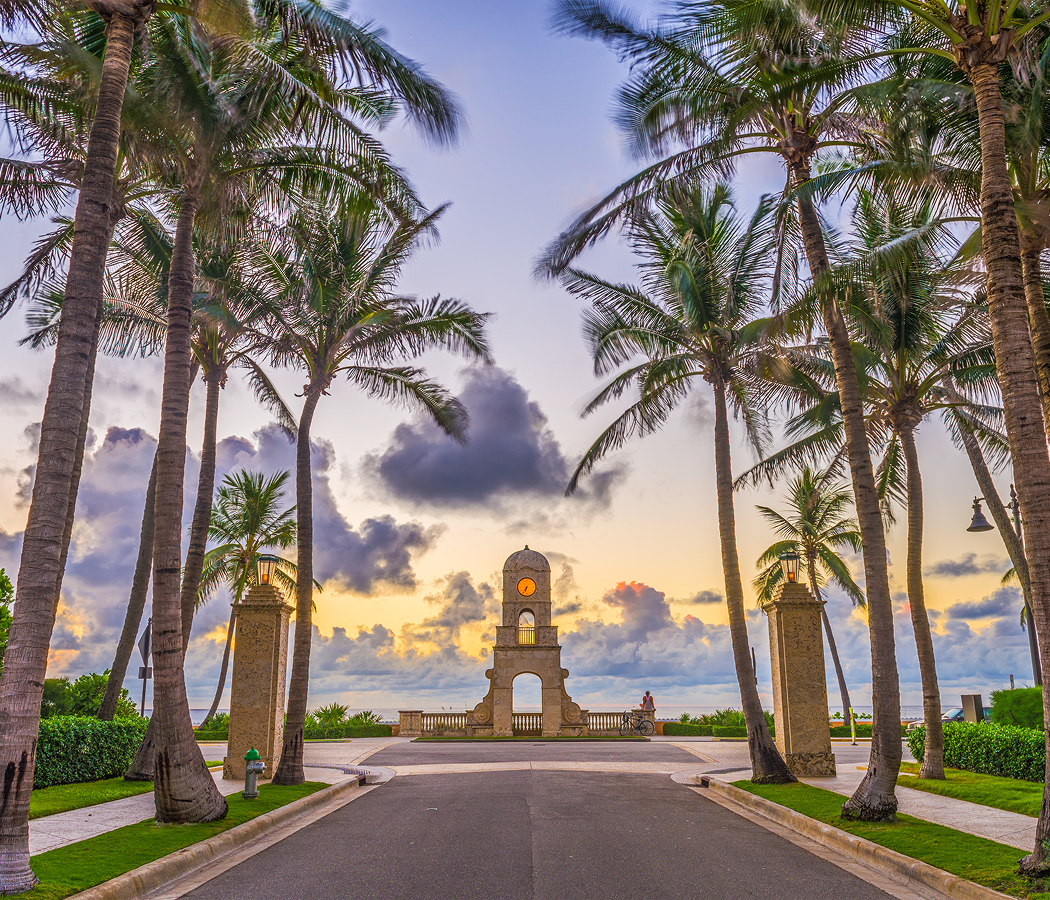
Set along South County Road near Royal Poinciana Way and a short walk from the Church of Bethesda-by-the-Sea, the resort occupies an oceanfront estate between Palm Beach's central residential district and the Atlantic shoreline, with landscaped grounds extending east toward the beach. Its twin towers rise above a symmetrical façade of arched windows, balconies and classical ornamentation. A formal entrance drive leads through landscaped gardens toward the principal building, establishing a ceremonial approach from the surrounding streets. Oceanfront terraces, recreational grounds and coastal vegetation connect the architecture with its subtropical setting. The result is a resort estate whose scale, architectural composition and relationship with the Atlantic preserve the ambitions of Palm Beach's original winter resort development.
What defines The Breakers Palm Beach.
The Breakers Palm Beach is best known for its Italian Renaissance Revival architecture, association with Henry Morrison Flagler and uninterrupted family ownership extending to the origins of Palm Beach's resort economy. Flagler, a founding partner of Standard Oil, invested his fortune in extending the Florida East Coast Railway and developing a network of hotels along Florida's Atlantic coast. His railroad reached West Palm Beach in April 1894, providing the transportation infrastructure necessary for the development of the barrier island as a winter resort. The Palm Beach Inn opened on January 16, 1896, as an oceanfront extension of Flagler's larger hospitality enterprise, attracting seasonal residents seeking direct access to the Atlantic. Its location near the breaking surf inspired the name The Breakers, adopted officially following an expansion in 1901. A fire destroyed the original wooden hotel on June 9, 1903, prompting Flagler to commission a replacement that reopened on February 1, 1904. The second building became associated with prominent American industrial and financial families, including the Rockefellers, Vanderbilts and Astors. Following Flagler's death in 1913, ownership passed through his family, preserving the resort's connection with the enterprise he established. A second fire destroyed the hotel on March 18, 1925, creating an opportunity for a comprehensive architectural reconstruction. William R. Kenan Jr., president of the Florida East Coast Hotel Company and brother of Flagler's widow, Mary Lily Kenan Flagler, directed the rebuilding program. The architectural firm Schultze and Weaver received the commission, drawing upon Leonard Schultze's admiration for the Villa Medici in Rome. Turner Construction began work in January 1926, employing more than 1,200 construction workers to complete the reinforced-concrete structure. The $7 million project was finished in eleven and a half months, and the hotel reopened on December 29, 1926. The reconstruction established the architectural form that continues to distinguish the property, securing its place in the history of American resort construction and the development of Palm Beach as an international winter destination.
How The Breakers Palm Beach fits.
The Breakers Palm Beach works as the architectural centerpiece for a Palm Beach itinerary connecting the island's early religious institutions, the private residences of its industrial founders and the cultural organizations established through its seasonal patronage.
Begin at the Church of Bethesda-by-the-Sea, the Episcopal congregation founded in 1889 during Palm Beach's earliest period of organized settlement. Its origins involved four communicants gathered along Lake Worth and the establishment of a mission serving the island's small seasonal population. The Reverend Joseph N. Mulford helped organize the congregation, whose first worship facilities were modest wooden structures. Construction of the surviving Gothic Revival church began in 1925 under Canon James Townsend Russell. Pointed arches, stone walls, stained-glass windows and landscaped gardens distinguish the building from the surrounding resort architecture. Its development preserves the religious history of Palm Beach's founding community. Continue to Henry Morrison Flagler Museum, housed within Whitehall on the western shore of the island. Completed in 1902, the Beaux-Arts residence was designed by Carrère and Hastings as a wedding gift from Flagler to Mary Lily Kenan. Its marble exterior encloses a grand entrance hall, formal reception rooms and elaborately furnished private apartments. The property preserves decorative arts associated with America's Gilded Age, including European furnishings, paintings and architectural ornamentation. A pavilion houses Flagler's private railway car, connecting the residence with the transportation investments that reshaped Florida. The museum interprets the commercial and social conditions underlying Palm Beach's development. Conclude at The Society of the Four Arts, the cultural institution founded in 1936 to support art, literature, music and drama. Its campus along Royal Palm Way contains exhibition galleries, a library, performance facilities and landscaped gardens. The Philip Hulitar Sculpture Garden presents works among formal planting beds and shaded pedestrian paths. The botanical garden incorporates cultivated landscapes representing different horticultural traditions. Exhibitions, lectures and concerts connect the institution with Palm Beach's tradition of private cultural patronage. Its development demonstrates the expansion of the island's seasonal institutions into organized artistic and educational programming. The progression moves from the island's founding religious community through Gilded Age residential architecture and culminates in organized cultural patronage, connecting The Breakers Palm Beach with the institutions that shaped the resort town's development.
Where your story begins.
Foresyte Travel reveals places that feel extraordinary long before you arrive.
Enjoy editorial crafted for luxury travelers.