
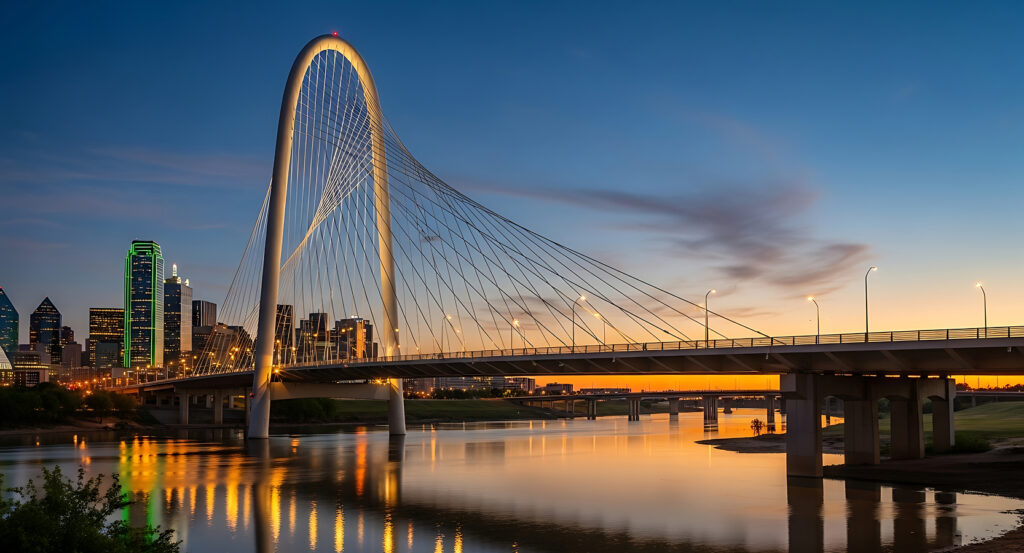
Perfect weekend in Dallas, Texas.
Dallas developed from a nineteenth-century trading settlement on the North Texas prairie into one of America's foremost centers of commerce, finance, and technological enterprise. Located along the Trinity River, the city occupies a landscape of rolling grasslands, limestone formations, and wooded waterways that historically connected Indigenous communities across the southern Great Plains. The region formed part of the territories traversed by Caddo, Wichita, Comanche, and other Indigenous peoples before Anglo-American settlement expanded into North Texas. John Neely Bryan established a trading post near the Trinity River in 1841, selecting a location associated with established transportation routes and prospective commercial opportunities. Dallas County was created in 1846, and the settlement developed into an agricultural trading center serving the surrounding cotton-producing region. The arrival of the Houston and Texas Central Railroad in 1872 and the Texas and Pacific Railway in 1873 transformed Dallas into a major distribution center, attracting merchants, manufacturers, and financial institutions. Cotton commerce supported the expansion of warehouses, banks, and commercial buildings during the late nineteenth century. The establishment of the Federal Reserve Bank of Dallas in 1914 strengthened the city's financial importance, and the discovery of major East Texas oil deposits in 1930 accelerated investment in petroleum-related businesses. Dallas subsequently became a center of corporate headquarters, insurance enterprises, and commercial banking. During the twentieth century, aviation manufacturing and electronics contributed to industrial diversification, with Texas Instruments, founded in 1930 as Geophysical Service Incorporated, becoming a prominent force in semiconductor development. The integrated circuit work of Jack Kilby at Texas Instruments in 1958 helped establish North Texas as an important center of American technological innovation. The expansion of Dallas/Fort Worth International Airport, which opened in 1974, further strengthened regional transportation and commercial relationships. Dallas entered the twenty-first century as a metropolitan center whose economic foundations encompass telecommunications, financial services, technology, healthcare, and international trade.
Texan musical history acquired an influential urban center in Dallas, where blues, country, jazz, and contemporary performance traditions developed alongside the commercial expansion of North Texas. Blind Lemon Jefferson performed in the city's African American entertainment districts during the early twentieth century, becoming one of the most consequential figures in the development of recorded country blues. His recordings influenced generations of guitarists and singers, establishing connections between Dallas and the foundations of American popular music. The city's performing arts institutions expanded through private philanthropy and civic investment, with the Dallas Symphony Orchestra tracing its origins to 1900. The Morton H. Meyerson Symphony Center, designed by I. M. Pei and completed in 1989, became a major architectural achievement associated with the city's classical music culture. The Nasher Sculpture Center, designed by Renzo Piano and opened in 2003, developed an internationally significant collection of modern and contemporary sculpture, including works by Auguste Rodin, Pablo Picasso, and Henry Moore. The Meadows Museum at Southern Methodist University established one of the foremost collections of Spanish art outside Spain, encompassing works by El Greco, Diego Velázquez, Francisco Goya, and Joaquín Sorolla. Dallas's literary connections include playwright and screenwriter Horton Foote, whose work explored family relationships and social change in Texas communities. The city's culinary foundations developed through cattle ranching, cotton agriculture, and the cooking traditions of Mexican American, African American, and European immigrant communities. Texas barbecue became closely associated with slow-smoked brisket, beef ribs, and sausages, supported by the state's longstanding ranching economy. Tex-Mex cooking contributed enchiladas, fajitas, tamales, and chile con queso, with restaurants throughout Dallas developing regional variations over successive generations. Southern traditions involving fried chicken, cornbread, collard greens, and pecan desserts retained strong connections to the agricultural communities of North Texas. German and Czech immigrant influences contributed smoked meats, sausages, and baked goods to the wider regional food culture. Dallas's contemporary dining establishments extend these foundations through seasonal Texas produce, Gulf seafood, international culinary techniques, and ambitious interpretations of regional cooking. A weekend in Dallas connects the commercial ambitions of the American Southwest with a substantial legacy of blues music, modern sculpture, historic residential communities, and the enduring food traditions of Texas.
Three day itinerary.
Day 1: Reunion Tower
Reunion Tower is best known for giving the Dallas skyline a distinctive geodesic sphere elevated above the western edge of downtown. Architect Welton Becket designed the 561-foot structure as part of the original Hyatt Regency Dallas development, which opened in 1978 beside the historic rail corridor. Three concrete shafts support the spherical upper structure, with the central core containing elevators and stairs and the outer shafts contributing structural support. A network of aluminum struts forms the sphere, whose exterior lighting turned its geometric pattern into a defining nighttime feature. Reunion Tower subsequently became one of Dallas's most recognizable works of late twentieth-century architecture and a visual marker of the city's rapid metropolitan growth.
Day 1: Lucia
Lucia is best known for David and Jennifer Uygur's intimate interpretation of Italian cooking in Dallas's Bishop Arts District. David Uygur developed his craft through professional kitchens before the couple opened Lucia in 2010, building the restaurant around handmade pasta, house-cured salumi, seasonal produce, and close relationships with regional farmers. Italian techniques provide the foundation for a menu responsive to Texas ingredients and the changing agricultural calendar. The restaurant's deliberately small scale placed extraordinary emphasis on the kitchen, service, and continuity between producers and individual dishes. Lucia became one of the most influential independent restaurants in modern Dallas dining, helping establish Bishop Arts as a serious culinary district and demonstrating the city's appetite for highly personal chef-owned restaurants.
Day 2: Dealey Plaza
Dealey Plaza is best known as the site of President John F. Kennedy's assassination on November 22, 1963, an event that permanently embedded the western edge of Downtown within American history. The plaza originated as a civic gateway created where several downtown streets converge near the Trinity River corridor and was named for newspaper publisher George Bannerman Dealey. Kennedy's presidential motorcade entered the plaza after traveling through downtown, passing the Texas School Book Depository before gunfire struck the president on Elm Street. Lee Harvey Oswald was subsequently accused of firing from the building's sixth floor. The surviving streets, grassy areas, railroad structures, and former depository preserve the physical geography of one of the most intensively examined events of the twentieth century.
Day 2: Sachet
Sachet is best known for its sophisticated coastal Mediterranean cuisine and its influential contribution to Dallas's contemporary dining culture. Established in 2017 by husband-and-wife restaurateurs Stephen Rogers and Allison Yoder, the restaurant emerged from the culinary partnership behind Gemma, introducing an ambitious exploration of the gastronomic traditions of Southern Europe, North Africa, and the eastern Mediterranean. Rogers developed his culinary approach through extensive professional experience in California, incorporating classical European techniques, seasonal ingredients, and the distinctive flavors of Mediterranean coastal cooking. The kitchen draws inspiration from Morocco, Syria, Spain, Italy, and France, emphasizing carefully prepared seafood, grilled meats, fresh vegetables, aromatic herbs, and traditional regional ingredients. Signature preparations include octopus with freekeh and lamb with gigante beans, reflecting the restaurant's concentration on Mediterranean culinary traditions and sophisticated ingredient combinations. Its extensive wine program earned national recognition, including a James Beard Award semifinalist distinction for Outstanding Wine Program in 2022, reinforcing the restaurant's reputation for exceptional European and Mediterranean selections. The dining room incorporates warm natural materials, contemporary furnishings, and an elegant architectural composition influenced by the coastal environments of Southern Europe. Sachet represents an important achievement in Dallas gastronomy through its accomplished culinary leadership, exceptional wine program, and distinctive interpretation of Mediterranean regional cuisine.
Day 2: Dallas Arts District
Dallas Arts District is best known for concentrating major cultural institutions and works by internationally consequential architects within a compact section of downtown. The district's development accelerated after Dallas leaders pursued a centralized cultural campus during the late twentieth century. Edward Larrabee Barnes designed the Dallas Museum of Art, and I. M. Pei created the geometric Morton H. Meyerson Symphony Center for the Dallas Symphony Orchestra. Renzo Piano subsequently designed the Nasher Sculpture Center, integrating galleries with a landscaped sculpture garden. Foster + Partners and OMA added major performing-arts buildings as the district expanded. The resulting concentration of museums, performance halls, public art, and modern architecture made the district one of the most ambitious American civic investments in cultural infrastructure.
Day 2: Tatsu Dallas
Tatsu Dallas is best known for Tatsuya Sekiguchi's highly disciplined expression of Edomae sushi within an intimate Deep Ellum dining room. Sekiguchi represents a family lineage of sushi chefs and developed his craft through years of training in Japan and the United States. His omakase centers on carefully sourced seafood, meticulously prepared rice, precise knife work, aging, curing, marination, and other techniques associated with the Edo tradition. Individual pieces emerge from decisions about temperature, texture, seasoning, and maturation that treat sushi as a complete preparation rather than an assembly of raw fish and rice. MICHELIN recognition placed Tatsu among Dallas's most distinguished restaurants and gave traditional Japanese sushi craftsmanship a prominent position within the city's contemporary dining culture.
Day 3: Written by the Seasons
Written by the Seasons is best known for its seasonal American cuisine and its ingredient-driven approach to contemporary Dallas gastronomy. Established by restaurateurs Brenton and Jessica Phillips, the restaurant developed a culinary character centered on the agricultural rhythms of Texas and the changing availability of regional produce. Its kitchen emphasizes carefully sourced vegetables, fresh seafood, premium meats, and preparations that highlight the natural character of seasonal ingredients. The menu evolves throughout the year, incorporating contemporary American techniques and Mediterranean influences into compositions shaped by freshness, texture, and balanced flavors. Wood-fired preparations contribute distinctive roasted characteristics to vegetables and proteins, reinforcing the restaurant's concentration on elemental cooking methods. Its dining environment combines natural materials, warm architectural details, and a sophisticated neighborhood atmosphere that reflects the independent restaurant culture of Dallas's Bishop Arts District. The restaurant's approach connects contemporary hospitality with the agricultural diversity of North Texas, emphasizing the relationship between regional producers and accomplished culinary craftsmanship. Written by the Seasons represents a distinguished expression of modern Dallas dining through its commitment to seasonal ingredients, thoughtful culinary execution, and independent neighborhood hospitality.
Day 3: The Dallas Arboretum and Botanical Garden
The Dallas Arboretum and Botanical Garden is best known for transforming historic estates along White Rock Lake into one of the major horticultural institutions of North Texas. The garden occupies land associated with the former estates of geophysicist Everette Lee DeGolyer and oilman Alex Camp, whose properties eventually became part of the public botanical complex. DeGolyer's Spanish Colonial Revival residence anchors an extensive landscape of formal gardens, lawns, fountains, seasonal displays, and specialized plant collections. Development across the grounds created environments responsive to North Texas climate conditions and horticultural traditions. The arboretum's position above White Rock Lake joins cultivated landscapes to one of Dallas's most important bodies of water, preserving a substantial green environment within the metropolitan city.
Day 3: Klyde Warren Park
Klyde Warren Park is best known for reconnecting Central Dallas neighborhoods through a public landscape constructed directly above the Woodall Rodgers Freeway. The highway had created a physical divide between downtown and Uptown after its construction, leaving a major transportation trench through the urban core. Landscape architecture firm OJB designed a deck park spanning the roadway, using structural infrastructure capable of supporting lawns, trees, gardens, paths, gathering spaces, and programming above active traffic lanes. The park opened in 2012 and created a direct pedestrian connection between the Dallas Arts District and neighborhoods to the north. Its success made Klyde Warren Park an influential American example of using engineered public space to repair urban divisions created by twentieth-century highway construction.
Day 3: The Mansion Restaurant
The Mansion Restaurant is best known for helping establish modern Southwestern cuisine within one of Dallas's most historically significant luxury properties. The restaurant occupies the former Sheppard King mansion, an early twentieth-century residence whose transformation into Rosewood Mansion on Turtle Creek created a new model for luxury hospitality in the city. Chef Dean Fearing led the kitchen for more than two decades and developed an influential cuisine combining classical technique with Texas ingredients, Southwestern chiles, game, seafood, and regional flavors. Generations of chefs subsequently extended the restaurant's culinary character through changing interpretations of contemporary American cooking. The Mansion's longevity connects Dallas fine dining to the period when Texas regional cuisine first gained sustained national attention.
Where your story begins.
Foresyte Travel reveals places that feel extraordinary long before you arrive.
Enjoy editorial crafted for luxury travelers.
Foresyte may earn a commission when you book.







































































































