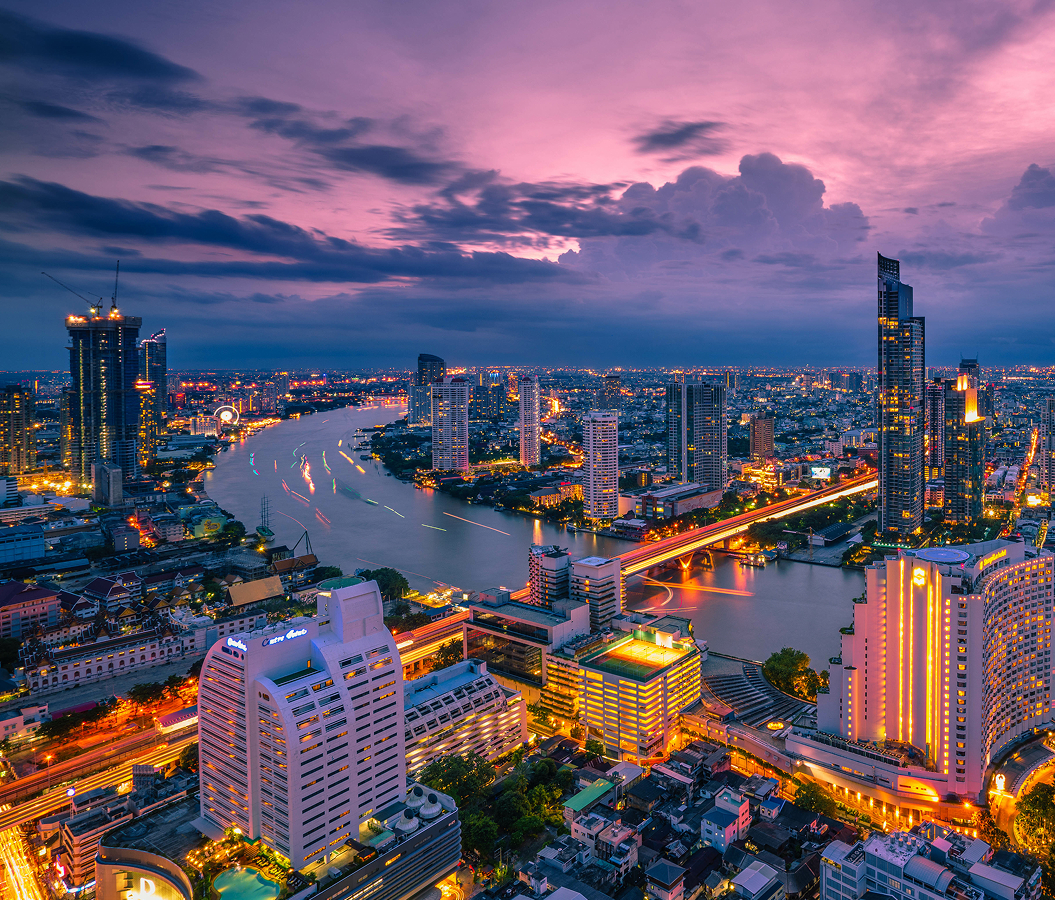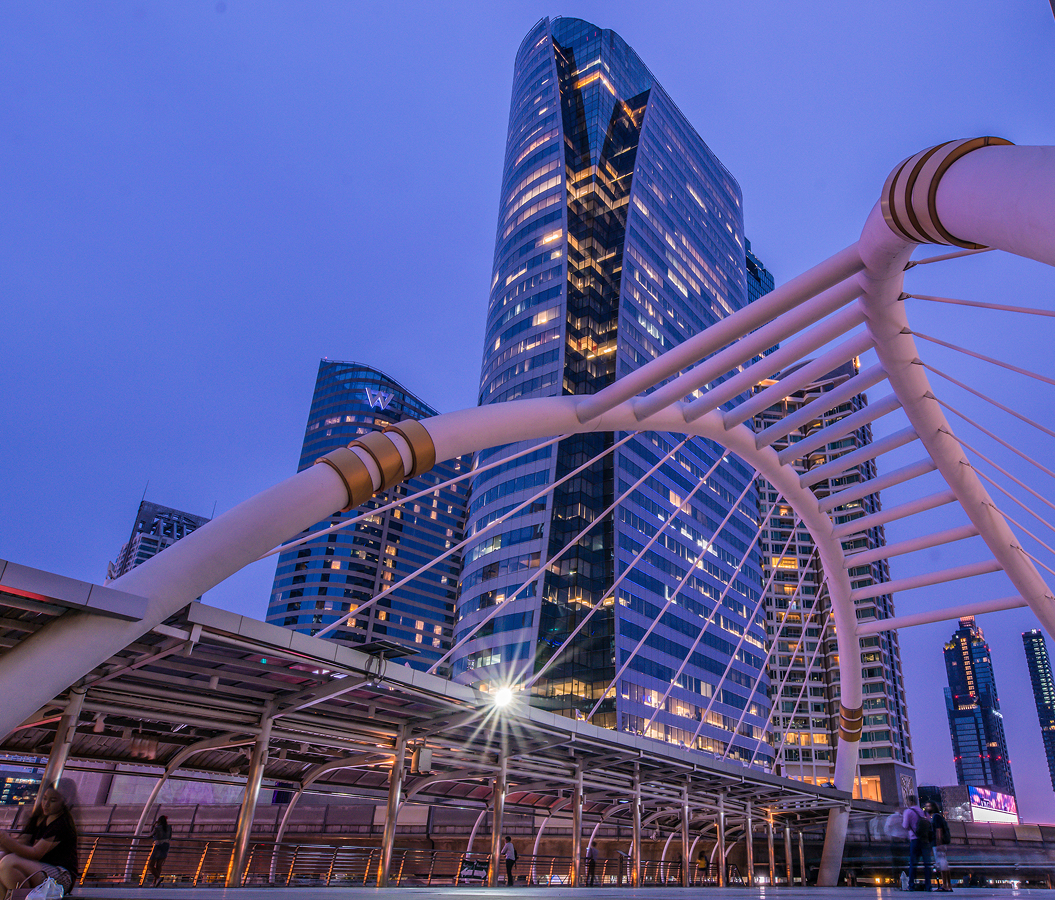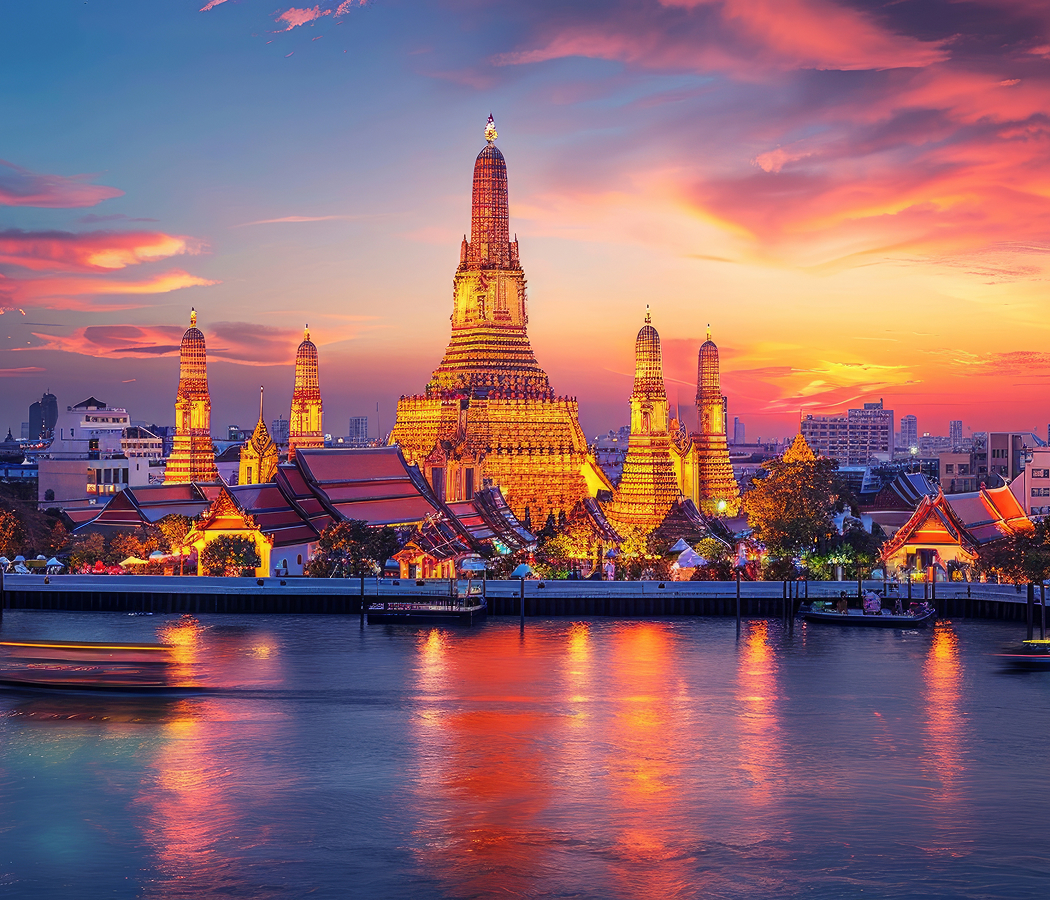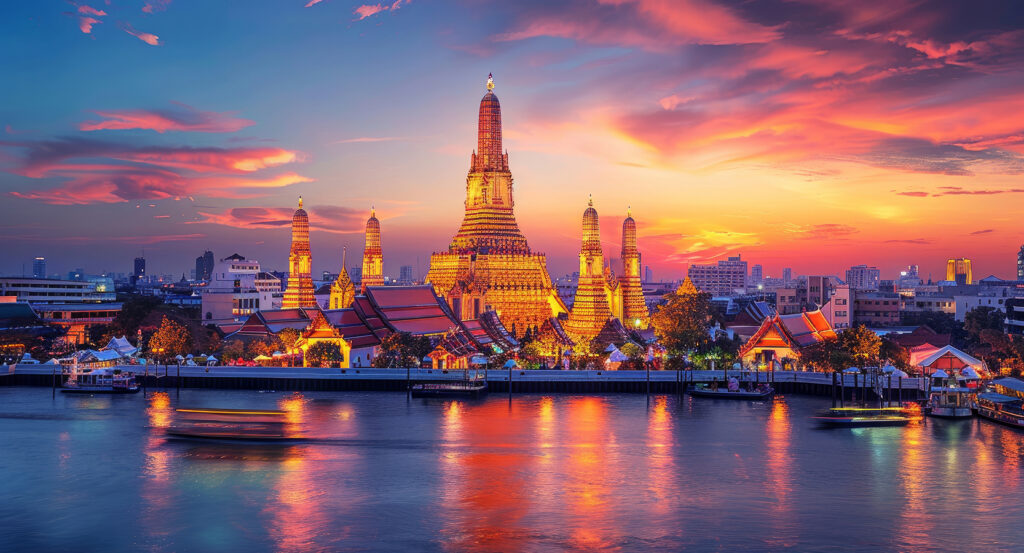
Perfect weekend in Bangkok, Thailand.
Bangkok became the capital of Siam in 1782, when King Rama I established a new royal center on the eastern bank of the Chao Phraya River, beginning an era of political consolidation, commercial expansion, and architectural patronage that reshaped mainland Southeast Asia. The surrounding river basin had supported agricultural settlements and trading communities for centuries, with canals connecting fertile floodplains to the Gulf of Thailand. During the Ayutthaya Kingdom, the area served as a strategic customs and military outpost along the principal waterway leading to the royal capital. Following the destruction of Ayutthaya by Burmese forces in 1767, King Taksin established a new capital at Thonburi on the western bank of the river. His successor, Rama I, transferred the royal center across the water and founded the Chakri dynasty, initiating the construction of ceremonial institutions and defensive waterways around the new capital of Rattanakosin. Chinese merchants played a central role in Bangkok's early commercial prosperity, developing trading relationships that connected Siamese agricultural production with markets throughout East and Southeast Asia. During the nineteenth century, Kings Mongkut and Chulalongkorn pursued diplomatic and administrative reforms that strengthened Siam's independence amid European colonial expansion. The Bowring Treaty of 1855 accelerated international commerce, encouraging rice exports and the growth of foreign trading enterprises. King Chulalongkorn subsequently expanded government institutions, introduced modern transportation infrastructure, and commissioned public buildings influenced by European architectural traditions. The establishment of constitutional monarchy in 1932 transformed the country's political system, followed by the official adoption of the name Thailand in 1939. Postwar industrialization brought substantial migration from rural provinces, accelerating metropolitan growth and the construction of roads, commercial buildings, and residential districts. Bangkok subsequently developed into Thailand's principal center of finance, education, publishing, and international commerce, retaining the waterways and royal institutions that shaped its historical development.
Thai Buddhist artistic patronage reached extraordinary refinement in Bangkok, where royal workshops and religious institutions cultivated traditions of mural painting, sculpture, manuscript illumination, and decorative craftsmanship. The Chakri monarchs commissioned extensive religious artwork, supporting generations of artisans specializing in gilded ornamentation, lacquerwork, woodcarving, and intricate architectural decoration. Wat Suthat, constructed during the nineteenth century, contains elaborate murals depicting Buddhist teachings and cosmological traditions, alongside grand religious sculpture associated with the artistic ambitions of the early Bangkok period. The National Museum Bangkok preserves collections encompassing prehistoric objects, royal ceremonial artifacts, Buddhist sculpture, and decorative arts from successive periods of Thai history. Bangkok's literary traditions include the poetry and dramatic works of Sunthorn Phu, whose nineteenth-century compositions contributed to the development of classical Thai literature. His epic poem Phra Aphai Mani became one of the country's most celebrated literary works, combining romantic adventure with supernatural themes and elaborate poetic composition. Traditional Thai performing arts developed through royal patronage, particularly khon, a masked dance-drama associated with episodes from the Ramakien, Thailand's adaptation of the Indian Ramayana. Elaborate costumes, stylized gestures, and orchestral accompaniment distinguish performances that preserve centuries of theatrical craftsmanship. Bangkok's culinary traditions developed through the agricultural abundance of the Chao Phraya basin, royal court cooking, Chinese migration, and regional exchanges throughout mainland Southeast Asia. Central Thai cuisine emphasizes aromatic herbs, coconut milk, freshwater fish, fermented seasonings, and carefully balanced combinations of sour, salty, sweet, and spicy flavors. Traditional preparations include tom yum goong, a fragrant shrimp soup seasoned with lemongrass, galangal, lime leaves, and chilies, and gaeng khiao wan, a green curry combining coconut milk, fresh herbs, and aromatic curry paste. Chinese Thai communities contributed noodle dishes, roasted meats, and wok-based cooking techniques that became integral to Bangkok's street food culture. Pad thai acquired national prominence during the twentieth century, combining stir-fried rice noodles with tamarind, fish sauce, eggs, and accompanying garnishes. Royal Thai cuisine contributed elaborate vegetable carving, refined presentation, and carefully prepared dishes associated with ceremonial dining. Contemporary Bangkok restaurants extend these foundations through regional Thai ingredients, historical recipes, and ambitious interpretations of traditional cooking. A weekend in Bangkok unfolds through the ceremonial achievements of the Chakri dynasty, the commercial traditions of its riverside communities, and a culinary culture shaped by centuries of royal patronage and regional exchange.
Three day itinerary.
Day 1: Asiatique The Riverfront
Asiatique The Riverfront is best known for transforming former East Asiatic Company docks into a major contemporary riverfront district on the Chao Phraya. The site developed during the expansion of trade between Siam and Denmark, when the Danish company used the waterfront for the export of teak and other commodities. Warehouses and port infrastructure subsequently preserved a physical record of Bangkok's emergence as an internationally connected trading city. Commercial port operations ended in the twentieth century, leaving the industrial complex available for eventual redevelopment. The restored district opened as Asiatique in 2012, adapting historic warehouse architecture to retail, dining, entertainment, and public riverfront space and returning a substantial stretch of the former commercial waterfront to intensive public use.
Day 1: Sorn
Sorn is best known for Supaksorn Jongsiri's elevation of southern Thai cooking through extraordinary regional specificity and technical refinement. Jongsiri built the restaurant around culinary traditions rooted in southern Thailand, drawing heavily on family knowledge, regional ingredients, seafood, spices, coconut, and the intense flavor structures associated with the peninsula. The kitchen developed direct relationships with producers and fishing communities as it expanded the style of southern Thai cuisine within a fine-dining format. Preparations move across multiple provinces and culinary traditions, treating the south as a complex collection of distinct food cultures. MICHELIN awarded Sorn three stars, placing Jongsiri's deeply regional Thai cooking at the highest level of international restaurant recognition.
Day 2: The Grand Palace
The Grand Palace is best known for embodying the establishment of Bangkok as the capital of the Chakri dynasty. King Rama I transferred the capital to the eastern bank of the Chao Phraya in 1782 and ordered construction of a new royal palace modeled in function on the former royal complex at Ayutthaya. The grounds combined royal residences, throne halls, administrative buildings, defensive walls, and Wat Phra Kaew, establishing an architectural center for monarchy, government, and religion within the new capital. The Emerald Buddha was installed inside Wat Phra Kaew as one of the kingdom's most sacred religious objects. Successive monarchs expanded and altered the complex, leaving an extraordinary concentration of Thai architectural forms tied directly to the political and ceremonial development of modern Bangkok.
Day 2: Nusara
Nusara is best known for Thitid “Ton” Tassanakajohn's contemporary interpretation of Thai cuisine through recipes, memories, and techniques connected to his grandmother. Tassanakajohn developed the restaurant as an intimate counterpart to his broader culinary work in Bangkok, naming it for the family figure whose cooking helped shape his understanding of Thai food. The kitchen builds elaborate tasting sequences from regional relishes, curries, seafood, vegetables, grilled preparations, and deeply concentrated sauces, treating familiar Thai flavor structures with fine-dining precision. Its dining room overlooks Wat Pho, connecting contemporary Thai gastronomy directly to the architectural landscape of historic Rattanakosin. MICHELIN awarded Nusara a star in the 2026 Thailand guide, extending Tassanakajohn's influence across multiple major Bangkok restaurants.
Day 2: Wat Pho
Wat Pho is best known for joining royal Buddhist architecture with one of Thailand's great historical repositories of art, medicine, education, and traditional knowledge. King Rama I began a major reconstruction of the older Wat Phodharam in 1788 after establishing Bangkok as the new Chakri capital. King Rama III subsequently directed an immense expansion lasting more than sixteen years, enlarging the monastery and developing it as a center for knowledge accessible beyond the royal court. Inscriptions and demonstrated teachings covering medicine, massage, literature, religion, and other disciplines were installed throughout the complex. The immense Reclining Buddha became its most celebrated individual work, and the monastery's continuing association with traditional Thai massage grew directly from its educational history.
Day 2: Baan Tepa
Baan Tepa is best known for Chudaree “Tam” Debhakam's transformation of her family property into a restaurant examining Thai ingredients, agriculture, and culinary heritage. Debhakam trained at the Culinary Institute of America and worked under Dan Barber at Blue Hill at Stone Barns, developing an intensive interest in the relationship between kitchens and agricultural systems. She returned to Bangkok and established Baan Tepa within her family's multigenerational home, surrounding the restaurant with gardens and spaces devoted to food education. The kitchen builds contemporary Thai cooking from close relationships with farmers, fishermen, artisans, and regional producers across the country. Two MICHELIN stars and a MICHELIN Green Star established Baan Tepa as one of Thailand's most consequential intersections of fine dining, local sourcing, and environmental responsibility.
Day 3: Restaurant POTONG
Restaurant POTONG is best known for Pichaya “Pam” Soontornyanakij's transformation of her family's historic Chinatown property into an exploration of Thai-Chinese culinary inheritance. The building had housed the family's traditional Chinese medicine business for generations, giving the restaurant a direct physical connection to Bangkok's long history of Chinese migration, commerce, and cultural exchange. Soontornyanakij trained at the Culinary Institute of America and worked at Jean-Georges in New York before returning to Bangkok. Her cooking draws on Chinese techniques, Thai ingredients, fermentation, preservation, and family memory within elaborate contemporary compositions. MICHELIN recognition placed Potong among Bangkok's leading restaurants and made the restored family building an important expression of Yaowarat's evolving Thai-Chinese culture.
Day 3: Chatuchak Weekend Market
Chatuchak Weekend Market is best known for concentrating thousands of independent merchants into one of Bangkok's most extensive commercial environments. Its lineage reaches into government efforts to establish organized public markets during the twentieth century, with the present Chatuchak site developing beside the city's northern transport corridors. Dense sections devoted to clothing, ceramics, furniture, plants, food, art, antiques, household goods, and specialized collectibles created a commercial structure resembling a city within the city. Generations of small traders and craftspeople turned the market into an important distribution point for Thai-made goods alongside imported merchandise. Its immense scale captures a form of Bangkok commerce grounded in specialization, negotiation, entrepreneurship, and the continual circulation of objects through tightly packed pedestrian streets.
Day 3: Lumpini Park
Lumpini Park is best known for introducing a major public green space into the expanding urban fabric of twentieth-century Bangkok. King Rama VI donated royal land for the project during the 1920s and named the park after Lumbini, the traditional birthplace of the Buddha in present-day Nepal. The grounds initially supported exhibitions and public activities before developing into a landscaped urban park of lawns, lakes, paths, and recreational spaces. Bangkok subsequently expanded dramatically around its perimeter, placing the park between major commercial districts and some of the capital's most intensely developed streets. Its survival created a substantial ecological and recreational interruption within Central Bangkok and preserved a physical connection to an era when the modernizing capital began deliberately creating civic spaces for public use.
Day 3: Gaa
Gaa is best known for Garima Arora's development of contemporary Indian cooking through techniques and ingredients shaped by her career in Bangkok. Born in Mumbai, Arora studied at Le Cordon Bleu in Paris and worked with Gordon Ramsay, René Redzepi, and Gaggan Anand before establishing Gaa. Her cooking examines Indian culinary traditions through fermentation, grilling, pickling, regional ingredients, and close engagement with Thai produce, creating a restaurant rooted simultaneously in India and Southeast Asia. Arora became the first Indian woman to receive a MICHELIN star, expanding her influence far beyond Bangkok. MICHELIN subsequently awarded Gaa two stars, placing her among the most consequential Indian chefs working internationally and establishing Bangkok as an important center for the continuing evolution of Indian fine dining.
Where your story begins.
Foresyte Travel reveals places that feel extraordinary long before you arrive.
Enjoy editorial crafted for luxury travelers.
Foresyte may earn a commission when you book.