Perfect weekend in Dublin, Ireland.
Dublin is a city where Georgian streets, literary heritage, lively pubs, and centuries of Irish history come together along the banks of the River Liffey.
Begin the mornings strolling the cobbled courtyards of Trinity College Dublin, where the historic campus gradually awakens before continuing to admire the Book of Kells and the grand Long Room of the Old Library. Wander through the elegant squares of Georgian Dublin, cross the bridges spanning the River Liffey, or explore the cafés, galleries, and independent shops woven throughout the city center. By late morning, Dublin's remarkable character unfolds through the exhibits of the EPIC The Irish Emigration Museum, the medieval halls of Dublin Castle, the grandeur of St. Patrick's Cathedral, and the energetic streets of Temple Bar, while neighborhoods like St. Stephen's Green and Grafton Street reveal another side of the Irish capital's culture, architecture, and daily life. Spend afternoons exploring the Guinness Storehouse, touring the historic grounds of Kilmainham Gaol, relaxing beneath the trees of Phoenix Park, or discovering the boutiques, bookstores, and music venues that have shaped Dublin's enduring literary and artistic traditions.
As evenings approach, Dublin settles into the warm rhythm that has made the city famous around the world. Traditional pubs, contemporary restaurants, and intimate music venues fill with conversation as Irish stew, fresh seafood, artisan cheeses, and perfectly poured pints accompany live folk music and storytelling. After dark, the lively streets of Temple Bar, the welcoming pubs surrounding Grafton Street, and the illuminated quays along the River Liffey reveal another unforgettable side of the Irish capital. Between the scholarly legacy of Trinity College Dublin, the historic grandeur of Dublin Castle, the expansive landscapes of Phoenix Park, and the unmistakable atmosphere of Temple Bar, Dublin rewards every visit with another unforgettable expression of Ireland.
Three day itinerary.
Day 1: Ha'penny Bridge
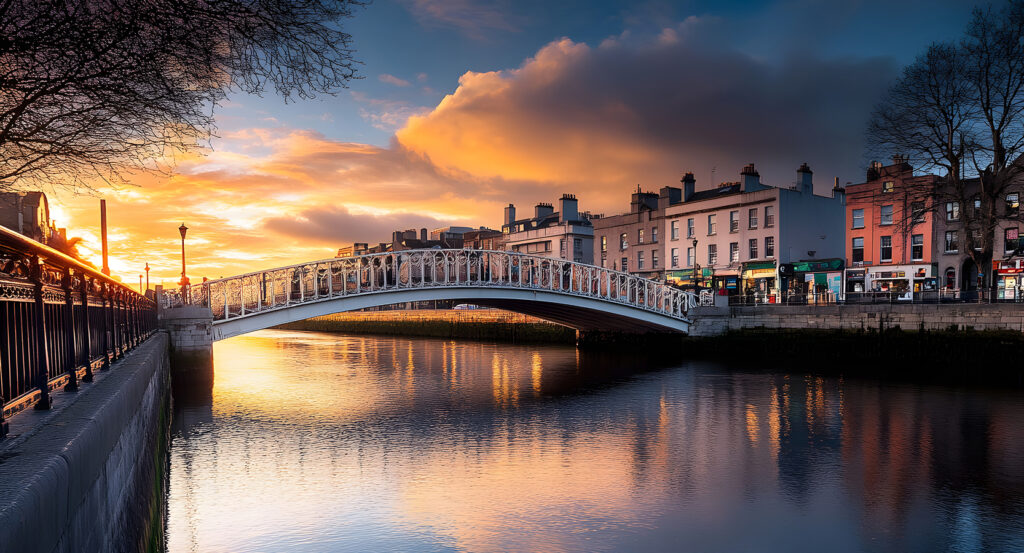
Ha'penny Bridge is best known for creating Dublin's first dedicated pedestrian crossing of the River Liffey through an elegant cast-iron structure opened in 1816. William Walsh commissioned the bridge after operating ferries across the river, replacing that service with a permanent connection between the north and south quays. The Coalbrookdale foundry in Shropshire produced its ironwork, forming a shallow arch whose light construction contrasted with the heavier masonry bridges elsewhere on the Liffey. Pedestrians originally paid a halfpenny toll to cross, giving the officially named Liffey Bridge its enduring popular identity. The structure survived the profound transformation of the surrounding quays as Dublin evolved from a Georgian capital into a modern city. Its compact span preserves an unusually intimate piece of nineteenth-century engineering at the center of Dublin.
Day 1: Chapter One
Chapter One is best known for Mickael Viljanen's sophisticated contemporary cooking within one of Dublin's most consequential fine-dining institutions. The restaurant began on Parnell Square in 1992, establishing a destination dining room beneath the Dublin Writers Museum before Viljanen assumed culinary leadership in 2021. His arrival followed an acclaimed tenure at The Greenhouse and introduced a highly technical approach built around complex sauces, precise construction, luxury products, and exceptional Irish ingredients. Viljanen rapidly carried the restaurant to two MICHELIN stars, placing it at the summit of dining in the Irish capital. The result joins three decades of institutional history with the work of a chef who materially elevated Dublin's international culinary standing.
Day 2: Trinity College
Trinity College is best known for anchoring Irish scholarship in Central Dublin through an institution founded by Elizabeth I in 1592. Established on the former grounds of the Augustinian Priory of All Hallows, the university developed into Ireland's foremost academic institution across more than four centuries of political and intellectual change. Monumental buildings accumulated around Parliament Square and Library Square as the college expanded within the growing city. The Old Library houses the Book of Kells, whose elaborately illuminated pages survive as masterpieces of early medieval Insular art. Jonathan Swift, Oscar Wilde, Samuel Beckett, and physicist Ernest Walton number among the figures connected with Trinity's extraordinary intellectual history. The college unites scholarship, literature, science, architecture, and manuscript culture within one of Dublin's defining historic precincts.
Day 2: D'Olier Street
D'Olier Street Restaurant is best known for James Moore's technically intricate contemporary cuisine inside a restored Victorian building opposite Trinity College. The restaurant entered Dublin's dining landscape in late 2022 and reached MICHELIN-starred status less than two years later. Moore's international career informs a surprise tasting menu that draws freely across global techniques, exceptional products, elaborate preparations, and highly detailed presentation. Original plasterwork and high ceilings retain the architectural character of D'Olier Chambers, giving the modern dining room a tangible connection to nineteenth-century commercial Dublin. Counter seating places the kitchen's precision directly within view, reinforcing the craftsmanship underlying the restaurant's rapid ascent into the city's culinary elite.
Day 2: Kilmainham Gaol
Kilmainham Gaol is best known for concentrating the history of Irish nationalism, rebellion, imprisonment, and revolution within an eighteenth-century prison. The gaol opened in 1796 under changing ideas about incarceration and institutional control. Political prisoners entered its cells during successive uprisings against British rule, connecting the building with the rebellions of 1798, 1803, 1848, and 1867. Leaders of the 1916 Easter Rising were imprisoned and executed there, including Patrick Pearse, James Connolly, and Joseph Plunkett. Those executions transformed public attitudes toward the rebellion and gave Kilmainham an enduring place in the political history preceding Irish independence. Éamon de Valera became its final prisoner before closure in 1924, completing the prison's extraordinary passage from instrument of British administration to monument of Irish revolutionary history.
Day 2: Variety Jones
Variety Jones is best known for Keelan Higgs's highly individual cooking in The Liberties, among Dublin's oldest urban districts. Higgs opened the restaurant with his brother Aaron in 2018 and built its character around a compact chef's-choice menu whose courses change with available products and culinary inspiration. Direct fire plays a central role in the kitchen, giving seafood, vegetables, and meat variable textures and flavors produced through live cooking. Fermentation and concentrated preparations deepen a style grounded in generosity and forceful flavor. MICHELIN-starred recognition established the restaurant among the independent dining rooms that reshaped Dublin's culinary hierarchy, giving The Liberties a destination whose character remains closely tied to its chef-owner.
Day 3: Alma
Alma is best known for bringing Argentine flavors into a dedicated Dublin breakfast and brunch format built around Irish produce. The family behind the Portobello café moved from Argentina to Ireland and constructed its seasonal menu around the culinary connection between those two countries. Dulce de leche, chimichurri, salsa criolla, Argentine-style sausage, eggs, sourdough, local dairy, vegetables, and Dublin-roasted coffee give the daytime kitchen a distinct identity. The café's name combines the initials of the family's four daughters, Anabella, Luciana, Macarena, and Agustina, while also carrying the Spanish word for soul. Its Curzon Street dining room turns the brunch position into a genuine expression of immigrant family history and contemporary Dublin food culture.
Day 3: St. Patrick's Cathedral
St. Patrick's Cathedral is best known for embodying more than eight centuries of Irish religious history on a site traditionally associated with Saint Patrick. Archbishop John Comyn established a church there during the late twelfth century, and substantial Gothic construction followed during the thirteenth century as Dublin expanded under Anglo-Norman rule. Jonathan Swift served as dean from 1713 until 1745, connecting the cathedral permanently with one of the greatest figures in English-language literature. Swift was buried within the building alongside Esther Johnson, known as Stella. Centuries of structural deterioration prompted a major nineteenth-century restoration financed by Benjamin Lee Guinness of the brewing dynasty. The cathedral unites medieval Christianity, literary Dublin, Victorian philanthropy, and the institutional history of the Church of Ireland.
Day 3: Dublin Castle
Dublin Castle is best known for serving as the principal seat of English and British administration in Ireland for more than seven centuries. King John ordered the construction of a fortified complex during the early thirteenth century, establishing royal authority on elevated ground beside the River Poddle. Medieval defensive structures progressively gave way to Georgian state apartments as the castle evolved from fortress into administrative and ceremonial headquarters. Viceroys governed from the complex, making its chambers central to the institutions through which Britain exercised political authority over Ireland. Following the War of Independence and Anglo-Irish Treaty, Michael Collins accepted the castle's transfer from British authorities in January 1922. Dublin Castle physically records the political transformation from medieval English lordship through British government to an independent Irish state.
Day 3: Restaurant Patrick Guilbaud
Restaurant Patrick Guilbaud is best known for establishing an enduring summit of Irish fine dining through Patrick Guilbaud's French culinary foundations and exceptional Irish ingredients. Guilbaud opened his Dublin restaurant in 1981, beginning a career that profoundly influenced the development of ambitious restaurant cooking in Ireland. The dining room later moved into The Merrion, embedding the institution within the Georgian architecture surrounding Merrion Square. Seafood, meat, vegetables, and meticulously developed sauces enter cooking grounded in French technique and refined across more than four decades. Two MICHELIN stars place Patrick Guilbaud alongside Chapter One at the highest MICHELIN level within Dublin itself, giving the final dinner unusual historical authority as well as contemporary stature.
Where your story begins.
Foresyte Travel reveals places that feel extraordinary long before you arrive.
Enjoy editorial crafted for luxury travelers.
Foresyte may earn a commission when you book.