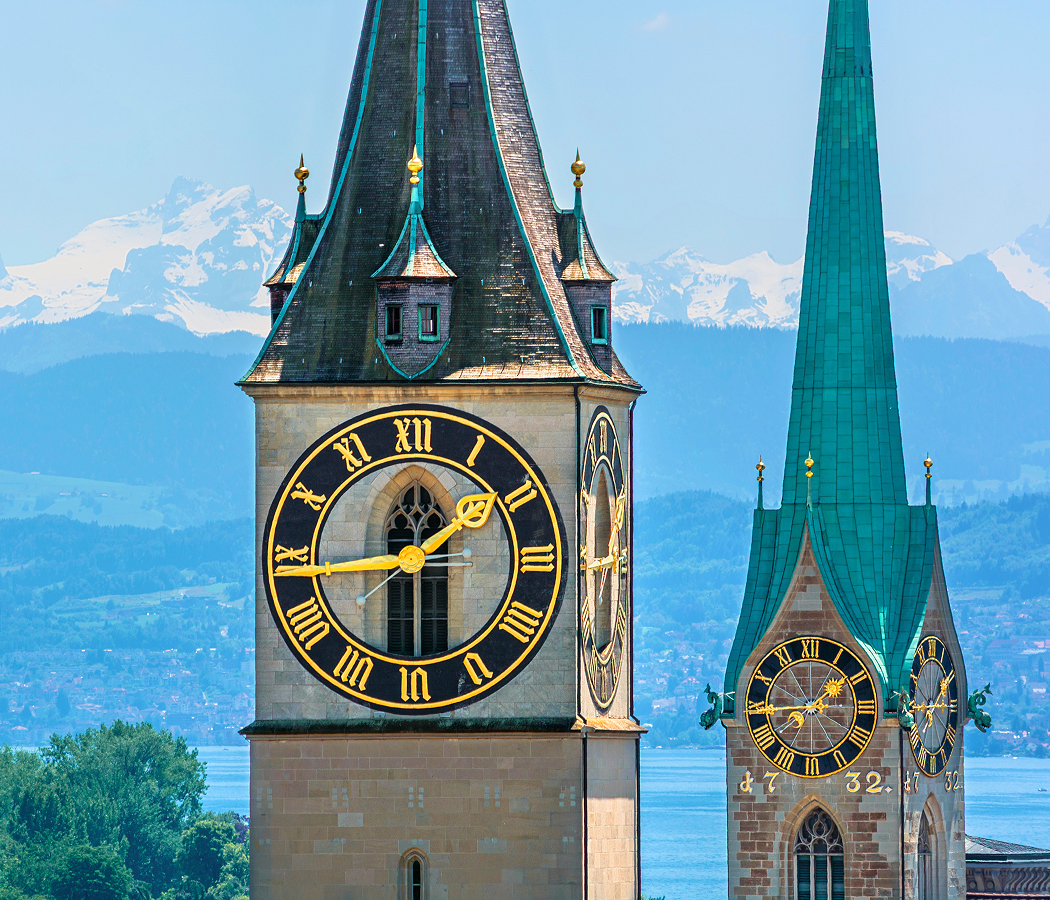
Perfect weekend in Zürich, Switzerland.
Zürich became Switzerland's foremost financial and commercial center through centuries of river trade, medieval independence, religious reform, and industrial enterprise. Situated at the northern end of Lake Zürich, where the Limmat River flows toward the Rhine, the city developed at a natural transportation junction connecting the Swiss Plateau with the Alpine passes and commercial routes of Central Europe. Archaeological discoveries along the lakeshore trace human settlement to Neolithic communities whose timber dwellings and agricultural practices established an early relationship with the surrounding waterways. During the Roman period, Turicum developed as a customs station along the Limmat, collecting duties on goods moving between provincial territories. Following the decline of Roman authority, the settlement passed through successive Alemannic and Frankish political structures before acquiring greater prominence under the medieval German kingdoms. Zürich became an imperial free city in 1218, strengthening its municipal independence and expanding the influence of merchant families and craft guilds. The establishment of guild government in 1336 under Rudolf Brun transformed the city's political institutions, giving organized trades a central role in civic administration. Zürich joined the Swiss Confederation in 1351, securing relationships that strengthened its regional commercial position. During the sixteenth century, Huldrych Zwingli initiated the Protestant Reformation in Zürich, introducing religious and institutional changes that influenced Reformed Christianity throughout Europe. The city subsequently attracted Protestant refugees, skilled artisans, and merchants whose enterprises contributed to its economic development. Textile production became particularly significant during the eighteenth and nineteenth centuries, with silk manufacturing and cotton processing supporting industrial prosperity. The establishment of the Swiss Federal Institute of Technology in 1855 strengthened Zürich's position as a center of scientific education and engineering. Alfred Escher, a prominent political and financial figure, contributed to the development of Swiss railway infrastructure and the institutions that supported industrial investment. Zürich's banking sector expanded through the nineteenth and twentieth centuries, establishing commercial relationships across international markets. The city's subsequent growth in finance, pharmaceuticals, technology, and higher education reinforced its importance within Switzerland's economic and intellectual life.
Swiss intellectual life acquired a particularly influential center in Zürich, where universities, publishing houses, artists, and political exiles contributed to movements that transformed European science and culture. Albert Einstein studied at the Swiss Federal Polytechnic during the 1890s and subsequently returned to Zürich as a professor, strengthening the city's association with theoretical physics and modern scientific inquiry. During the First World War, Zürich became a gathering place for writers and artists displaced by the conflict, contributing to the emergence of Dada in 1916. Hugo Ball and Emmy Hennings established Cabaret Voltaire as a venue for experimental performance, attracting figures including Tristan Tzara, Hans Arp, and Marcel Janco. Their distinctive poetry, visual art, and theatrical experiments challenged established artistic conventions and influenced subsequent avant-garde movements. The Kunsthaus Zürich developed into one of Switzerland's principal art institutions, with collections encompassing Swiss painting, European modernism, and works by artists including Alberto Giacometti and Ferdinand Hodler. Zürich's literary history includes Max Frisch, whose novels and plays explored questions of personal responsibility, political society, and modern European life. The Schauspielhaus Zürich became an important theatrical institution during the twentieth century, providing a platform for German-language drama and attracting writers and performers who opposed National Socialism. Composer Richard Wagner lived in Zürich during his political exile following the revolutions of 1848-1849, developing major artistic ideas that influenced his subsequent operatic compositions. Zürich's culinary traditions developed through the agricultural resources of northeastern Switzerland, the dairy-producing communities of the surrounding countryside, and the commercial prosperity of the city. Zürcher Geschnetzeltes, prepared with sliced veal in a creamy mushroom sauce, became closely associated with local cooking and is traditionally served with rösti. Regional specialties also include Zürcher Eintopf, substantial seasonal stews, and breads prepared through established Swiss baking traditions. Swiss chocolate production acquired international prominence during the nineteenth century, with Zürich confectioners contributing to the refinement of chocolate-making and specialist pastry craftsmanship. The city's historic guild houses preserve connections to traditional dining, and contemporary restaurants extend Swiss culinary foundations through seasonal regional ingredients and techniques drawn from European fine dining. A weekend in Zürich brings the political independence of a medieval Swiss city together with pioneering scientific thought, avant-garde artistic experimentation, and a culinary culture shaped by Alpine agriculture and generations of urban craftsmanship.
Three day itinerary.
Day 1: Bahnhofstrasse
Bahnhofstrasse is best known for transforming the line of Zürich's former western fortifications into one of Europe's most concentrated commercial boulevards. The city demolished its seventeenth-century defenses during the nineteenth century, opening land between Zürich Hauptbahnhof and Lake Zürich for a new urban axis. Bahnhofstrasse developed from that transformation as banks, department stores, jewelers, hotels, and commercial buildings progressively replaced the former defensive landscape. Paradeplatz became especially important through the concentration of major Swiss financial institutions around the intersection. Successive generations of redevelopment turned the street into a physical expression of Zürich's emergence as an international center of banking, luxury commerce, and private wealth.
Day 1: Widder Restaurant
Widder Restaurant is best known for Stefan Heilemann's highly precise contemporary cooking inside one of Zürich's most architecturally complex historic hotels. The Widder Hotel incorporates a group of medieval townhouses in the Altstadt whose surviving structures were consolidated through an extensive late twentieth-century redevelopment. Heilemann brought a culinary career shaped by Harald Wohlfahrt and other major European kitchens to the property, developing cuisine that combines French foundations with pronounced Asian influences. Seafood, concentrated sauces, acidity, spice, and meticulous technical execution became defining elements of his work. Two MICHELIN stars place Widder Restaurant among Zürich's highest-ranked dining rooms, joining contemporary gastronomy to a building complex rooted in centuries of the city's urban history.
Day 2: Grossmünster
Grossmünster is best known for standing at the center of the Swiss Reformation led in Zürich by Huldrych Zwingli. The Romanesque church developed during the medieval period on a site associated by tradition with the city's patron saints Felix and Regula. Zwingli became its people's priest in 1519 and used the pulpit to advance a program of religious reform grounded in direct engagement with scripture. Zürich subsequently removed images, relics, and other elements of medieval Catholic worship as the Reformation transformed the city's religious institutions. The church's theological importance subsequently extended through Heinrich Bullinger, Zwingli's successor and a major architect of the Reformed tradition. Grossmünster occupies a central position in the religious history that carried Zürich's influence far beyond Switzerland.
Day 2: Restaurant Kronenhalle
Restaurant Kronenhalle is best known for uniting traditional Zürich cooking with an extraordinary collection of twentieth-century art. Hulda and Gottlieb Zumsteg assumed control of the restaurant during the twentieth century, and their daughter Gustav Zumsteg subsequently became a defining figure in its cultural life. Writers, artists, musicians, actors, and other intellectual figures gathered in its dining rooms as the restaurant developed into a Zürich institution. Original works by Marc Chagall, Joan Miró, Pierre Bonnard, and other major artists hang throughout spaces devoted to classic dishes including sliced veal with rösti. The restaurant has operated under the Kronenhalle character since 1924, giving Restaurant Kronenhalle an exceptional position at the intersection of Zürich's culinary, artistic, and social history.
Day 2: Lake Zürich
Lake Zürich is best known for shaping the geography, commerce, settlement, and recreational landscape of Switzerland's largest city. The elongated glacial lake extends southeast from Zürich through a densely settled corridor toward Rapperswil and the upper lake beyond the Seedamm. Its waters connect with the Limmat at Zürich, placing the city within a larger hydrological system extending through the region. Steam navigation, railway construction, industrial growth, and expanding lakeside communities transformed the shoreline during the nineteenth and twentieth centuries. Zürich subsequently developed extensive promenades, parks, swimming facilities, marinas, and public spaces along the water. The lake operates as both a defining geographic feature and a central organizing element in the metropolitan landscape.
Day 2: The Restaurant
The Restaurant is best known for Heiko Nieder's expansive approach to contemporary fine dining at The Dolder Grand above Zürich. Nieder assumed culinary leadership after developing his career in Germany and built his cooking around intricate combinations of acidity, bitterness, spice, herbs, aromatics, and concentrated sauces. The restaurant occupies the historic luxury hotel whose elevated position between city and forest has shaped Zürich hospitality since the original Dolder complex emerged in the late nineteenth century. Nieder's menus draw across international culinary traditions and an unusually broad spectrum of ingredients, producing compositions characterized by complexity and exact technical control. Two MICHELIN stars and 19 GaultMillau points place The Restaurant among the leading institutions in Swiss gastronomy.
Day 3: Confiserie Sprüngli
Confiserie Sprüngli is best known for linking Zürich's confectionery tradition to one of Switzerland's most consequential chocolate dynasties. David Sprüngli and his son Rudolf established their confectionery enterprise in Zürich during the nineteenth century, eventually expanding into chocolate production. The family business later divided, with one branch developing into the company that became Lindt & Sprüngli and another continuing the confectionery operation associated with Zürich. Sprüngli established its prominent Paradeplatz presence during the nineteenth century, placing pastries, chocolates, cakes, and café culture at the center of the city's financial district. Luxemburgerli, the company's small filled macarons, subsequently became one of its signature creations. The institution connects contemporary Zürich directly to the entrepreneurial history that helped make Swiss chocolate an internationally recognized industry.
Day 3: Uetliberg
Uetliberg is best known for providing the dominant natural overlook above Zürich and the northern end of Lake Zürich. Rising to 871 meters, the mountain forms part of the Albis chain along the western side of the city and creates a wooded counterpoint to the dense metropolitan basin below. Archaeological evidence of prehistoric settlement gives the summit a human history extending far beyond modern Zürich. Railway construction in the nineteenth century transformed access to the mountain and strengthened its role as a major recreational destination for the growing city. Forest trails and elevated viewpoints subsequently embedded Uetliberg within everyday Zürich life, with the summit revealing the geographic relationship among the city, lake, surrounding hills, and distant Alpine chain.
Day 3: Niederdorf
Niederdorf is best known for preserving the dense medieval street pattern of Zürich's Altstadt along the eastern bank of the Limmat. Narrow lanes, small squares, guild houses, religious buildings, workshops, and residences accumulated across centuries beneath Grossmünster and the surrounding old city. The district's commercial character evolved as crafts and neighborhood businesses gave way to restaurants, cafés, shops, entertainment venues, and cultural institutions. Zürich's intellectual history also penetrated these streets, particularly during the early twentieth century when artists, writers, political exiles, and avant-garde figures made the city a major center of European cultural exchange. Niederdorf preserves the intimate urban scale of premodern Zürich within the commercial and cultural core of the contemporary city.
Day 3: IGNIV Zürich by Andreas Caminada
IGNIV Zürich by Andreas Caminada is best known for translating Andreas Caminada's Swiss fine-dining philosophy into an elaborate shared-table format. Caminada established his reputation at Schloss Schauenstein in Fürstenau before developing IGNIV as a distinct restaurant concept whose name derives from the Romansh word for “nest.” The Zürich restaurant occupies Marktgasse Hotel in the Altstadt, embedding the concept within the historic street fabric near the Limmat. Its menu replaces the conventional sequence of individually plated courses with numerous preparations designed for communal dining, extending Caminada's culinary organization through a deliberately social structure. Two MICHELIN stars place IGNIV Zürich by Andreas Caminada among the city's leading restaurants and connect contemporary Zürich dining to one of Switzerland's most influential culinary figures.
Where your story begins.
Foresyte Travel reveals places that feel extraordinary long before you arrive.
Enjoy editorial crafted for luxury travelers.
Foresyte may earn a commission when you book.