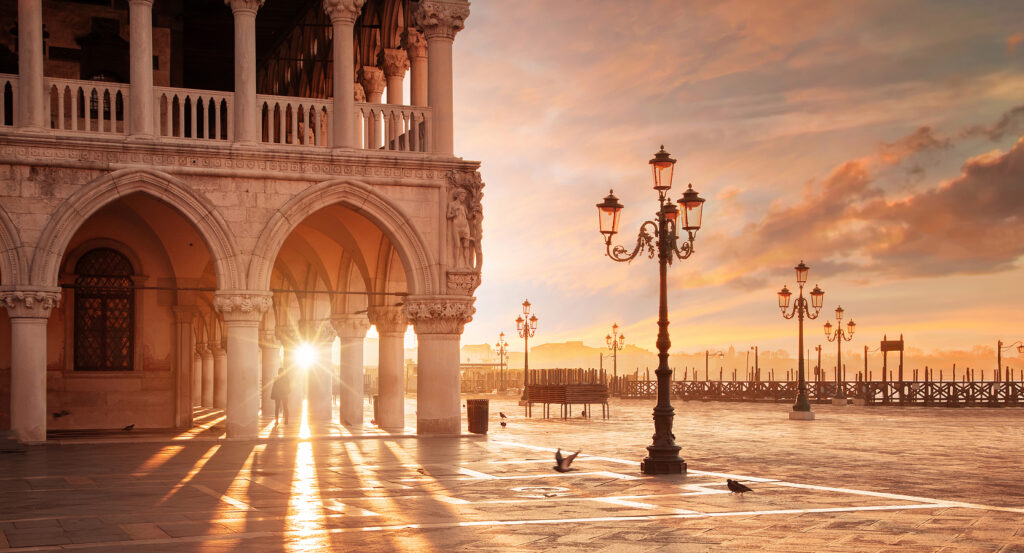
Perfect weekend in Venice, Italy.
Venice's emergence as a maritime republic transformed a collection of settlements in the northern Adriatic lagoon into one of the Mediterranean's most powerful commercial and political centers. Its origins extend to the late Roman and early medieval periods, when communities developed across the lagoon's islands amid the political instability accompanying the decline of Roman authority in northern Italy. Byzantine influence shaped the settlement's earliest institutions, although Venice gradually acquired political autonomy under its elected dukes, known as doges. The transfer of the ducal seat to the Rialto islands in the early ninth century strengthened the foundations of the future republic. Maritime commerce subsequently connected Venetian merchants with Constantinople, Alexandria, and the trading cities of the eastern Mediterranean, generating substantial wealth through shipping, banking, and luxury goods. The Fourth Crusade culminated in the sack of Constantinople in 1204, expanding Venetian commercial privileges and territorial possessions throughout the eastern Mediterranean. During the Renaissance, the republic became an influential patron of architecture, painting, printing, and music, supporting artists and scholars whose work circulated across Europe. Venetian political authority extended into mainland territories and overseas possessions, creating a maritime state sustained by naval power and sophisticated diplomatic institutions. The republic's independence ended in 1797 following Napoleon Bonaparte's invasion, bringing more than a millennium of Venetian self-government to a close. Subsequent Austrian administration and incorporation into the Kingdom of Italy in 1866 introduced new political arrangements, although the city's distinctive relationship with the lagoon continued to shape its architecture, transportation, and commercial traditions.
Venetian culture flourished through the patronage of merchant families, religious confraternities, and civic institutions whose commissions supported generations of painters, composers, architects, and craftsmen. Giovanni Bellini helped establish the Venetian Renaissance painting tradition through his sophisticated treatment of color, light, and religious subjects, influencing subsequent artists including Giorgione and Titian. Tintoretto developed ambitious narrative compositions distinguished by dramatic perspective and complex arrangements of figures, producing extensive decorative cycles for Venetian religious institutions. The Scuola Grande di San Rocco contains one of his most substantial surviving collections, connecting the city's charitable confraternities with the artistic ambitions of the late Renaissance. Venice also became a leading European center of music publishing and opera, with the Teatro San Cassiano opening in 1637 as the first public opera house. Antonio Vivaldi developed his musical career through the Ospedale della Pietà, composing instrumental works that contributed substantially to the international development of Baroque music. The Venice Biennale, founded in 1895, subsequently established an influential international exhibition devoted to contemporary art, later expanding into architecture, cinema, theater, music, and dance. Venetian cuisine developed through the lagoon's fishing traditions, regional agriculture, and commercial connections with the eastern Mediterranean. Specialties including sarde in saor, baccalà mantecato, risotto al nero di seppia, and cicchetti demonstrate the influence of seafood, preserved ingredients, and traditional tavern culture. A perfect weekend in Venice brings together the political inheritance of a maritime republic, Renaissance masterpieces, centuries of craftsmanship, and the distinctive culinary traditions of the Venetian lagoon.
Three day itinerary.
Day 1: Piazza San Marco
Piazza San Marco is best known for serving as the ceremonial and political center of the Venetian Republic across centuries of maritime power. The space developed beside St. Mark's Basilica and the Doge's Palace as Venice concentrated religious authority, government, commerce, and public ritual around the mouth of the Grand Canal. Procuratie buildings progressively enclosed its long sides, housing the officials responsible for administering the immense property holdings of the Basilica of San Marco. State processions, religious ceremonies, diplomatic receptions, festivals, and political spectacles turned the piazza into the principal theater of republican life. Jacopo Sansovino's sixteenth-century interventions, including the Biblioteca Marciana, brought Renaissance classicism into discussion with the Byzantine and Gothic architecture surrounding it. St. Mark's Square became the architectural expression of a republic whose commercial networks and political influence extended throughout the Mediterranean.
Day 1: Ristorante Quadri
Ristorante Quadri is best known for bringing contemporary Italian cooking into one of Venice's historic dining institutions directly on St. Mark's Square. The establishment traces its origins to the eighteenth century, when Giorgio Quadri returned from Corfu and established a coffeehouse beneath the Procuratie Vecchie. Generations of Venetian social life unfolded in the rooms overlooking the piazza before the Alajmo family assumed control of the restaurant in the twenty-first century. Massimiliano Alajmo reshaped its cuisine through modern technique, precise sauces, seafood, vegetables, and ingredients connected to Venice and the surrounding lagoon. Philippe Starck subsequently redesigned the historic interiors in collaboration with Venetian artisans, preserving the rooms' decorative character within a contemporary restoration. Quadri joins centuries of Venetian café culture to one of Italy's most accomplished modern restaurant families.
Day 2: Ponte di Rialto
Ponte di Rialto is best known for carrying Venice's principal historic crossing of the Grand Canal at the commercial center of the republic. Earlier wooden bridges repeatedly occupied the site before the Venetian Senate commissioned a permanent stone replacement during the sixteenth century. Antonio da Ponte won the competition for its design and constructed a single immense arch capable of spanning the canal without obstructing the heavily trafficked waterway below. Two inclined ramps rise toward a central portico, with rows of shops embedded into the bridge as part of its commercial function. The adjoining Rialto markets formed the financial and mercantile heart of Venice, where goods arriving through Mediterranean and European trade networks entered the urban economy. The bridge united engineering, commerce, pedestrian circulation, and maritime transportation at the point where Venice's economic life reached its greatest intensity.
Day 2: Ristorante Wistèria
Ristorante Wistèria is best known for interpreting contemporary Venice through ingredients connected to the lagoon, Adriatic coast, and agricultural landscapes of the Veneto. The restaurant occupies a canal-side position along Rio de la Frescada in San Polo, placing its dining room within the dense urban fabric west of the Grand Canal. Seasonal seafood, vegetables, herbs, preserved products, and regional ingredients structure tasting menus whose culinary geography extends from Venice into its surrounding territory. Fermentation, concentrated broths, precise sauces, and controlled preparations deepen the natural character of individual products. The restaurant's MICHELIN recognition places it within the small group of contemporary kitchens advancing Venetian cuisine beyond inherited forms while maintaining a direct relationship with the environmental systems that historically fed the city.
Day 2: Saint Mark's Basilica
Saint Mark's Basilica is best known for embodying Venice's relationship with Byzantium through architecture, mosaics, relics, and the accumulated wealth of a maritime republic. Venetian merchants brought the relics of Saint Mark from Alexandria in the ninth century, giving the city a patron saint whose authority strengthened its political independence and religious prestige. The present basilica arose during the eleventh century with a Greek-cross plan and five domes profoundly influenced by Byzantine architecture. Centuries of mosaics covered its vaults and domes in gold, transforming biblical narratives into a luminous interior inseparable from Venetian ceremonial culture. Objects arriving through commerce, diplomacy, conquest, and the Fourth Crusade entered the church, including the celebrated bronze horses associated with Constantinople. The basilica became an expansive repository for the religious aspirations, artistic exchanges, and imperial ambitions of the Venetian Republic.
Day 2: Ristorante Glam
Ristorante Glam is best known for joining Enrico Bartolini's contemporary Italian cuisine to the historic Palazzo Venart on the Grand Canal. Bartolini built one of Italy's most consequential modern restaurant groups through cooking grounded in Italian ingredients, technical refinement, concentrated sauces, and carefully controlled tasting-menu experience. The Venice restaurant occupies an intimate garden and palazzo setting in Santa Croce, creating a rare transition from the city's dense calle into a secluded historic residence. Lagoon seafood, vegetables, regional products, and ingredients drawn from broader Italian gastronomy give the kitchen a foundation responsive to Venice without reducing its cooking to traditional repertory. Glam occupies the highest echelon of Venetian fine dining, placing ambitious contemporary Italian cuisine within the domestic architecture and canal geography of the historic city.
Day 3: Caffè Florian
Caffè Florian is best known for preserving more than three centuries of Venetian coffeehouse culture beneath the Procuratie Nuove on St. Mark's Square. Floriano Francesconi opened the establishment in 1720 as Alla Venezia Trionfante, and the café subsequently became known by the proprietor's name. Its rooms attracted aristocrats, merchants, writers, artists, political figures, and international travelers as coffeehouses became important social institutions within eighteenth-century European cities. Casanova belonged to the world surrounding Florian, and later patrons included figures associated with the literary and artistic culture that made Venice a central destination of the Grand Tour. Ornately decorated nineteenth-century rooms transformed the interior into a succession of painted, gilded, and mirrored salons. Florian gives a morning meal exceptional historical weight through an institution inseparable from the social and intellectual life of St. Mark's Square.
Day 3: Doge's Palace
Doge’s Palace is best known for embodying the governmental machinery and extraordinary political longevity of the Venetian Republic in Venetian Gothic architecture. The palace served simultaneously as the doge's residence, seat of governing councils, courthouse, administrative center, and symbol of republican authority. Major rebuilding during the fourteenth and fifteenth centuries produced the extraordinary arcaded facades facing the lagoon and Piazzetta, reversing conventional fortress architecture by placing immense decorated walls above visually delicate stone loggias. Interior chambers accommodated institutions including the Great Council, whose membership represented Venice's hereditary ruling class. Tintoretto's immense Paradise dominates the Great Council Chamber, binding state power to one of the republic's most ambitious artistic commissions. The palace transformed government into architecture, giving Venice a civic complex commensurate with the reach and sophistication of its maritime republic.
Day 3: Grand Canal
Grand Canal is best known for functioning as Venice's principal aquatic thoroughfare and the architectural axis along which the republic's wealth became most visibly concentrated. The reverse-S-shaped waterway follows an ancient channel through the islands on which Venice developed, connecting the lagoon near Santa Lucia with the basin beside St. Mark's Square. Merchant families constructed palaces directly along its banks, turning water access into both commercial infrastructure and a display of dynastic status. Byzantine, Gothic, Renaissance, Baroque, and later buildings accumulated beside the canal as successive generations rebuilt properties according to changing architectural ambitions. Warehouses and fondachi connected domestic space with maritime commerce, allowing goods to move directly between boats and mercantile buildings. The Grand Canal functions as Venice's most complete architectural record of the fortunes generated by trade across the Mediterranean and beyond.
Day 3: Club del Doge
Club del Doge is best known for executive chef Alberto Fol's sophisticated interpretation of Venetian gastronomy within the historic Gritti Palace overlooking the Grand Canal. The restaurant occupies Palazzo Pisani Gritti, a fifteenth-century aristocratic residence associated with Doge Andrea Gritti that became a luxury hotel in 1895. Fol, born in Treviso in 1974 to a family originating in the Dolomites, began his career at the Gritti Palace before developing his culinary expertise at prominent establishments throughout the Veneto. He subsequently became executive chef at the Hotel des Bains on the Lido, directed a forty-person kitchen brigade at the Westin Europa & Regina between 2008 and 2018, and assumed culinary leadership of the historic Hotel Danieli in 2018. His return to the Gritti Palace in September 2023 succeeded executive chef Daniele Turco and introduced a culinary philosophy connecting the Venetian lagoon with the agricultural and mountain traditions of northeastern Italy. Signature preparations include Hemingway-inspired risotto with raw and cooked scampi, lemon gel, and parsley oil, alongside seafood compositions incorporating wild herbs, seasonal vegetables, and regional ingredients. The restaurant's Grand Canal terrace faces the Santa Maria della Salute, connecting Fol's contemporary Venetian cooking with the aristocratic hospitality traditions of one of the city's most distinguished historic palaces.
Where your story begins.
Foresyte Travel reveals places that feel extraordinary long before you arrive.
Enjoy editorial crafted for luxury travelers.
Foresyte may earn a commission when you book.