
Why Saint Mark's Basilica matters.
Saint Mark's Basilica is an eleventh-century Byzantine cathedral where San Marco's maritime heritage meets the religious authority of Venice's patron saint, the imperial artistic traditions of Constantinople and the ceremonial power of the Venetian Republic.
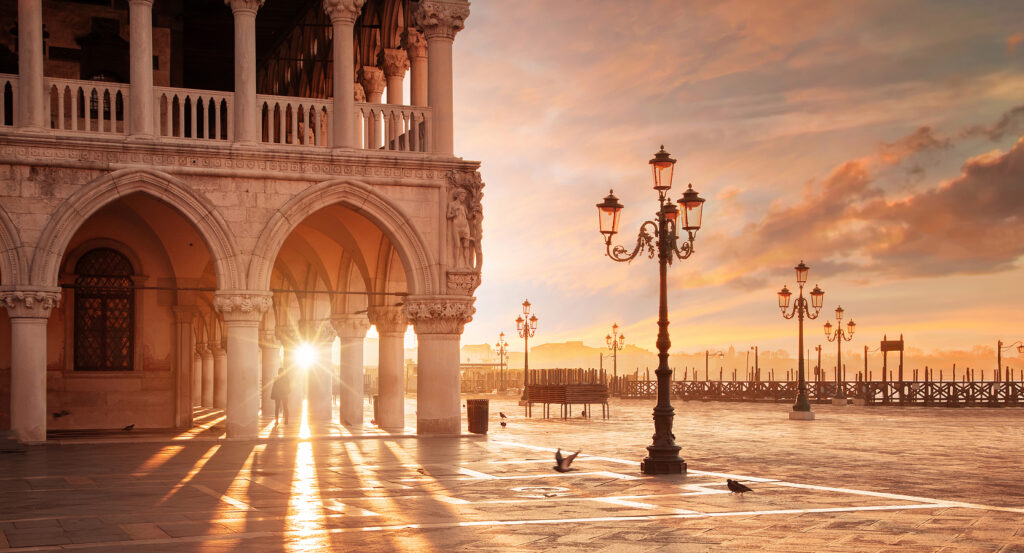
Standing at the eastern end of Piazza San Marco beside the former seat of ducal government, the basilica occupies the religious center of Venice's historic civic precinct, where five domes rise above a marble-clad structure overlooking the square's principal ceremonial approach. Its western façade contains five arched portals beneath galleries decorated with mosaics and sculptural ornament. Columns of colored marble, carved capitals and relief panels create a layered exterior assembled through successive medieval building campaigns. The northern and southern elevations incorporate additional entrances and decorative elements associated with the surrounding public spaces. The result is a cathedral whose architecture preserves Venice's connections with Byzantine Christianity, Mediterranean commerce and the ceremonial institutions of the republic.
What defines Saint Mark's Basilica.
Saint Mark's Basilica is best known for housing the relics of Saint Mark the Evangelist and for its development as the principal religious church of the Venetian Republic. In 828, Venetian merchants traditionally associated with the names Buono da Malamocco and Rustico da Torcello transported the saint's remains from Alexandria to Venice. The arrival of the relics strengthened the republic's religious standing and established Saint Mark as the city's patron saint. Doge Giustiniano Partecipazio initiated the construction of a church to accommodate the remains, creating a religious foundation adjoining the ducal residence. The original ninth-century structure was subsequently damaged during political conflict, prompting reconstruction under later Venetian rulers. In 1063, Doge Domenico Contarini initiated the construction of the basilica whose principal architectural arrangement survives. Its design incorporated a Greek-cross plan with five domes, drawing upon Byzantine church architecture associated with Constantinople. The building was consecrated in 1094, when the relics of Saint Mark were ceremonially installed within the completed church. During the twelfth and thirteenth centuries, Venice's expanding commercial and military influence across the eastern Mediterranean contributed to the acquisition of architectural elements and decorative objects. The Fourth Crusade culminated in the sack of Constantinople in 1204, after which substantial quantities of Byzantine sculpture, marble and precious objects reached Venice. These acquisitions contributed to the enrichment of the basilica's exterior and interior decoration, connecting its architectural development with the republic's imperial expansion. Successive doges commissioned mosaics, chapels and liturgical furnishings that strengthened the church's ceremonial importance. The basilica functioned as the doge's chapel for centuries, accommodating state religious ceremonies and processions associated with the government of the republic. Following the fall of the Venetian Republic in 1797, its institutional position changed during the subsequent political reorganization of the city. In 1807, the basilica became the cathedral of the Patriarchate of Venice, assuming the diocesan functions previously associated with San Pietro di Castello.
The Pala d'Oro occupies the high altar as one of the basilica's principal examples of Byzantine goldsmithing and medieval religious craftsmanship. Its development began with commissions associated with Venetian rulers during the tenth and eleventh centuries, and subsequent additions incorporated enamel panels, gemstones and elaborate gold settings. The surviving altarpiece contains religious figures arranged across a gilded surface, including representations of Christ, the Virgin Mary, angels and saints. Its craftsmanship preserves connections between Venetian patronage and the workshops of the Byzantine Empire. The basilica's interior mosaics extend across the domes, vaults and upper walls, covering thousands of square meters with biblical scenes and religious figures. Gold tesserae create luminous backgrounds surrounding compositions associated with the Old and New Testaments. The central domes contain major cycles devoted to Pentecost, the Ascension and the lives of religious figures, organizing theological subjects within the building's architectural structure. The marble floor incorporates geometric patterns, animal figures and intricate arrangements of colored stone associated with medieval decorative traditions. The Treasury contains religious objects, chalices, reliquaries and vessels acquired through diplomatic exchange, trade and military conquest. Its collections include Byzantine craftsmanship produced from precious metals, carved stone and enamel. The Horses of Saint Mark, a group of four ancient bronze equestrian sculptures, reached Venice following the Fourth Crusade and were installed above the western entrance. The original sculptures are preserved within the basilica's museum, with replicas occupying the exterior gallery. The museum also provides access to elevated interior spaces where visitors encounter the mosaics and architectural organization from the upper galleries. These artistic elements preserve the relationship between Venetian religious patronage, Byzantine craftsmanship and the ceremonial display of objects acquired across the Mediterranean.
How Saint Mark's Basilica fits.
Saint Mark's Basilica works as the Byzantine religious centerpiece for a Venice outing connecting the city's early Christian foundations, medieval artistic patronage and ecclesiastical institutions across the historic lagoon settlement.
Begin at Chiesa di San Zaccaria, the church occupying a historic religious precinct east of the principal civic square. Its origins extend to the ninth century, when a Benedictine convent developed under the patronage of the Venetian ruling families. The surviving church incorporates Gothic and Renaissance architectural elements associated with successive building campaigns. Antonio Gambello and Mauro Codussi contributed to its fifteenth-century construction, producing an exterior that combines pointed forms with classical architectural details. Its interior contains Giovanni Bellini's San Zaccaria Altarpiece, completed in 1505, a major work of Venetian Renaissance painting. Continue to Basilica dei Santi Giovanni e Paolo, the Dominican church associated with the funerary monuments of Venetian doges and prominent republican figures. Construction began during the thirteenth century, and the substantial Gothic building developed through later medieval campaigns. Its brick exterior, pointed arches and extensive interior preserve the architectural character of Venetian mendicant churches. The church contains numerous ducal tombs, including monuments incorporating Renaissance sculpture and elaborate funerary decoration. Its position beside the equestrian monument to Bartolomeo Colleoni connects religious patronage with the military and political institutions of the republic. Conclude at Santa Maria presso San Satiro dei Miracoli, the Renaissance church constructed between 1481 and 1489 under architect Pietro Lombardo. The building was commissioned to house a revered image of the Virgin Mary, whose devotional importance attracted substantial local patronage. Its exterior incorporates polychrome marble panels, sculptural ornament and classical architectural elements arranged across a compact façade. The interior preserves a barrel-vaulted ceiling, decorative stone surfaces and an elevated sanctuary associated with the church's devotional functions. Its architectural treatment demonstrates the development of Venetian Renaissance craftsmanship through marble construction and carefully proportioned interior spaces. The progression moves from Benedictine religious patronage through Dominican funerary traditions and culminates at a Renaissance devotional church, connecting Saint Mark's Basilica with the ecclesiastical architecture and artistic production of historic Venice.
Where your story begins.
Foresyte Travel reveals places that feel extraordinary long before you arrive.
Enjoy editorial crafted for luxury travelers.
Foresyte may earn a commission when you book.




















































































































