
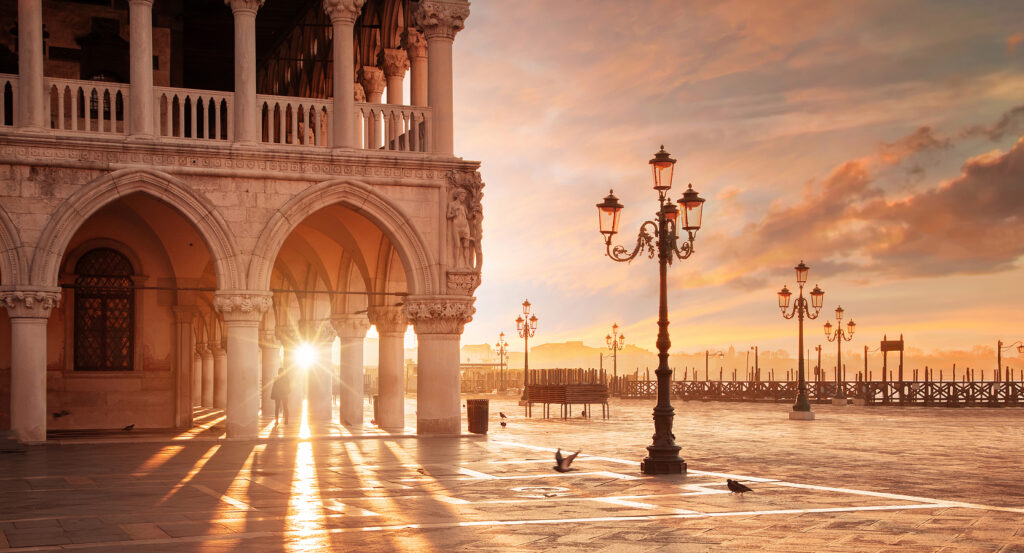
Why Doge's Palace matters.
Doge's Palace is a Venetian Gothic government palace where San Marco's maritime heritage meets the constitutional institutions of the Venetian Republic, the ceremonial authority of its elected doges and the artistic patronage of a Mediterranean trading power.
Standing along the waterfront of the Bacino di San Marco at the eastern end of the Piazzetta, the palace occupies the southeastern corner of Venice's historic civic precinct, where its two principal façades overlook the lagoon and the ceremonial approach connecting the waterfront with the city's political center. Two tiers of pointed arcades support upper walls faced with patterned pink-and-white stone. Carved capitals, quatrefoil openings and corner sculptures contribute to the exterior's Gothic architectural program. An internal courtyard organizes circulation between ceremonial chambers, administrative rooms and the former judicial facilities. The result is a government complex whose architecture preserves the relationship between republican administration, public ceremony and Venice's maritime position.
What defines Doge's Palace.
Doge's Palace is best known as the former residence of the doge and the headquarters of the governing councils, courts and administrative institutions of the Venetian Republic. Its origins extend to the ninth century, when Doge Agnello Partecipazio established a fortified residence near the lagoon following the consolidation of Venetian political authority around the Rialto islands. The early complex contained defensive structures and buildings associated with the developing government. Fires and political disturbances damaged successive residences, prompting reconstruction as Venice expanded its commercial and diplomatic influence. During the twelfth century, Doge Sebastiano Ziani supported substantial alterations that introduced a more extensive palace arrangement. The republic's increasingly elaborate constitutional institutions required larger chambers for deliberation, judicial proceedings and administrative business. A major Gothic rebuilding began during the fourteenth century, producing the southern waterfront wing and its substantial council chamber. Construction extended around the western side during the fifteenth century, creating the principal architectural enclosure visible from the Piazzetta. The palace accommodated the Great Council, whose membership represented Venice's hereditary governing patriciate following the constitutional changes associated with the Serrata of 1297. The Senate directed major aspects of foreign policy and commercial administration, connecting the palace's deliberations with Venice's Mediterranean trading network. The Council of Ten, established in 1310, exercised responsibilities associated with state security and political investigations. A major fire in 1574 damaged portions of the palace, and a second fire in 1577 devastated important ceremonial rooms and artworks. Reconstruction retained the Gothic exterior and introduced extensive interior decoration commissioned from leading Venetian painters. The republic continued to govern from the palace until its dissolution in 1797 following Napoleon Bonaparte's campaign in northern Italy. Subsequent administrations adapted portions of the complex for government offices and institutional functions. The palace became a public museum during the twentieth century, preserving its architectural interiors and the material history of Venetian republican government.
Jacopo Tintoretto's Paradise occupies the eastern wall of the Sala del Maggior Consiglio, the chamber where the Great Council assembled beneath an extensive painted ceiling. Completed through the work of Tintoretto and his workshop during the late sixteenth century, the painting depicts a celestial assembly surrounding Christ and the Virgin Mary. Its scale corresponds to the chamber's substantial dimensions and the ceremonial importance of the institution that met there. Paolo Veronese's Triumph of Venice adorns the ceiling of the Sala del Maggior Consiglio, presenting an allegorical composition associated with the republic's prosperity and political authority. The Sala dello Scrutinio served electoral functions and contains paintings depicting episodes from Venetian military and maritime history. The Sala del Senato preserves a decorative program associated with diplomatic deliberations and the government of overseas possessions. In the Sala del Collegio, Veronese's ceiling paintings accompany the chamber where the doge and senior councillors received foreign representatives. The Scala d'Oro provides a ceremonial staircase connecting the courtyard with the principal governmental apartments. Its gilded stucco vault was developed during the sixteenth century through architectural work associated with Jacopo Sansovino and Antonio Abbondi. The Porta della Carta, constructed during the fifteenth century by Giovanni and Bartolomeo Bon, forms an elaborate Gothic entrance between the palace and the adjoining religious precinct. Its sculptural program includes the winged lion of Saint Mark and a representation of Doge Francesco Foscari kneeling before the republic's patron symbol. The palace's former prisons occupy rooms associated with judicial detention, preserving the institutional relationship between government and criminal administration. The Bridge of Sighs, completed during the early seventeenth century, connects the palace's interrogation chambers with the New Prisons across the Rio di Palazzo. Its enclosed passage and stone windows preserve the physical separation between judicial proceedings and imprisonment. The palace's interior sequence connects legislative chambers, ceremonial apartments, judicial facilities and works of art commissioned to communicate the authority of Venetian government.
How Doge's Palace fits.
Doge's Palace works as the republican government centerpiece for a Venice outing connecting the city's maritime institutions, Renaissance civic architecture and the commercial infrastructure that supported its Mediterranean power.
Begin at Libreria Marciana, the Renaissance library occupying the western side of the Piazzetta opposite the palace. Jacopo Sansovino designed the building during the sixteenth century, creating a classical façade with superimposed arcades, sculptural ornament and substantial interior reading rooms. The institution developed around the manuscript collection donated to Venice by Cardinal Bessarion in 1468. Its holdings include Greek and Latin manuscripts associated with the transmission of classical learning through the eastern Mediterranean. The expansive staircase and decorated library rooms preserve the relationship between Venetian civic patronage and Renaissance scholarship. Continue to Zecca di Venezia, the former mint standing beside the library near the waterfront. Sansovino designed the surviving building during the sixteenth century, incorporating heavy stone construction and a façade organized through classical architectural elements. The mint produced coinage associated with the republic's extensive commercial network, including the gold ducat introduced during the thirteenth century. Venetian currency circulated through Mediterranean and European markets, supporting trade conducted by merchants operating under the republic's authority. The building's position near the principal governmental precinct connected monetary administration with the institutions responsible for maritime commerce. Conclude at Arsenale di Venezia, the historic shipbuilding complex occupying a substantial enclosure in the Castello district. Its origins extend to the early twelfth century, when the republic developed organized naval construction facilities. The arsenal expanded during subsequent centuries, incorporating workshops, docks, warehouses and specialized production areas devoted to shipbuilding and naval equipment. Its labor organization supported the construction and maintenance of fleets essential to Venetian commerce and military operations. The expansive land entrance, developed during the fifteenth century, incorporates Renaissance architectural elements and sculptural decoration associated with the republic's naval authority. The progression moves from Renaissance scholarship through monetary administration and culminates at the republic's principal shipbuilding complex, connecting Doge's Palace with the intellectual, financial and maritime institutions of Venice.
Where your story begins.
Foresyte Travel reveals places that feel extraordinary long before you arrive.
Enjoy editorial crafted for luxury travelers.
Foresyte may earn a commission when you book.




















































































































