Fun facts about Greece.
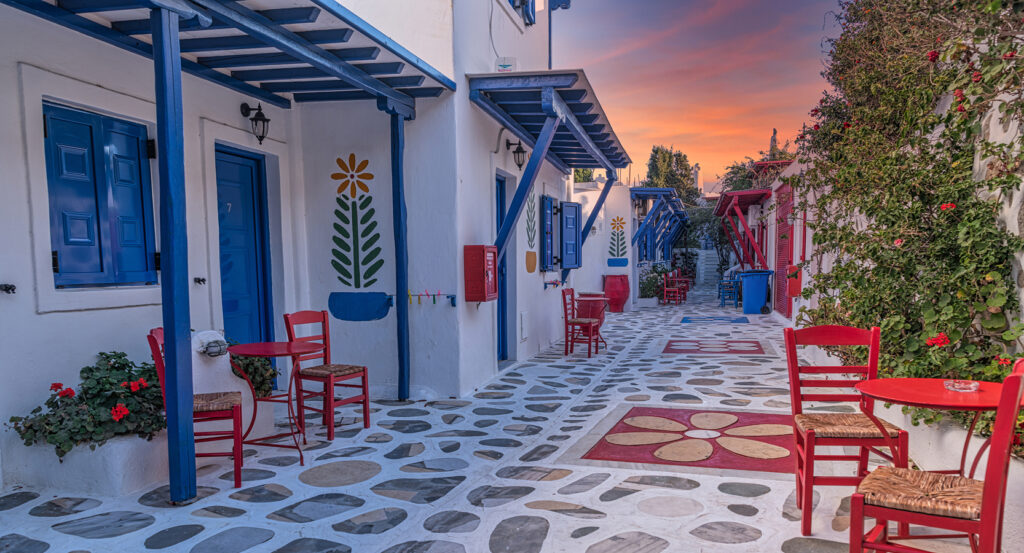
Mykonos rises from the Central Aegean Sea as a landscape of granite hills, rocky headlands, sheltered coves, and dry agricultural valleys, 150 kilometers southeast of Athens. The island belongs to the Cyclades, an archipelago distinguished by its whitewashed settlements, terraced hillsides, and architecture adapted to intense sunlight and seasonal winds. Its terrain is relatively low and rugged, with Mount Profitis Ilias reaching 340 meters above sea level. Sparse vegetation, stone boundary walls, and scattered rural chapels characterize much of the interior, where traditional farming and pastoral activities once sustained village communities. The principal settlement, Mykonos Town, or Chora, occupies a sheltered harbor on the western coast, its densely arranged buildings forming an intricate network of narrow pedestrian streets. Whitewashed houses, brightly painted wooden doors, external staircases, and small courtyards create the characteristic Cycladic streetscape, with irregular alignments providing shelter from the strong northerly meltemi winds. The waterfront district of Little Venice contains historic houses built directly above the sea, their colorful balconies projecting toward the harbor. Originally associated with prosperous merchants and maritime families, these buildings now accommodate restaurants, bars, and galleries overlooking the western horizon. Above the waterfront, the Kato Mili windmills stand along an exposed ridge, preserving one of the island's most recognizable architectural ensembles. Their cylindrical white towers and conical roofs reflect the historical importance of wind-powered grain milling within the Cycladic economy. Nearby, the Church of Panagia Paraportiani presents an unusual composition of interconnected whitewashed chapels, whose sculptural forms have become emblematic of traditional Aegean religious architecture. The old harbor remains a central gathering place, connecting waterfront cafés, fishing boats, and ferry activity with the surrounding historic streets. Inland from Chora, Ano Mera forms the island's principal traditional village, organized around a central square and the Monastery of Panagia Tourliani. Founded in the sixteenth century and subsequently renovated, the monastery contains an elaborate carved iconostasis and religious objects associated with Orthodox worship. The surrounding countryside preserves agricultural terraces, rural churches, and stone farmhouses scattered across the hills. Along the southern coast, a succession of beaches occupies sheltered bays protected from the strongest northern winds. Ornos and Platis Gialos contain established resort communities with beachfront hotels, restaurants, and small harbors. Farther east, Psarou is associated with luxury hospitality and yacht activity, and Paradise and Super Paradise beaches are internationally known for their beach clubs and nightlife. Elia extends along a broader sandy bay, with resort development arranged against the surrounding hillsides. The northern coast presents a contrasting landscape of more exposed beaches and rocky shorelines, including Agios Sostis and Ftelia, where the meltemi creates conditions favored by windsurfers. West of Mykonos, the uninhabited island of Delos lies across a narrow channel, preserving extensive archaeological remains within a UNESCO World Heritage Site. Its ancient sanctuaries, residential quarters, mosaics, and expansive terraces form one of the most important archaeological landscapes in Greece. Mykonos's physical character arises from the close relationship between its compact Cycladic settlements, wind-shaped agricultural terrain, contrasting coastlines, and the ancient sacred island visible across the surrounding Aegean.
Greek island culture on Mykonos preserves elements of Cycladic maritime life, Orthodox religious practice, and local craftsmanship within a destination whose international reputation has become closely associated with music, nightlife, and contemporary luxury. Traditional religious festivals remain important occasions for community gathering, particularly celebrations honoring local patron saints through church services, shared meals, music, and dancing. These panigyria connect the island's rural chapels and village communities with customs sustained across generations. The Feast of the Assumption on August 15 brings particular attention to the Monastery of Panagia Tourliani, where religious observances form part of the wider Greek Orthodox calendar. Mykonian folk music incorporates the violin, lute, and traditional Cycladic dance rhythms, with communal performances associated with weddings, festivals, and seasonal celebrations. The island's maritime heritage also survives through its historical associations with shipbuilding, fishing, and commercial navigation. The Aegean Maritime Museum in Chora presents collections of nautical instruments, ship models, maps, and artifacts tracing the seafaring history of the Greek islands. The Archaeological Museum of Mykonos preserves objects from the surrounding region, including ceramics and funerary finds associated with ancient Delos and neighboring islands. The Folklore Museum of Mykonos contains traditional furniture, textiles, household objects, and historical materials illustrating domestic life before the expansion of mass tourism. Contemporary Mykonos supports galleries, fashion boutiques, design businesses, and seasonal exhibitions, with artistic activity concentrated in Chora's pedestrian streets. The island's nightlife acquired international prominence during the later twentieth century, attracting performers, artists, and travelers seeking a socially liberal Mediterranean setting. Its LGBTQ+ community contributed substantially to this reputation, establishing Mykonos as an important European destination for inclusive leisure and nightlife. Beach clubs along the southern coast subsequently expanded the island's entertainment culture through international DJs, electronic music, and elaborate waterfront hospitality. The annual summer season now brings a concentrated calendar of performances, private events, and social gatherings connected to the global resort economy. Mykonian cuisine reflects the agricultural constraints and maritime resources of the Cyclades, emphasizing preserved meats, regional cheeses, seafood, vegetables, and simple preparations suited to island life. Kopanisti, a pungent, spicy cheese traditionally produced from fermented milk, is among the island's most distinctive specialties, commonly served with bread, tomatoes, or local rusks. Louza, a cured pork preparation seasoned with herbs and spices, reflects traditional methods of preserving meat before refrigeration. Local sausages, barley rusks, and onion pies contribute further examples of Cycladic home cooking. Fresh fish, octopus, squid, and shellfish feature prominently in coastal tavernas, frequently grilled and served with olive oil, lemon, and seasonal vegetables. The island's contemporary dining scene incorporates sophisticated interpretations of Greek and Mediterranean cuisine, supported by international chefs and luxury hospitality groups. Mykonos also maintains longstanding connections with nearby Delos, whose archaeological heritage introduces a deeper historical dimension to the island's cultural landscape. Excursions to the ancient sanctuary connect visitors with the religious and commercial networks that shaped the Central Aegean for centuries. The island's distinctive cultural position rests upon this unusual proximity of ancient sacred history, enduring Cycladic customs, and a modern entertainment culture that has made Mykonos one of the Mediterranean's most internationally recognized destinations.
Five fascinations.
5. Mykonos became famous for windmills because wind once powered a major island industry.
Mykonos occupies an exposed position in the Cyclades, where persistent Aegean winds created ideal conditions for wind-powered milling. From the early modern period onward, dozens of windmills operated across the island, grinding locally grown and imported grain into flour for residents and passing ships. Their cylindrical whitewashed bodies and thatched roofs became especially prominent above Mykonos Town, where the surviving Kato Mili still overlook the waterfront. Mechanized milling eventually ended their original economic role, yet the structures endured as defining landmarks. One of Mykonos's most photographed architectural forms originated as practical infrastructure serving an island economy shaped by wind and maritime trade.
4. Mykonos Town was built as a maze of narrow lanes that helped protect island life from the elements and intruders.
Chora, the principal settlement of Mykonos, developed as a dense network of whitewashed houses, tiny squares, stairways, churches, and narrow pedestrian passages. The irregular street pattern creates shade and shelter from strong Cycladic winds while producing a compact urban environment suited to island life. Local tradition also associates the labyrinthine layout with making navigation difficult for pirates during centuries when raids threatened Aegean communities. Brilliant white walls, blue and brightly painted details, stone paving, and tightly packed buildings subsequently became visual signatures of the island. Mykonos's celebrated aesthetic emerged from architecture responding directly to climate, geography, security, and limited space.
3. Little Venice was built directly against the sea by wealthy maritime families.
Along the western edge of Mykonos Town, rows of historic houses rise immediately from the Aegean, their balconies projecting above the water. The district now known as Little Venice developed particularly during the eighteenth and nineteenth centuries, when merchants and ship captains constructed residences beside the harbor. Lower-level openings gave buildings unusually direct access to maritime activity, tying domestic architecture to the island's seafaring economy. Waves still break against the foundations beneath colorful wooden balconies and façades. One of Mykonos's most romantic settings originated as a working maritime neighborhood whose architecture physically erased much of the boundary between settlement and sea.
2. Mykonos sits beside Delos, among the most sacred islands of the ancient Greek world.
Only a short distance southwest of Mykonos lies Delos, revered in Greek mythology as the birthplace of Apollo and Artemis. Its sanctuary attracted worshippers from across the Aegean, while the island later developed into an extraordinarily prosperous commercial center connected with Mediterranean trade. Temples, houses, mosaics, statues, theaters, and expansive terraces survive across an archaeological landscape largely free from modern urban development. Mykonos eventually became the principal modern gateway for visitors traveling to the island. The resort destination occupies the immediate maritime neighborhood of a place that functioned for centuries as both a sacred center and an international marketplace of the ancient Mediterranean.
1. Mykonos became an international jet-set destination before mass tourism transformed the Greek islands.
Mykonos began attracting artists, intellectuals, wealthy travelers, and international celebrities during the decades after World War II, building upon visitor traffic associated with nearby Delos. By the 1950s and 1960s, figures from European royalty, cinema, fashion, and international society were increasingly associated with the island. Its compact whitewashed town, beaches, nightlife, and comparatively cosmopolitan social atmosphere gave Mykonos a character distinct from many other Cycladic islands. Tourism subsequently expanded on a far larger scale, yet the island's luxury reputation had already taken shape. Mykonos became a prototype for the glamorous Mediterranean island destination long before contemporary resort culture reached its present scale.
Where your story begins.
Foresyte Travel reveals places that feel extraordinary long before you arrive.
Enjoy editorial crafted for luxury travelers.
Foresyte may earn a commission when you book.