Fun facts about Shanghai, China.
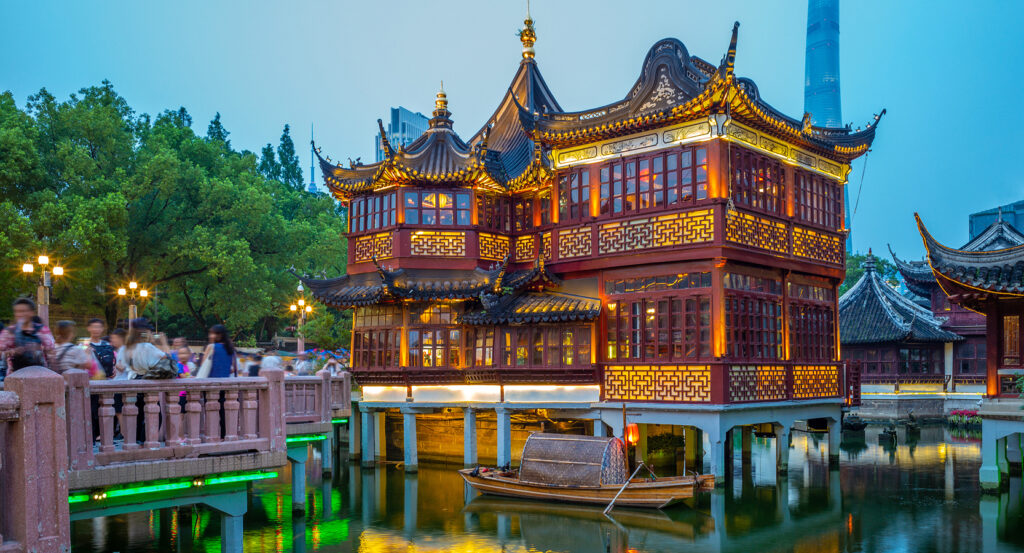
Shanghai extends across the low-lying Yangtze River Delta near the East China Sea, where an intricate network of rivers, canals, and reclaimed land forms the setting for one of the world's largest urban concentrations. The Huangpu River divides the historic western districts of Puxi from the modern commercial landscape of Pudong, creating a striking architectural contrast across the waterfront. The Bund follows the river's western bank through an expansive promenade lined with early twentieth-century banks, trading houses, hotels, and government buildings. Its architecture combines Neoclassical, Beaux-Arts, Gothic Revival, and Art Deco influences, reflecting the city's development as an international commercial center. The former Hongkong and Shanghai Banking Corporation building, the Customs House, and the Peace Hotel contribute to an unusually concentrated ensemble of historic waterfront architecture. Across the Huangpu, Lujiazui rises through a dense skyline of contemporary towers, including the Oriental Pearl Tower, Jin Mao Tower, Shanghai World Financial Center, and Shanghai Tower. Completed in 2015, Shanghai Tower reaches 632 meters, its twisting glass façade creating one of the city's most recognizable modern silhouettes. The surrounding district contains elevated pedestrian connections, landscaped public spaces, shopping complexes, and financial institutions. West of the Bund, the historic commercial center extends toward People's Square, where major civic and cultural buildings occupy the former grounds of the Shanghai Racecourse. The Shanghai Museum and Shanghai Grand Theatre establish a prominent institutional presence around the square. Nanjing Road connects the central district with the waterfront through one of China's best-known shopping corridors, combining historic department stores, illuminated commercial façades, and extensive pedestrian activity. Southward, the Old City preserves elements of Shanghai's premodern urban structure, particularly around the City God Temple and Yu Garden. Yu Garden presents an intricate landscape of traditional pavilions, ornamental rockeries, ponds, covered walkways, and classical Jiangnan garden architecture. The surrounding commercial streets contain reconstructed traditional-style buildings, markets, and restaurants that recall the area's historic mercantile activity. Farther west, the former French Concession is distinguished by plane-tree-lined avenues, historic villas, apartment buildings, and commercial streets shaped by early twentieth-century urban planning. The Wukang Building, designed by László Hudec, occupies a dramatic triangular site at the intersection of Wukang Road and Huaihai Middle Road, its distinctive form reflecting Shanghai's interwar architectural experimentation. Nearby neighborhoods contain Art Deco residences, former diplomatic properties, independent shops, and landscaped residential compounds. Xintiandi combines preserved shikumen architecture with contemporary restaurants, galleries, and commercial spaces. These distinctive stone-gate houses developed during the nineteenth and early twentieth centuries, blending Chinese courtyard traditions with Western-influenced terrace housing. Tianzifang, within the former French Concession, occupies another network of narrow lanes and adapted residential buildings, now accommodating studios, boutiques, and cafés. North of the historic center, Hongkou contains important sites associated with Shanghai's literary and Jewish refugee communities, alongside older residential streets and industrial architecture. The city's waterfront continues north toward the Yangtze estuary through port facilities, residential developments, and extensive transportation infrastructure. Beyond the central metropolis, districts including Qingpu and Songjiang preserve historic water towns and canal landscapes associated with the wider Jiangnan region. Zhujiajiao is distinguished by stone bridges, narrow waterways, traditional houses, and commercial streets organized around an older canal network. Shanghai's physical character is defined by the exceptional proximity of historic European-influenced architecture, traditional Chinese gardens, intimate residential lanes, and an expansive contemporary skyline rising above the Huangpu River.
Chinese modern culture found one of its most influential twentieth-century centers in Shanghai, where publishing, cinema, fashion, music, and commercial entertainment flourished amid intense intellectual and political change. The city's literary community helped shape modern Chinese writing through authors who explored urban life, social inequality, revolutionary politics, and the tensions between tradition and modernity. Lu Xun spent his final years in Shanghai, contributing to the development of modern Chinese literature through fiction, essays, and cultural criticism. Eileen Chang, also known as Zhang Ailing, portrayed the complexities of metropolitan society through psychologically intricate fiction set against the city's wartime and cosmopolitan environments. Shanghai's publishing houses, newspapers, and literary journals established influential networks of intellectual exchange during the Republican era. The city's film industry became a major center of Chinese cinema during the 1930s, producing works that addressed urban poverty, changing gender roles, and social conflict. Films such as The Goddess and Street Angel remain important achievements of early Chinese filmmaking, associated with performers including Ruan Lingyu and Zhou Xuan. Shanghai also developed a distinctive musical culture through the popularity of shidaiqu, a genre blending Chinese melodies with jazz and Western popular music. Dance halls, cabarets, and recording studios contributed to the city's international reputation for nightlife during the interwar years. Contemporary Shanghai maintains a substantial cultural infrastructure through institutions including the Shanghai Museum, whose collections encompass ancient Chinese bronzes, ceramics, calligraphy, painting, and decorative arts. The China Art Museum occupies the expansive former China Pavilion from Expo 2010, presenting exhibitions devoted to Chinese visual art. The Power Station of Art, established within a converted industrial facility along the Huangpu, has become a major center for contemporary exhibitions and international artistic exchange. The Shanghai Symphony Orchestra, founded in 1879, represents one of Asia's oldest orchestral traditions, and the Shanghai Grand Theatre presents opera, ballet, theater, and major musical productions. Shanghai's fashion and design communities draw upon the city's historic textile industries, Art Deco heritage, and contemporary commercial influence. The annual Shanghai Fashion Week brings designers, brands, and international industry professionals to the city, reinforcing its position within China's creative economy. Culinary culture provides another essential connection to Shanghai's regional history. Shanghainese cooking belongs to the broader Jiangnan culinary tradition, emphasizing seasonal ingredients, delicate textures, freshwater seafood, and balanced combinations of sweetness and savory flavor. Xiaolongbao, delicate steamed dumplings filled with seasoned pork and hot broth, are among the city's most celebrated specialties. Shengjianbao, pan-fried buns with crisp bases and juicy fillings, remain a popular breakfast and street-food tradition. Red-braised pork belly, known as hongshao rou, exemplifies the region's use of soy sauce, sugar, and slow cooking to create richly flavored dishes. Hairy crab from the surrounding freshwater lakes is a prized seasonal delicacy, particularly during autumn. Scallion oil noodles, drunken shrimp, and dishes featuring bamboo shoots, river fish, and leafy vegetables further reflect the agricultural resources of the Yangtze Delta. Shanghai's contemporary dining landscape encompasses regional Chinese cuisines alongside international restaurants, innovative tasting menus, historic teahouses, and neighborhood eateries. Traditional tea culture remains visible in garden pavilions and specialist shops, and the city's cafés reflect a rapidly expanding enthusiasm for specialty coffee. Major festivals and public celebrations include Lunar New Year observances, lantern displays, contemporary arts programming, and events associated with the city's international commercial calendar. Shanghai's cultural vitality is especially apparent in the contrast between a traditional dumpling shop tucked into a residential lane, an experimental exhibition inside a former power station, and the illuminated towers rising across the river after dark.
Five fascinations.
5. Shanghai's Bund grew from a muddy riverbank into one of Asia's great architectural waterfronts.
The Bund developed along the Huangpu River after Shanghai became a treaty port in the nineteenth century. Foreign banks, trading companies, shipping firms, hotels, and consulates progressively transformed the waterfront into the financial heart of an internationally connected city. Its surviving buildings encompass Gothic Revival, Neoclassical, Renaissance Revival, and Art Deco influences, producing an unusually concentrated record of Shanghai's commercial expansion. Across the river, Pudong later created an entirely different skyline of supertall towers. The Bund places two transformative eras of Shanghai almost face-to-face: the mercantile metropolis of the nineteenth and early twentieth centuries and the vertical megacity that emerged across the Huangpu.
4. Shanghai contains one of the world's most extraordinary concentrations of Art Deco architecture.
Shanghai experienced an extraordinary construction boom during the 1920s and 1930s, when Art Deco became embedded in hotels, cinemas, apartment buildings, offices, and private residences across the city. Structures such as the Park Hotel translated the movement's geometric forms and vertical emphasis into Shanghai's rapidly modernizing urban landscape. Chinese architects and patrons also adapted international design ideas to local materials, motifs, and ways of living, producing distinctive hybrids beyond straightforward Western imitation. Much of this architectural legacy survived later political and economic transformations. Shanghai's reputation for futuristic architecture has a striking historical counterpart in a modernist building culture that flourished nearly a century ago.
3. Pudong changed from a low-rise district into one of the world's most recognizable skylines within a generation.
For much of modern Shanghai's history, the eastern side of the Huangpu River lacked the expansive skyline associated with the Bund opposite it. Pudong's large-scale development accelerated after 1990, bringing new financial districts, infrastructure, housing, and some of the tallest buildings on Earth. The Oriental Pearl Tower became an early emblem of the transformation, followed by Jin Mao Tower, Shanghai World Financial Center, and the 632-meter Shanghai Tower. Their radically different silhouettes now form the defining image of contemporary Shanghai. The famous skyline is remarkably young, representing an urban transformation compressed into only a few decades.
2. Shanghai Tower twists as it rises partly to reduce the enormous forces created by wind.
Shanghai Tower reaches 632 meters above Pudong, making extreme wind loads a fundamental engineering challenge. Its asymmetrical exterior rotates progressively around the structural core as the building climbs, creating a tapered, twisting profile that helps reduce wind pressure on the tower. The design also incorporates a double-skin façade enclosing large vertical atriums that divide the immense structure into stacked neighborhoods. Engineers supplemented the structural system with a massive tuned-mass damper near the top to limit movement and improve comfort. Shanghai's tallest skyscraper derives its unmistakable appearance from engineering as much as aesthetics: the building's geometry actively responds to atmospheric forces acting hundreds of meters above the city.
1. Shanghai built an entire deep-water port on islands connected to the mainland by one of the world's longest sea bridges.
Shanghai's enormous shipping economy faced a geographic problem: sections of the Yangtze River estuary are too shallow for the largest modern container ships. Yangshan Deep-Water Port was developed offshore among islands in Hangzhou Bay, where deeper water provides access for major vessels. The Donghai Bridge links the port with Shanghai's mainland logistics network across more than 30 kilometers of open water. Container terminals, automated equipment, enormous storage areas, and maritime infrastructure subsequently turned the offshore complex into a critical component of Shanghai's global trading system. The city effectively extended its port far into the sea to overcome the natural limitations of its own coastline.
Where your story begins.
Foresyte Travel reveals places that feel extraordinary long before you arrive.
Enjoy editorial crafted for luxury travelers.
Foresyte may earn a commission when you book.