
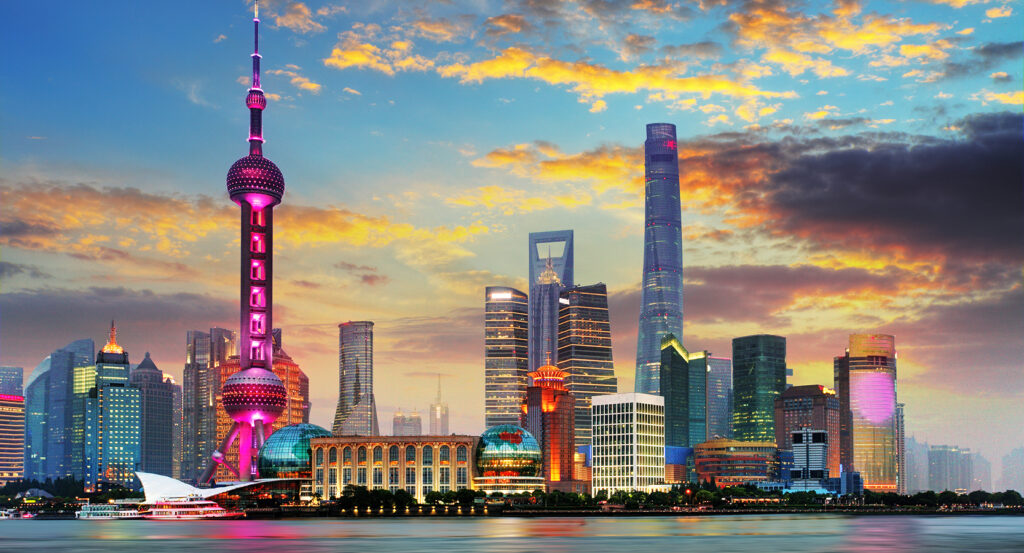
Why Oriental Pearl Tower matters.
The Oriental Pearl Tower is the beating heart of Pudong's skyline, a luminous totem that captures the spirit of Shanghai's leap from the past into the future.
Rising 468 meters above the Huangpu River, its twin spheres seem to float in air, glowing pink, violet, and silver as day turns to night. No photograph of Shanghai feels complete without it, but standing beneath it is another experience entirely. Its design, inspired by a Tang dynasty poem about “pearls falling on a jade plate,” captures the city's fusion of history, art, and audacious modernity. From its glass viewing decks, you can see The Bund stretch out like a dream, colonial façades mirrored in the steel of tomorrow. And when the tower lights up at dusk, it becomes a living pulse, sending color through the night sky and reflection into the river below. The Oriental Pearl Tower isn't just Shanghai's most recognizable landmark, it's its beating heart, shimmering with infinite possibility.
What defines Oriental Pearl Tower.
Completed in 1994, the Oriental Pearl Tower was the first modern skyscraper to rise in Lujiazui, marking the birth of Pudong's transformation from empty riverfront to global skyline.
Designed by architects Jiang Huan Cheng, Lin Benlin, and Zhang Xiulin, the tower blends futuristic geometry with poetic symbolism, eleven spheres connected by columns of steel, representing the continuity of time and space. At its base sits a circular urban plaza and Shanghai's Municipal History Museum, which traces the city's evolution from fishing port to metropolis. The main observation deck, located at 263 meters, offers 360-degree views of both the Huangpu River and The Bund, while the Space Module at 351 meters feels suspended between earth and sky. The tower's most thrilling feature, the glass-bottomed Skywalk, lets visitors step into the void, the city spinning silently below. Its exterior lighting system, installed during the 2010 World Expo, uses over 16,000 LED lights, capable of painting the tower in waves of motion and color that sync with music and seasonal festivals. Few know that its structure also doubles as a communications tower, housing more than 50 broadcasting transmitters that keep Shanghai connected to the airwaves, literally and symbolically. Today, it remains one of China's most visited architectural icons, not only for its views but for the feeling it evokes: standing inside the heartbeat of a city that dared to reimagine itself.
How Oriental Pearl Tower fits.
The Oriental Pearl Tower is more than a viewpoint, it's an experience that defines the rhythm of your entire Shanghai visit.
Arrive via Lujiazui Metro Station (Line 2), exiting directly into the tower's shadow. For the most cinematic moment, visit just before sunset, when the sky fades from amber to electric indigo and the lights along the Huangpu flicker to life. Begin with the Municipal History Museum at the base, then ascend to the Sightseeing Floor (263 m) and Space Module (351 m) for panoramic views. Don't miss the glass-floored observation loop, where you can walk above the skyline, a thrill both surreal and grounding. Allocate 90 minutes to two hours for the full visit, longer if you plan to dine at the revolving Oriental Pearl Restaurant, which completes a full rotation every 45 minutes. After the descent, walk to the Binjiang Riverside Promenade for the best external view of the tower's reflection shimmering across the river. Tickets range from 160-230 RMB, depending on deck access, and lines are shortest before 10 a.m. or after 8 p.m. As you step away, look back once more, the Oriental Pearl Tower doesn't just mark the skyline; it captures Shanghai's entire trajectory, forever rising, forever luminous.
Where your story begins.
Foresyte Travel reveals places that feel extraordinary long before you arrive.
Enjoy editorial crafted for luxury travelers.
Foresyte may earn a commission when you book.

















































































































