Fun facts about San Diego, California.
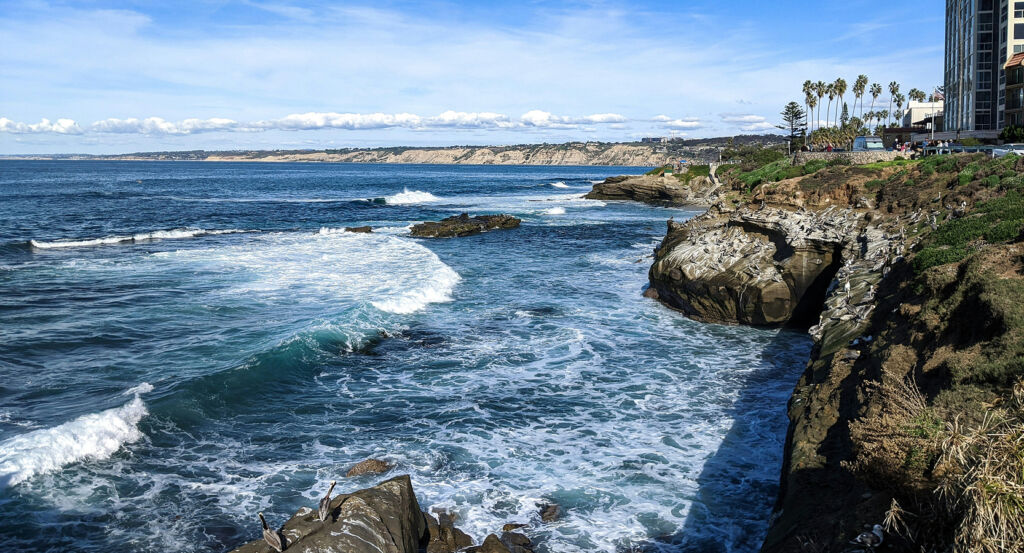
San Diego's metropolitan landscape extends around a deep natural harbor and along a coastline of sandstone cliffs, sandy beaches, coastal wetlands, and broad marine terraces, creating an urban environment whose development has been shaped by the relationship between maritime geography and the region's mild Mediterranean climate. San Diego Bay forms the city's principal geographic anchor, with Point Loma protecting its entrance from the open Pacific and Coronado separating much of the harbor from the ocean. The Cabrillo National Monument occupies the southern heights of Point Loma, preserving a prominent coastal vantage point above the bay and the Pacific approaches. Nearby, the Old Point Loma Lighthouse, completed in 1855, reflects the nineteenth-century expansion of maritime navigation infrastructure along the California coast. Downtown developed along the eastern waterfront, where historic commercial blocks now coexist with contemporary towers, convention facilities, and extensive public promenades. The Gaslamp Quarter preserves a concentration of Victorian-era commercial buildings, including ornate brick façades, decorative cornices, and narrow storefronts associated with the city's late nineteenth-century expansion. The district's historic streets connect with the modern waterfront through an urban fabric shaped by successive periods of commercial redevelopment. Farther north, Balboa Park contains one of the country's most distinctive collections of civic architecture, with expansive buildings, landscaped gardens, museums, and ceremonial promenades extending across a broad plateau above downtown. The park's celebrated Spanish Colonial Revival ensemble developed through the 1915 exposition, with architect Bertram Goodhue playing a principal role in establishing its richly ornamented architectural vocabulary. The California Building, distinguished by its elaborate tower and sculptural façade, became a defining landmark of the exhibition grounds. The Botanical Building and adjacent Lily Pond introduce another memorable composition through a historic lath structure framed by formal landscaping and reflective water. The park's subsequent California Pacific International Exposition of 1935 contributed additional buildings and public spaces, strengthening its importance as a center of civic life. Across the bay, Coronado developed into a coastal resort community distinguished by broad residential streets, landscaped grounds, and the expansive Hotel del Coronado, whose timber construction, conical towers, and expansive beachfront setting reflect the ambitions of nineteenth-century American resort architecture. North of the central city, La Jolla occupies a dramatic section of coastline where rocky coves, sea cliffs, and protected marine habitats create an unusually varied coastal environment. The Scripps Institution of Oceanography occupies a prominent coastal campus overlooking the Pacific, connecting scientific research facilities with the surrounding marine landscape. Nearby, the Salk Institute, designed by Louis Kahn and completed in 1965, presents a landmark of modern architecture through its symmetrical concrete buildings, open travertine courtyard, and narrow water channel directed toward the ocean horizon. The Torrey Pines State Natural Reserve preserves rare coastal pine habitat above sandstone cliffs and the Pacific shoreline, providing a striking example of the region's distinctive ecology. Inland neighborhoods including North Park, Hillcrest, and Mission Hills introduce early twentieth-century residential streets, Craftsman houses, historic commercial corridors, and a varied collection of neighborhood institutions. San Diego's built environment expresses the enduring influence of its harbor, coastal topography, exposition-era civic ambitions, and the scientific institutions established along the Pacific shoreline.
Five fascinations.
5. San Diego contains the largest wooden structure in the United States.
The Hotel del Coronado opened across the bay from San Diego in 1888 as an extraordinary Victorian seaside resort built primarily from wood. Its immense red-roofed complex was constructed during Southern California's nineteenth-century development boom and quickly became a destination for presidents, celebrities, and other prominent guests. The hotel later provided a major filming location for Billy Wilder's Some Like It Hot. More than a century after its construction, the sprawling resort remains one of the country's largest surviving examples of wooden Victorian architecture and an unmistakable landmark along the San Diego coastline.
4. Balboa Park became expansive because San Diego hosted two international expositions.
Balboa Park's elaborate architecture owes much of its character to major expositions staged in 1915-1916 and 1935-1936. For the Panama-California Exposition, architect Bertram Goodhue helped create an extraordinary Spanish Colonial Revival ensemble along El Prado, using ornate towers, arcades, courtyards, and façades to establish a romantic architectural vision of California's Spanish past. A second exposition introduced additional buildings and attractions two decades later. Temporary world's-fair architecture ultimately became part of San Diego's permanent cultural center, with museums, gardens, theaters, and the San Diego Zoo occupying the surrounding landscape.
3. San Diego helped give birth to modern naval aviation.
North Island became one of America's most important early aviation sites during the years when powered flight was still experimental. Glenn Curtiss established an aviation school there in 1911 and trained military personnel as the United States explored the possibilities of aircraft for naval operations. The Navy subsequently developed a permanent presence on North Island, which evolved into Naval Air Station North Island and a major center of Pacific aviation. San Diego's enormous contemporary military character reaches back to a period when pilots, engineers, and naval officers were still determining how airplanes might operate alongside warships.
2. The San Diego-Coronado Bridge was deliberately curved across the bay.
The San Diego-Coronado Bridge opened in 1969 with a sweeping curved route that became one of the region's defining pieces of infrastructure. Its unusual path served important engineering and operational purposes: the additional length helped the roadway climb gradually to the clearance required for naval vessels passing beneath it. The bridge rises high above San Diego Bay before descending toward Coronado, supported by distinctive concrete piers. A practical solution to the competing demands of automobiles, geography, and one of the world's most important naval harbors ultimately produced an elegant landmark recognized throughout Southern California.
1. San Diego Zoo helped pioneer the modern cageless zoo.
When physician Harry Wegeforth founded the Zoological Society of San Diego in 1916, traditional zoos commonly displayed animals behind bars in relatively confined enclosures. San Diego Zoo progressively embraced more naturalistic habitats, using moats, vegetation, terrain, and carefully designed barriers to create environments with fewer visible cages. Its approach became influential as zoological institutions increasingly emphasized habitat design, animal behavior, conservation, and immersive visitor experiences. The transformation helped make San Diego a major center of zoological innovation and contributed to a broader rethinking of how wildlife institutions present animals to the public.
Where your story begins.
Foresyte Travel reveals places that feel extraordinary long before you arrive.
Enjoy editorial crafted for luxury travelers.