Fun facts about Sydney, Australia.
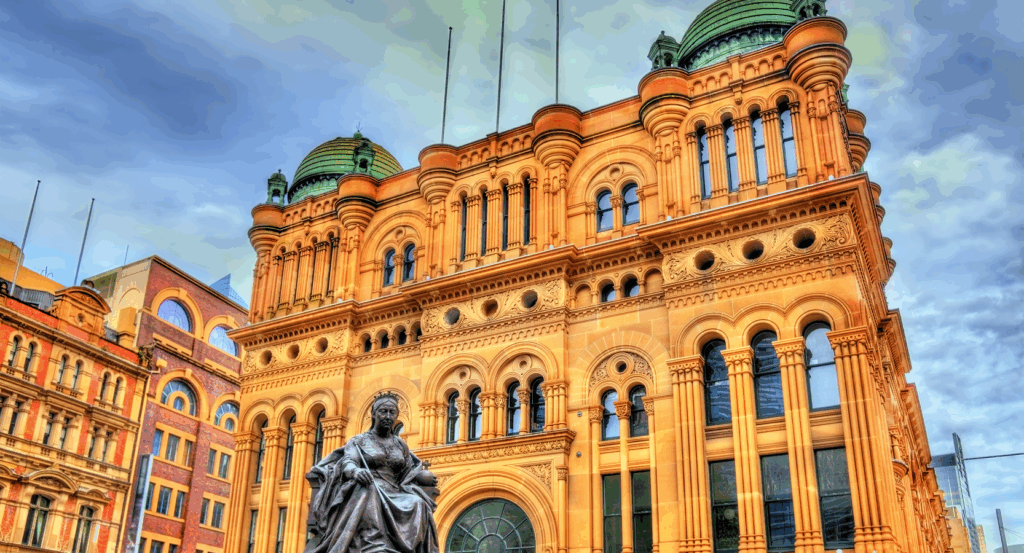
Sydney spreads around the intricate waterways of Port Jackson, where drowned river valleys, sandstone headlands, sheltered coves, and extensive Pacific beaches create an urban landscape distinguished by its remarkable relationship with the sea. Sydney Harbour extends inland from the Tasman Sea through a complex system of bays, islands, and narrow peninsulas formed as rising sea levels flooded ancient river valleys. The harbor's natural depth and sheltered waters established its importance to maritime transportation, naval activity, and commercial development. The historic center occupies the southern shoreline near Sydney Cove, where the Rocks preserves a network of narrow streets, sandstone buildings, and former warehouses associated with the city's earliest colonial settlement. Immediately east, Circular Quay forms the principal waterfront transportation interchange, connecting ferries, railway services, and pedestrian promenades around the harbor. The Sydney Opera House rises from Bennelong Point through a sequence of expansive white shell-like roofs designed by Danish architect Jørn Utzon. Its innovative structural engineering and sculptural relationship with the harbor established one of the twentieth century's most influential works of modern architecture. Across the water, the Sydney Harbour Bridge connects Dawes Point with Milsons Point through a vast steel arch spanning the harbor. Designed and constructed under the direction of engineer John Bradfield and the British firm Dorman Long, the bridge integrates road, rail, and pedestrian connections within an expansive industrial structure. West of Circular Quay, the central business district extends through a dense concentration of commercial towers, civic buildings, and historic streets. Martin Place forms an important pedestrian and institutional corridor, surrounded by substantial banking and government architecture. The Queen Victoria Building, completed in 1898, preserves an elaborate Romanesque Revival commercial interior beneath a series of domes and stained-glass windows. Nearby, Sydney Town Hall introduces another prominent nineteenth-century landmark through its sandstone façade and richly ornamented civic spaces. Hyde Park establishes a landscaped axis through the southern central district, connecting monuments, fountains, and mature trees with the surrounding urban fabric. The adjacent Australian Museum and St. Mary's Cathedral contribute major cultural and architectural landmarks. East of the center, the Royal Botanic Garden occupies a broad waterfront landscape overlooking Farm Cove, with extensive botanical collections and walking paths connecting the harbor to the historic Government House precinct. The surrounding neighborhoods reveal substantial architectural diversity, from the Victorian terraces of Paddington and Surry Hills to the waterfront residences of Double Bay and the converted industrial districts of Pyrmont. Across the harbor, North Sydney introduces another commercial skyline, with residential neighborhoods extending toward Mosman and the wooded headlands of the lower harbor. Farther east, the coastline opens onto the Pacific Ocean through a sequence of sandstone cliffs, rocky coves, and expansive beaches. Bondi Beach occupies a broad crescent-shaped bay framed by coastal headlands, establishing one of Australia's most recognizable urban beach landscapes. The Bondi to Coogee coastal walk follows dramatic sandstone cliffs, connecting beaches, ocean pools, and sheltered inlets through a continuous public pathway. North of the harbor entrance, Manly occupies a narrow peninsula between the sheltered waters of Sydney Harbour and the open Pacific, with ferry connections reinforcing its relationship with the central city. Sydney's western metropolitan districts extend across the Cumberland Plain toward the Blue Mountains, where sandstone plateaus, eucalyptus forests, and deeply incised valleys introduce a contrasting natural environment. The Parramatta River forms a major inland corridor connecting the central harbor with Parramatta, an important historic and contemporary urban center. Sydney's physical distinction arises from the extraordinary integration of a working maritime harbor, expansive modern architecture, extensive coastal landscapes, and metropolitan neighborhoods distributed across a complex network of waterways and sandstone ridges.
Australian cultural life finds its most internationally visible urban expression in Sydney, where Aboriginal artistic traditions, contemporary performance, literary production, multicultural communities, and coastal food culture intersect within a major Pacific metropolis. The city's cultural foundations remain inseparable from the Gadigal and other Aboriginal peoples of the Sydney region, whose artistic practices, storytelling traditions, and relationships with Country preserve enduring connections to the harbor and surrounding landscape. Aboriginal rock engravings and archaeological sites across the metropolitan region reflect cultural practices extending across thousands of years, with motifs depicting marine animals, ancestral figures, and ceremonial subjects. Contemporary Aboriginal artists continue to develop these traditions through painting, sculpture, performance, and interdisciplinary practice. The Art Gallery of New South Wales holds substantial collections of Aboriginal and Torres Strait Islander art alongside Australian, Asian, and international works, with its Sydney Modern expansion strengthening the city's contemporary exhibition environment. The Museum of Contemporary Art Australia occupies a prominent position at Circular Quay, presenting exhibitions that connect Australian artistic practice with international contemporary movements. Sydney's performing arts institutions contribute significantly to the country's cultural identity, particularly through Opera Australia, the Sydney Symphony Orchestra, and the Sydney Theatre Company. The Sydney Opera House provides an internationally recognized setting for opera, orchestral music, theater, dance, and contemporary performance. Australian theatrical traditions developed through a combination of colonial influences, Indigenous storytelling, and modern dramatic writing, with playwrights including David Williamson exploring the social tensions and changing values of Australian society. Sydney's literary history includes writers whose work examines urban life, class, identity, and the complexities of the Australian experience. Patrick White, awarded the Nobel Prize in Literature in 1973, developed influential novels exploring psychological experience and the social landscape of twentieth-century Australia. His works, including The Vivisector and The Eye of the Storm, established a distinctive literary voice associated with Sydney's cultural and intellectual environment. Contemporary writers including Kate Grenville have explored the historical consequences of colonization and the relationships between settlers and Aboriginal communities. Sydney's film industry occupies an important position within Australian cinema, supported by production facilities, creative institutions, and international connections. The Sydney Film Festival, established in 1954, contributes a major annual program of Australian and international filmmaking. The city's musical culture encompasses classical performance, rock, electronic music, and contemporary popular production, with internationally recognized groups including INXS and Midnight Oil contributing to Australia's modern musical identity. Sydney's multicultural communities have profoundly shaped its cultural landscape, particularly through substantial Chinese, Vietnamese, Lebanese, Greek, Italian, and Indian populations. Neighborhoods including Chinatown, Cabramatta, and Lakemba support distinctive commercial and culinary environments reflecting the traditions of their communities. The annual Sydney Festival presents theater, music, visual art, and large-scale public performances, while Vivid Sydney transforms prominent buildings and waterfront spaces through contemporary light installations and creative programming. Sydney's culinary character reflects the resources of the Pacific coast and the agricultural regions of New South Wales, with fresh seafood, regional produce, and contemporary Australian cooking occupying central positions. Sydney rock oysters, prawns, barramundi, and other marine ingredients connect local dining traditions with the harbor and surrounding coastal waters. The city's restaurant culture also reflects the influence of Asian and Mediterranean cuisines, producing a diverse culinary environment shaped by immigration and international exchange. Australian café culture holds particular importance in Sydney, where espresso-based coffee, neighborhood cafés, and contemporary breakfast traditions form established elements of everyday social life. The city's cultural significance lies in the continuing relationship between Aboriginal heritage, international artistic production, multicultural urban communities, and the distinctive coastal environment that has shaped Sydney's character across successive generations.
Five fascinations.
5. Sydney Harbour Bridge was assembled from both shores before meeting above the water.
Construction of the Sydney Harbour Bridge required two enormous steel arches to advance outward from opposite sides of the harbour, temporarily supported by cables anchored into the rock behind them. The halves finally met above the water in 1930, two years before the bridge officially opened. Its steelwork contains millions of rivets, and the completed arch spans 503 meters between its bearings. The engineering achievement permanently transformed movement between Central Sydney and the North Shore, turning a difficult harbour crossing into one of the most recognizable pieces of infrastructure in the world.
4. The Sydney Opera House grew from a competition entry initially rejected by the judging process.
An international competition launched in the 1950s sought a design for a new performing arts center at Bennelong Point. Danish architect Jørn Utzon submitted a dramatic proposal of sculptural roof forms that initially failed to advance among the favored entries. Architect Eero Saarinen, who joined the judging process later, championed Utzon's scheme, which ultimately won. Turning its drawings into a buildable structure required years of experimentation before the roof geometry was resolved through sections derived from a sphere. The resulting building transformed both twentieth-century architecture and Sydney's international character after opening in 1973.
3. Sydney's coastline contains ocean pools carved directly into its rocky edge.
Generations of Sydneysiders developed swimming pools beside the Pacific by constructing walls and enclosures along the city's sandstone coastline. Waves replenish many of these pools with seawater, creating protected swimming environments immediately beside the open ocean. Bondi Icebergs, Bronte Baths, and numerous other pools became distinctive pieces of public infrastructure embedded within beaches and headlands. Their proliferation reflects Sydney's unusually intimate relationship with coastal recreation, surf culture, and public swimming. Instead of separating built infrastructure from the natural shoreline, the city repeatedly inserted swimming spaces directly into the boundary where rock, beach, and Pacific surf meet.
2. Sydney transformed an industrial waterfront into Barangaroo using millions of tonnes of sandstone.
Barangaroo occupies a section of Sydney Harbour once dominated by maritime and industrial infrastructure. Twenty-first-century redevelopment radically reshaped the waterfront, and Barangaroo Reserve reconstructed a naturalistic headland using enormous quantities of sandstone excavated during development. Thousands of sandstone blocks were arranged around the shoreline and landscape, creating coves, terraces, walking routes, and restored access to the water. The project effectively manufactured a new interpretation of the harbour terrain on land altered by generations of industry. Sydney used material excavated beneath the modern city to construct a contemporary landscape evoking the geological character of its original shoreline.
1. Sydney's famous harbour is actually a drowned river valley.
Sydney Harbour, formally Port Jackson, owes its extraordinary branching form to geological processes extending far beyond the history of the city. Rivers and streams carved valleys through the region's sandstone during periods when sea levels were substantially lower. Rising seas after the last Ice Age inundated those valleys, creating the deep coves, inlets, peninsulas, and channels that define the harbour today. This ancient landscape subsequently dictated where settlements, ports, bridges, ferries, neighborhoods, and landmarks developed. Sydney's celebrated relationship with water begins with a prehistoric transformation: the ocean flooded an existing river system and created the geography around which the modern city grew.
Where your story begins.
Foresyte Travel reveals places that feel extraordinary long before you arrive.
Enjoy editorial crafted for luxury travelers.
Foresyte may earn a commission when you book.