
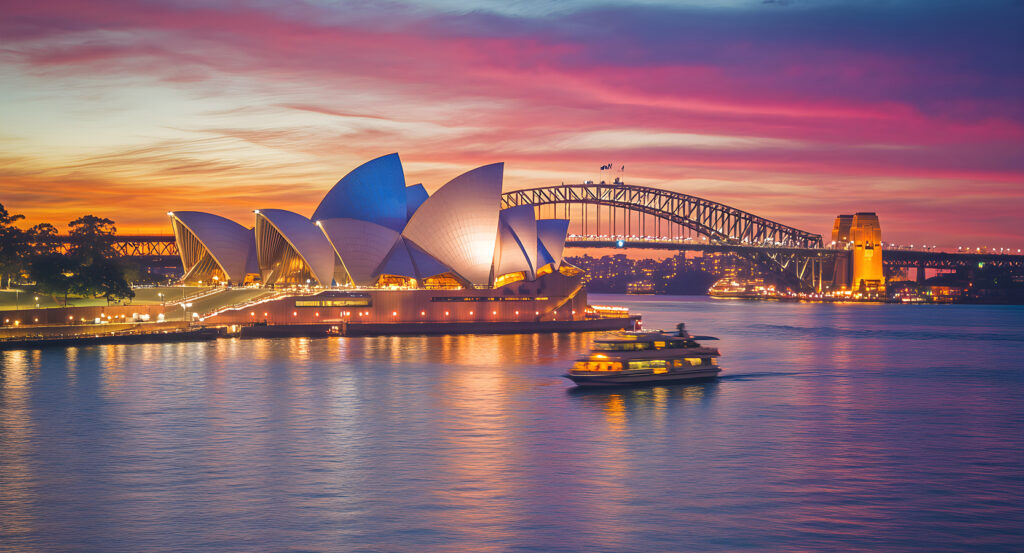
Why Circular Quay matters.
Circular Quay is a nineteenth-century maritime transport precinct where Sydney Cove's colonial port heritage meets the commercial development of New South Wales, the engineering of Sydney's metropolitan ferry network and the concentration of Australia's principal harborfront cultural institutions.
Curving along Alfred Street near George Street and just steps from Customs House, the waterfront occupies the southern shore of Sydney Cove between The Rocks and Bennelong Point, with ferry wharves projecting into the harbor beneath the elevated railway station and the surrounding commercial buildings. A broad pedestrian concourse connects the ferry terminals with the railway station, waterfront restaurants and adjoining public spaces. The shoreline follows the natural curve of the cove, retaining the geographical arrangement that attracted Sydney's earliest European settlement. Passenger vessels cross the water toward the harbor's northern and eastern suburbs. The result is a maritime interchange whose physical organization connects colonial port development, metropolitan transportation and the public waterfront of Central Sydney.
What defines Circular Quay.
Circular Quay is best known for its ferry terminals, elevated railway station and position at the center of Sydney's historic harbor transportation network. Its origins lie in Sydney Cove, where the First Fleet arrived in January 1788 under the command of Captain Arthur Phillip. The cove formed part of the traditional lands of the Gadigal people of the Eora Nation, whose communities maintained longstanding relationships with the harbor's marine resources. Phillip established the initial British settlement along the sheltered shoreline, creating the administrative and commercial center of the new colony of New South Wales. Early wharves and landing places developed as ships delivered supplies, transported convicts and connected the settlement with other colonial outposts. During the early nineteenth century, Sydney's expanding commercial economy increased demand for more substantial harbor infrastructure. The construction of Circular Quay began in 1837 under colonial engineer George Barney, involving the reclamation and reshaping of the shoreline to accommodate larger vessels and commercial operations. The project created a more formal waterfront, replacing portions of the original irregular shoreline with engineered wharves and retaining walls. Construction continued through the 1840s and 1850s as Sydney developed into a major port for trade, migration and regional transportation. The completion of the quay strengthened commercial connections between the harbor and the growing city, supporting warehouses, customs operations and shipping businesses. Steam-powered ferry services expanded during the nineteenth century, establishing regular passenger connections between the central city and settlements around Port Jackson. The opening of Sydney Harbour Bridge in 1932 altered the relationship between road, rail and ferry transportation, introducing a major fixed crossing to the northern suburbs. Circular Quay railway station opened in 1956, completing an important connection within Sydney's City Circle rail network. Its elevated platforms provided direct interchange between metropolitan trains and harbor ferries. Subsequent redevelopment consolidated passenger wharves and improved pedestrian circulation along the waterfront. The precinct became an important arrival point for international cruise vessels and a principal access route to the surrounding cultural institutions. Its continuing transportation functions preserve the relationship between Sydney's maritime origins and the infrastructure of the modern metropolitan region.
Where your story begins.
Foresyte Travel reveals places that feel extraordinary long before you arrive.
Enjoy editorial crafted for luxury travelers.

















































































































