Top places to stay in Amsterdam, Netherlands.
Amsterdam owes its distinctive hospitality heritage to the maritime prosperity of the Dutch Golden Age, when global trade, merchant wealth, and an expanding network of canals established the foundations of a cosmopolitan city renowned for its historic architecture, cultural sophistication, and international connections. Originating as a medieval settlement beside a dam on the Amstel River, Amsterdam developed into a major European trading center during the sixteenth century as merchants established commercial connections across the Baltic, Mediterranean, and Atlantic worlds. The founding of the Dutch East India Company in 1602 accelerated the concentration of international commerce in the city, attracting merchants, financiers, diplomats, and travelers whose presence supported an expanding network of inns and lodging houses. Amsterdam's seventeenth-century canal expansion created an unprecedented environment of substantial merchant residences, with the Herengracht, Keizersgracht, and Prinsengracht forming a carefully organized system of waterways, commercial streets, and prestigious residential addresses. Wealthy trading families commissioned imposing canal houses distinguished by elaborate gables, grand entrance halls, enclosed gardens, and richly decorated reception rooms, establishing the architectural foundations for the city's later tradition of intimate luxury hotels. The development of Amsterdam's financial institutions, including the Amsterdam Exchange Bank in 1609, strengthened its position as an international commercial capital and contributed to the prosperity of the merchant households whose residences became defining features of the historic center. The decline of Dutch maritime supremacy during the eighteenth century altered the city's economic position, but its extensive inheritance of canal houses, commercial buildings, and aristocratic residences preserved an unusually sophisticated urban environment for subsequent hospitality development. The nineteenth-century expansion of railway transportation and industrial commerce introduced new opportunities for grand hotel construction, particularly around Dam Square, the principal railway approaches, and the established commercial center. The Krasnapolsky Hotel developed from a coffeehouse acquired by Adolph Wilhelm Krasnapolsky in 1866 into one of Amsterdam's most prominent hospitality institutions, with its grand Winter Garden, completed in 1880, demonstrating the architectural ambitions of late nineteenth-century hotel development. The opening of the Amstel Hotel in 1867, designed by Cornelis Outshoorn, introduced an imposing expression of European grand hotel architecture overlooking the Amstel River, establishing a prestigious residential environment associated with international travelers and prominent cultural figures. The completion of Amsterdam Centraal in 1889, designed by Pierre Cuypers and Adolf Leonard van Gendt, strengthened the city's international railway connections and encouraged the development of substantial hotels near the historic waterfront. During the twentieth century, Amsterdam's expanding cultural institutions, international business community, and growing tourism economy supported the conversion of historic commercial properties into sophisticated accommodations. The restoration of canal houses for luxury hospitality became particularly influential as preservation policies protected the architectural character of the seventeenth-century center. The opening of The Dylan Amsterdam in 1999 within a historic canal-side property on Keizersgracht demonstrated the appeal of intimate design-oriented accommodation integrated into the city's residential heritage. The transformation of the former Amsterdam City Hall into Sofitel Legend The Grand Amsterdam established another prominent example of grand civic architecture adapted for contemporary luxury hospitality. The designation of Amsterdam's seventeenth-century canal ring as a UNESCO World Heritage Site in 2010 reinforced the international significance of the urban landscape surrounding many of its most prestigious hotels. Subsequent developments, including the conversion of historic bank buildings, grand public institutions, and industrial waterfront properties, established a hospitality industry distinguished by its integration of Dutch architectural preservation, contemporary design, and the commercial inheritance of one of Europe's most influential maritime capitals.
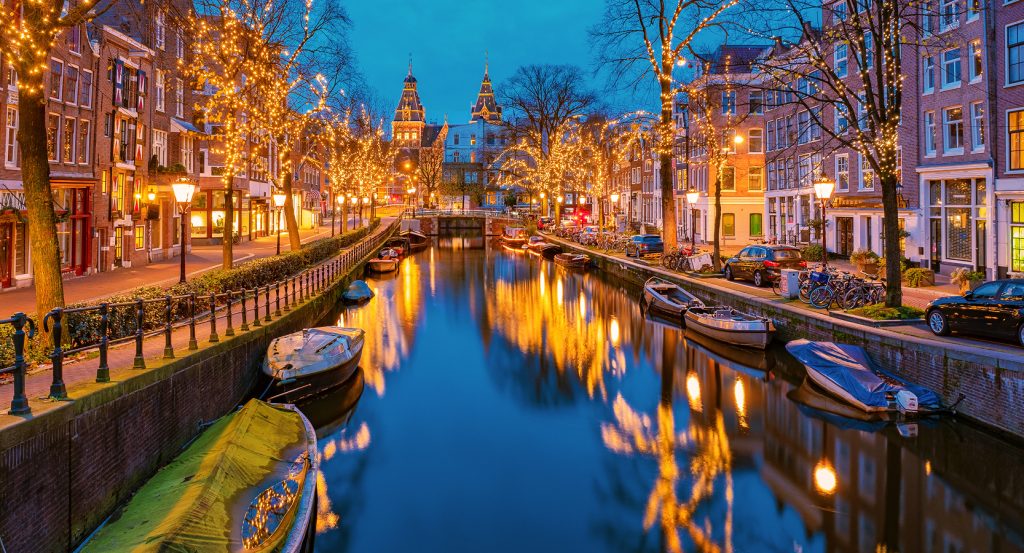
Amsterdam's hotel landscape follows the concentric organization of its seventeenth-century canal belt, the historic commercial streets surrounding Dam Square, and the transformation of former industrial waterfront districts into contemporary residential and cultural neighborhoods. The Grachtengordel occupies the most prestigious position within this landscape, where luxury hotels inhabit substantial canal houses overlooking the Herengracht, Keizersgracht, and Prinsengracht. These historic properties retain narrow street frontages, deep interior plans, elaborate stepped or bell-shaped gables, and enclosed rear gardens that reflect the architectural constraints and commercial prosperity of Golden Age Amsterdam. The Herengracht acquired particular distinction through its concentration of wealthy merchant residences, especially along the Gouden Bocht, or Golden Bend, where unusually broad canal houses and grand façades reflect the fortunes accumulated through international trade. The neighboring Keizersgracht and Prinsengracht contribute complementary accommodation environments through their combination of historic residential buildings, intimate bridges, waterside streets, and former commercial premises adapted into boutique hotels. The Nine Streets district, known as De Negen Straatjes, occupies a compact network of historic commercial streets connecting the principal canals, where independent boutiques, galleries, and restaurants contribute to a particularly intimate hospitality setting. The historic center surrounding Dam Square developed around Amsterdam's principal civic and commercial institutions, with substantial hotels occupying grand nineteenth-century buildings and former commercial properties near the Royal Palace and Nieuwe Kerk. The neighboring streets around the Oude Kerk and the medieval waterfront preserve an older urban fabric of narrow lanes, former warehouses, and historic trading premises, supporting accommodations closely connected to the city's earliest commercial districts. The Jordaan developed during the seventeenth-century expansion as a residential neighborhood for artisans, laborers, and immigrant communities, retaining a dense network of narrow streets, modest canal houses, enclosed courtyards, and neighborhood commercial buildings. Its accommodation character reflects this more intimate residential inheritance, with smaller boutique properties integrated into streets distinguished by independent shops and historic cafés. The Museum Quarter established a contrasting architectural environment through the nineteenth-century expansion of Amsterdam's affluent residential districts, with substantial townhouses, landscaped avenues, and grand cultural institutions surrounding Museumplein. The Rijksmuseum, designed by Pierre Cuypers, and the neighboring Concertgebouw contribute to an accommodation landscape associated with prestigious cultural institutions and elegant residential architecture. The adjoining Oud-Zuid district preserves extensive concentrations of late nineteenth- and early twentieth-century villas, substantial apartment buildings, and broad tree-lined streets, supporting distinguished hotels within one of Amsterdam's most established residential environments. De Pijp developed through the city's nineteenth-century population expansion, retaining dense residential blocks, traditional apartment buildings, and commercial streets associated with the Albert Cuyp Market, creating a more neighborhood-oriented setting for contemporary boutique accommodation. Along the Amstel River, prestigious hotels occupy prominent waterfront positions near historic bridges, grand civic buildings, and the former commercial approaches to the eastern harbor. The Plantage district retains a particularly distinguished landscape of nineteenth-century institutions, broad avenues, and established green spaces surrounding the Hortus Botanicus and ARTIS Amsterdam Royal Zoo, supporting intimate accommodations within historic residential and institutional buildings. Farther east, the Eastern Docklands developed through the transformation of former maritime infrastructure into contemporary residential neighborhoods, with converted warehouses, modern architectural projects, and substantial waterfront properties reflecting Amsterdam's changing relationship with its harbor. Amsterdam-Noord presents another expression of this transformation through the redevelopment of former shipyards and industrial sites along the northern bank of the IJ, where contemporary hotels occupy modern towers and adapted industrial buildings connected to the historic center by ferry. The NDSM Wharf contributes a particularly distinctive architectural setting through its grand former shipbuilding halls, industrial structures, and contemporary cultural institutions. These geographic distinctions establish an accommodation landscape extending from Golden Age canal palaces and intimate merchant-house retreats to grand civic hotels, elegant museum-quarter residences, and contemporary properties occupying Amsterdam's transformed maritime waterfront. Foresyte may earn a commission when you book.
Foresyte Travel's top five choices.
5. De L'Europe
De L'Europe occupies a prominent Amstel River site whose hospitality history began with an inn established beside the seventeenth-century Rondeel defensive tower, embedding the property within Amsterdam's former system of fortifications. The existing neo-Renaissance building was completed in 1896 to designs by Willem Hamer Jr., giving the riverfront hotel its turreted silhouette directly opposite the Muntplein. Alfred Heineken acquired the property in the 1950s, beginning the long association between De L'Europe and the Heineken family that subsequently shaped its collection of Dutch art and its preservation as an independently characterized grand hotel. The building's riverfront architecture, centuries-old hospitality site and Heineken stewardship connect De L'Europe directly with Amsterdam's evolution from fortified trading city to international cultural capital.
4. Hotel TwentySeven
Hotel TwentySeven occupies the upper floors of the Koninklijke Industrieele Groote Club on Dam Square, placing the hotel inside a protected early-twentieth-century building at the ceremonial center of Amsterdam. Architect Foeke Kuipers designed the structure in a richly ornamented historicist style for an institution created through the merger of two prominent Amsterdam clubs, giving its interiors and façade direct ties to the city's commercial elite. Hotelier Eric Toren transformed part of the building into Hotel TwentySeven, commissioning Wim van de Oudeweetering to develop interiors around extensive custom craftsmanship, layered textiles, stone and individually conceived decorative schemes. The conversion inserted an intimate contemporary hotel into a building whose original purpose reflected Dam Square's longstanding role as the meeting point of Amsterdam's civic, financial and commercial institutions.
3. Pulitzer Amsterdam
Pulitzer Amsterdam occupies an interconnected ensemble of 25 seventeenth and eighteenth-century canal houses spanning the Prinsengracht and Keizersgracht, turning Amsterdam's historic domestic architecture into the physical structure of the hotel itself. Peter Pulitzer, grandson of newspaper publisher Joseph Pulitzer, assembled the original property from adjoining canal houses during the 1960s, establishing a hotel whose expansion followed the irregular plots, staircases and internal courtyards inherited from centuries of urban development. Jacu Strauss later directed a comprehensive redesign that treated the houses as distinct historical environments, preserving their differing proportions and architectural details across the larger composition. The property functions as an unusually concentrated expression of Amsterdam's canal-house urbanism, with the hotel's fragmented plan retaining the parcel structure that shaped the seventeenth-century Canal Ring.
2. Mandarin Oriental Conservatorium, Amsterdam
Mandarin Oriental Conservatorium, Amsterdam occupies the former Rijkspostspaarbank building designed by Dutch architect Daniël Knuttel and completed at the end of the nineteenth century before the Sweelinck Conservatory transformed the complex into a center for musical education. Italian architect Piero Lissoni subsequently converted the protected building into a hotel, inserting a grand glass-and-steel structure within the original brick architecture and turning the former courtyard into its principal interior gathering space. The transformation preserved Knuttel's masonry, decorative tilework and grand staircases as components of a contemporary composition directly beside Museumplein and the Rijksmuseum. Mandarin Oriental assumed management in 2026, giving the group's first Amsterdam property an architectural lineage spanning Dutch banking, music education and one of the city's most substantial adaptive-reuse projects.
1. Waldorf Astoria Amsterdam
Waldorf Astoria Amsterdam occupies six interconnected seventeenth and eighteenth-century canal palaces on the Herengracht, including houses associated with some of the most powerful families of the Dutch Republic. The ensemble contains a grand staircase attributed to architect Daniel Marot, whose work for William III introduced an influential form of Louis XIV classicism into Dutch architecture after his arrival from France. Restoration joined the protected interiors into a single hotel while preserving historic ceilings, fireplaces, staircases and period rooms across properties originally constructed as independent patrician residences. Behind the canal façades, the houses open onto an extensive private garden formed from their historic rear plots, giving the hotel a surviving spatial relationship between Herengracht mansions and garden grounds that reaches directly into Amsterdam's Golden Age urban development.
Where your story begins.
Foresyte Travel reveals places that feel extraordinary long before you arrive.
Enjoy editorial crafted for luxury travelers.
Foresyte may earn a commission when you book.