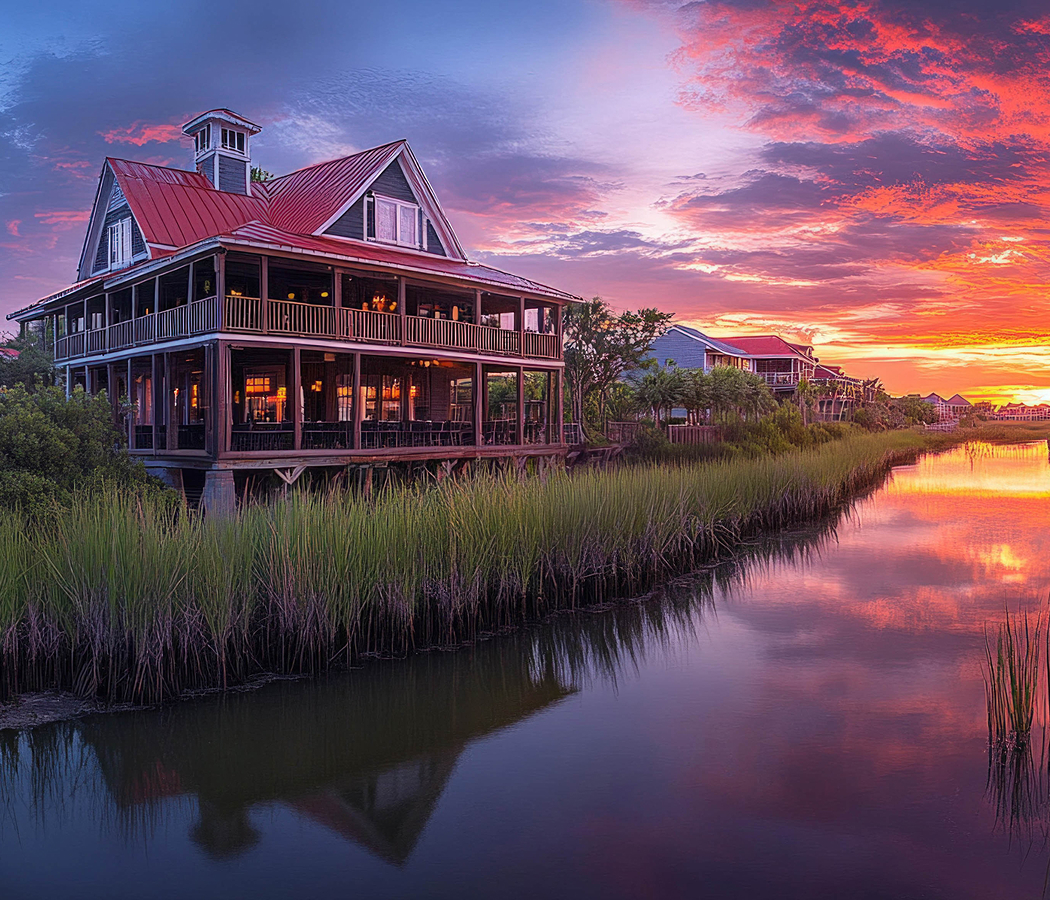
Top places to stay in Charleston, South Carolina.
Charleston traces its hospitality heritage to the maritime wealth of colonial South Carolina, the influence of Atlantic trade, and the architectural refinement of its eighteenth-century merchant society, with the preservation of historic townhouses, courtyard gardens, and Lowcountry culinary traditions shaping an enduring culture of Southern hospitality. Founded as Charles Town in 1670, the settlement moved to its present peninsula in 1680, occupying a strategic position between the Ashley and Cooper rivers. Its harbor connected the Carolina Lowcountry with Atlantic trading networks, bringing merchants, sailors, government officials, and travelers into a rapidly expanding colonial economy. Rice and indigo exports generated immense wealth through the labor of enslaved Africans, whose agricultural knowledge and skilled craftsmanship were fundamental to the region's prosperity. Affluent households developed formal traditions of reception within substantial townhouses, and commercial inns accommodated visitors conducting business near the waterfront. The opening of the Planters Hotel in 1809 established an important institution for travelers arriving in the prosperous port. During the antebellum period, Charleston's social calendar revolved around private dinners, assemblies, and seasonal gatherings, supporting an increasingly elaborate hospitality economy. The opening of the Charleston Hotel in 1836 introduced a grand establishment at Meeting and Hayne streets, reflecting the city's commercial ambitions and architectural refinement. The Civil War devastated Charleston's economy, with the bombardment of the city and the destruction of slavery transforming the foundations of its commercial society. Reconstruction brought profound economic and political change, followed by decades of limited investment that contributed to the survival of substantial portions of the historic urban fabric. The founding of the Society for the Preservation of Old Dwellings in 1920 strengthened organized architectural conservation, encouraging renewed appreciation of Charleston's historic residences. The opening of the Francis Marion Hotel in 1924 introduced a prominent metropolitan landmark overlooking Marion Square, reflecting the growing importance of automobile travel and regional tourism. The establishment of the Historic Charleston Foundation in 1947 further strengthened preservation efforts, supporting the restoration of distinguished buildings and neighborhoods. The inaugural Spoleto Festival USA in 1977 brought international performing arts to the city, encouraging cultural tourism and expanding demand for sophisticated accommodation. The opening of Charleston Place in 1986 marked a major investment in downtown luxury hospitality, connecting prestigious accommodation with the commercial revival of the historic center. Subsequent decades brought the conversion of former warehouses, merchant houses, and substantial residences into intimate boutique hotels. Charleston's contemporary hospitality character remains inseparable from the fortunes of its port, the architectural inheritance of its merchant elite, the labor and cultural contributions of African Americans, and the preservation movement that shaped the modern city.
Charleston's most distinguished places to stay occupy a compact peninsula whose historic streets extend between two tidal rivers toward the harbor, creating an intimate urban landscape of church steeples, enclosed gardens, and carefully preserved architecture. The French Quarter forms one of the most atmospheric accommodation districts, with boutique hotels occupying restored commercial buildings and historic residences near the waterfront. Narrow streets, substantial brick warehouses, and elegant townhouses preserve the architectural character of the former mercantile center. The district's position near Waterfront Park provides access to landscaped promenades overlooking the Cooper River and the harbor beyond. Westward, the streets surrounding King Street establish Charleston's principal corridor of shopping, dining, and metropolitan hospitality. Prestigious hotels occupy substantial historic buildings and contemporary properties along its commercial blocks, connecting accommodation with independent boutiques, galleries, and established restaurants. The adjoining streets of the Historic District preserve an exceptional concentration of Charleston single houses, whose narrow street-facing elevations and long side piazzas respond to the coastal climate. Raised foundations, shuttered windows, and enclosed gardens contribute to a distinctive residential architecture shaped by heat, humidity, and prevailing breezes. South of Broad Street, substantial eighteenth- and nineteenth-century residences occupy carefully maintained streets extending toward the peninsula's southern waterfront. The Battery presents an especially distinguished architectural setting through grand historic houses overlooking the harbor and the landscaped promenade of White Point Garden. Accommodation in this southern district tends toward intimate historic properties and carefully restored residences, with the surrounding streets preserving a quieter residential atmosphere. Northward, the Market Street corridor occupies a central position between the historic waterfront and the principal commercial avenues. Hotels near the Charleston City Market provide convenient access to the city's established shopping streets, restaurants, and cultural attractions. The surrounding architectural environment combines restored commercial buildings, traditional brick façades, and substantial contemporary hotels designed within the historic urban scale. Farther north, the neighborhoods surrounding Marion Square introduce a more metropolitan setting through substantial early twentieth-century buildings, historic churches, and established cultural institutions. Upper King Street extends beyond the square through a lively district of restored commercial properties, contemporary restaurants, and boutique accommodation. The neighboring Cannonborough-Elliotborough area preserves a more residential character through historic cottages, narrow streets, and carefully adapted former commercial buildings. Westward, Harleston Village occupies an established residential landscape near the Ashley River, with substantial historic houses, landscaped gardens, and the academic buildings of the College of Charleston. The district's quieter streets provide an intimate setting within walking distance of the historic commercial center. Across the Cooper River, Mount Pleasant introduces a contrasting coastal environment through contemporary hotels, established residential communities, and waterfront views toward the Charleston peninsula. The neighboring barrier islands of Sullivan's Island and Isle of Palms extend the region's hospitality geography toward the Atlantic, with beach houses, resort properties, and broad sandy shorelines defining a separate tradition of coastal leisure. Farther southwest, Kiawah Island presents a secluded resort landscape through maritime forests, tidal marshes, championship golf courses, and substantial oceanfront accommodation. These settings create a distinctive relationship between preserved urban architecture and the natural environments of the Lowcountry, extending Charleston's hospitality traditions from intimate historic residences to prestigious waterfront and island resorts. Foresyte may earn a commission when you book.
Foresyte Travel's top five choices.
5. French Quarter Inn
French Quarter Inn occupies a site near the Charleston City Market within the historic commercial district that developed between Meeting Street and the Cooper River. The hotel emerged from the late-twentieth-century revival of the blocks surrounding Market Street, where preservation and reinvestment transformed a formerly utilitarian commercial corridor into one of the city's principal hospitality districts. Its architecture draws from Charleston's historic urban style through masonry façades, arched openings, ironwork and an interior courtyard, integrating a purpose-built hotel into the scale of the surrounding streets. The property belongs to the modern chapter of Charleston preservation, when renewed investment around the City Market extended the economic life of the historic center through hospitality and adaptive urban development.
4. The Spectator Hotel
The Spectator Hotel opened in 2015 near the Charleston City Market with a design program rooted in the city's prosperity during the 1920s and the decorative language of the Jazz Age. Charleston architect Liollio Architecture developed the building to fit the scale and architectural rhythms of the surrounding historic district, with an exterior shaped by masonry, traditional proportions and carefully articulated street frontage. Jenny Keenan Design translated the period concept into interiors built around lacquered surfaces, brass detailing, custom furnishings and graphic patterns, giving the property a specific connection to the vivacious decorative arts of the interwar era. The Spectator interprets a distinct period of Charleston social history through contemporary architecture and design within the dense commercial fabric surrounding the City Market.
3. The Dewberry Charleston
The Dewberry Charleston occupies the former L. Mendel Rivers Federal Building, completed in 1964 during an era when modernist government architecture was reshaping American civic centers. Architect L. F. Wingard designed the structure in a restrained mid-century language that sharply distinguished it from Charleston's celebrated Georgian, Federal and Greek Revival architecture surrounding Marion Square. Developer John Dewberry acquired the long-vacant building and undertook an extensive transformation that preserved its structural identity, limestone exterior and disciplined horizontal geometry before the hotel opened in 2016. The project gave Charleston an unusually prominent example of mid-century preservation, extending the city's conservation culture beyond its colonial and antebellum architecture to a consequential work of postwar civic design.
2. Zero George
Zero George occupies a collection of historic buildings centered on 0 George Street in Charleston's Ansonborough neighborhood, including residences and dependencies dating to the early nineteenth century. The complex incorporates the restored 1804 main house alongside carriage houses and other structures arranged around landscaped courtyards, preserving the intimate spatial relationships characteristic of Charleston's historic domestic compounds. Original heart-pine floors, architectural millwork and piazzas retain substantial evidence of the craftsmanship and building traditions that shaped the city's residential architecture during the early republic. Its conversion into a hotel preserved the scale of an urban residential ensemble, making Charleston's historic house-and-outbuilding pattern the physical foundation of the property.
1. Hotel Bennett
Hotel Bennett occupies the western edge of Marion Square, a civic space whose history extends from eighteenth-century fortifications through military use and the development of modern Central Charleston. Local businessman Michael Bennett pursued the hotel project for years on the former site of the Charleston County Library, ultimately opening the property in 2019 after one of the most closely watched developments in the city's historic center. Fairfax & Sammons designed the building through classical forms, limestone and locally responsive architectural details intended to address Marion Square and the surrounding fabric of King Street. The hotel represents a major twenty-first-century intervention on one of Charleston's most historically layered public spaces, linking private development with the continuing architectural evolution of the city's civic core.
Where your story begins.
Foresyte Travel reveals places that feel extraordinary long before you arrive.
Enjoy editorial crafted for luxury travelers.
Foresyte may earn a commission when you book.