Top places to stay in Bangkok, Thailand.
Bangkok evolved from a riverside royal city into an international center of commerce, diplomacy, and luxury travel. King Rama I established Bangkok as the capital of Siam in 1782, transferring the royal seat to the eastern bank of the Chao Phraya River. Canals, floating markets, and river landings supported a commercial economy in which visiting merchants found accommodation near trading houses and waterfront communities. During the nineteenth century, expanding relations with European powers introduced new diplomatic missions, commercial enterprises, and international travelers. The Bowring Treaty of 1855 accelerated foreign trade, strengthening the importance of the riverfront districts surrounding Bang Rak. The Oriental Hotel opened in 1876, establishing an enduring institution associated with visiting writers, diplomats, and affluent travelers. Its Authors' Wing subsequently became a celebrated expression of Bangkok's literary and colonial-era hospitality heritage. King Chulalongkorn's modernization programs expanded transportation infrastructure and encouraged the construction of grand avenues, railway facilities, and European-influenced buildings. The opening of Hua Lamphong railway station in 1916 strengthened connections between the capital and provincial destinations, bringing additional commercial travelers into the city. The Royal Hotel opened near Sanam Luang in 1943, providing accommodation close to Bangkok's principal ceremonial district. Following the Second World War, expanding aviation and international commerce transformed the city's visitor economy. The Erawan Hotel opened in 1956 beside Ratchaprasong, establishing a prestigious address associated with international visitors and official guests. The Dusit Thani Bangkok opened in 1970, introducing a landmark high-rise hotel overlooking Lumphini Park and signaling the growing ambitions of Thailand's luxury hospitality industry. During the following decades, substantial international hotels appeared along Sukhumvit Road, Silom Road, and the riverfront, reflecting expanding business travel and tourism. The opening of Suvarnabhumi Airport in 2006 strengthened Bangkok's role as a major Asian aviation hub. Luxury development subsequently embraced restored riverside properties, sophisticated urban towers, and contemporary resorts inspired by traditional Thai architecture. Bangkok's hotel history reflects the continuing influence of royal patronage, international trade, and a remarkable capacity to combine established traditions of service with metropolitan reinvention.
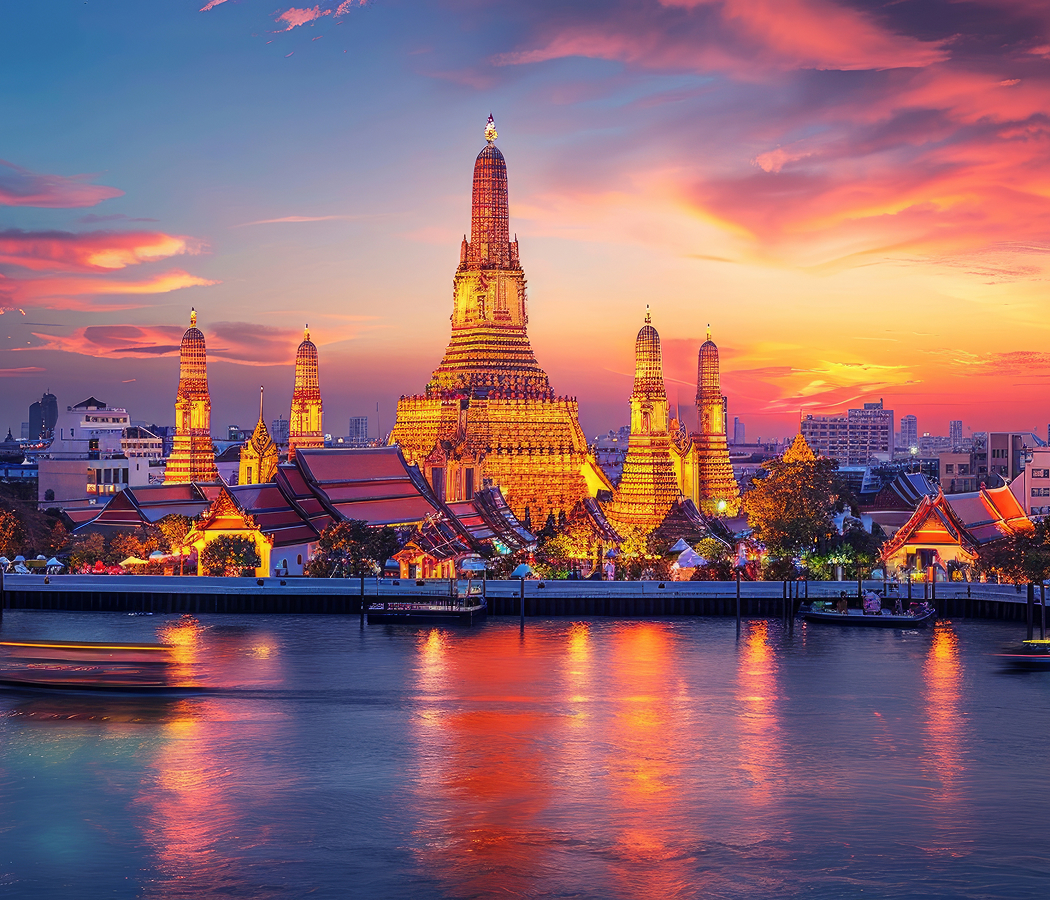
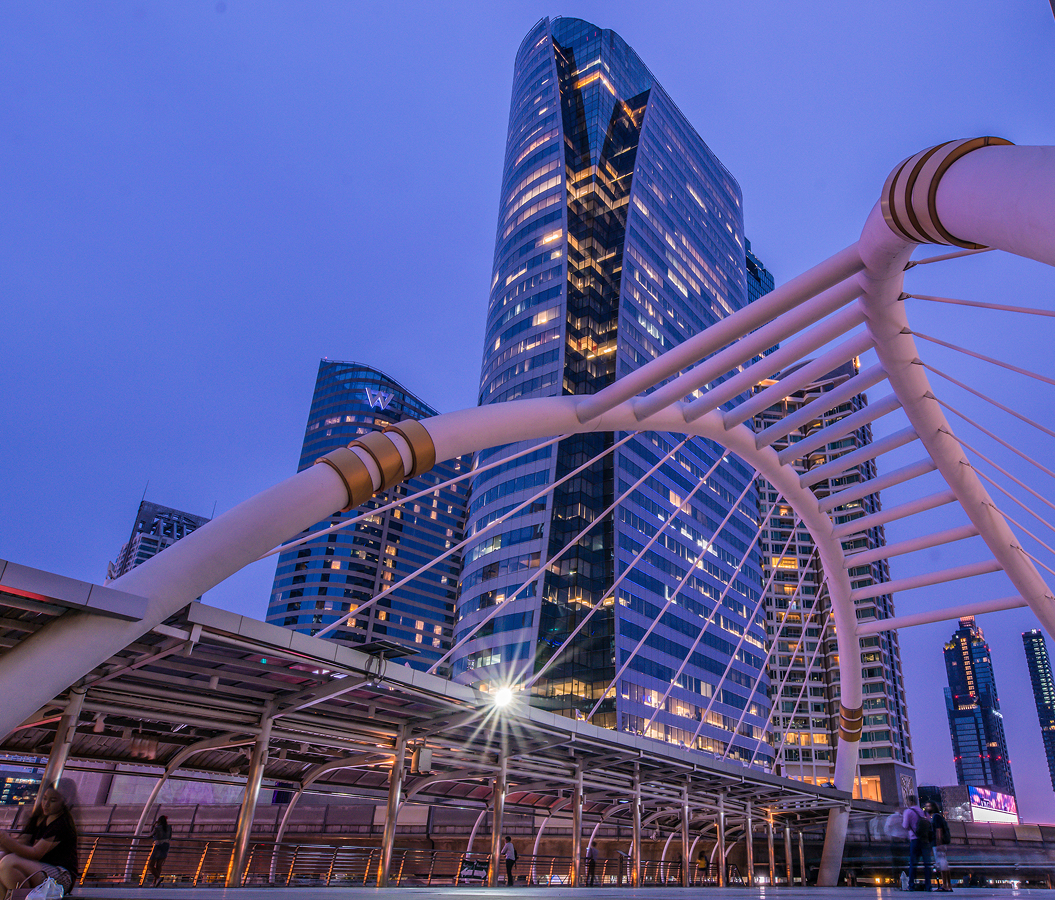
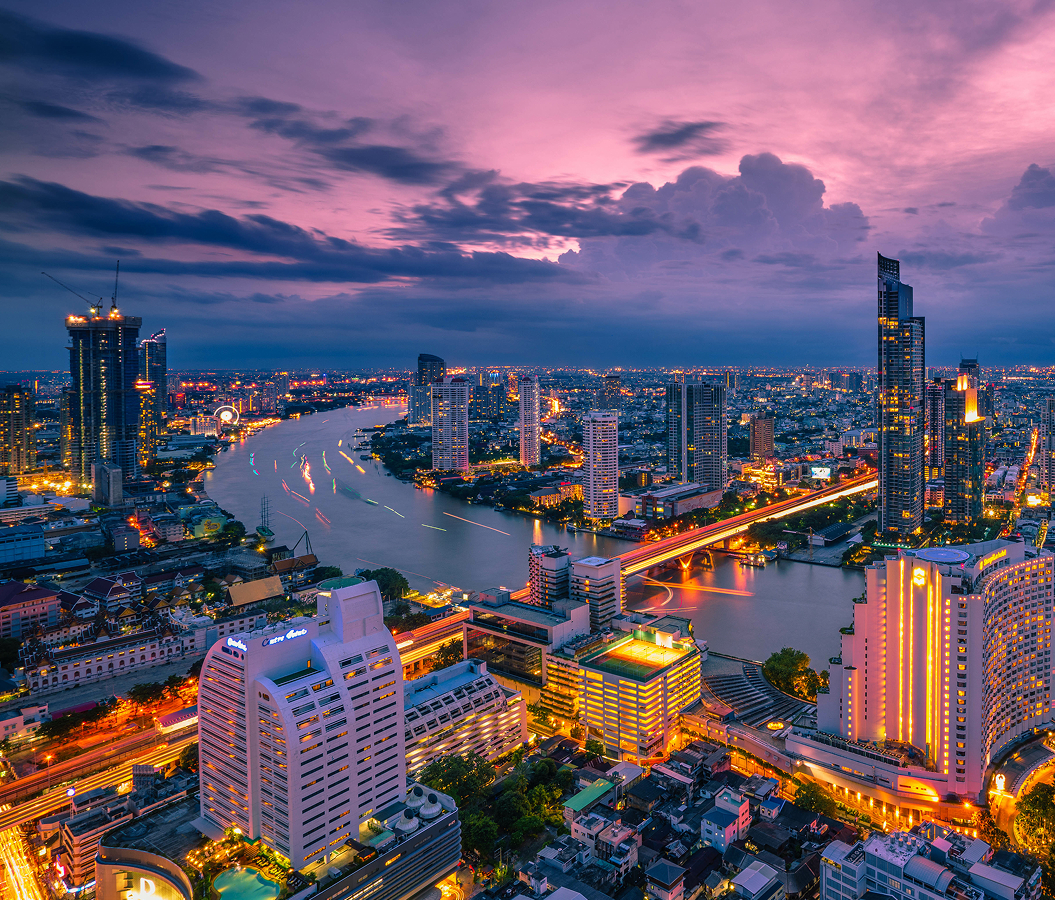
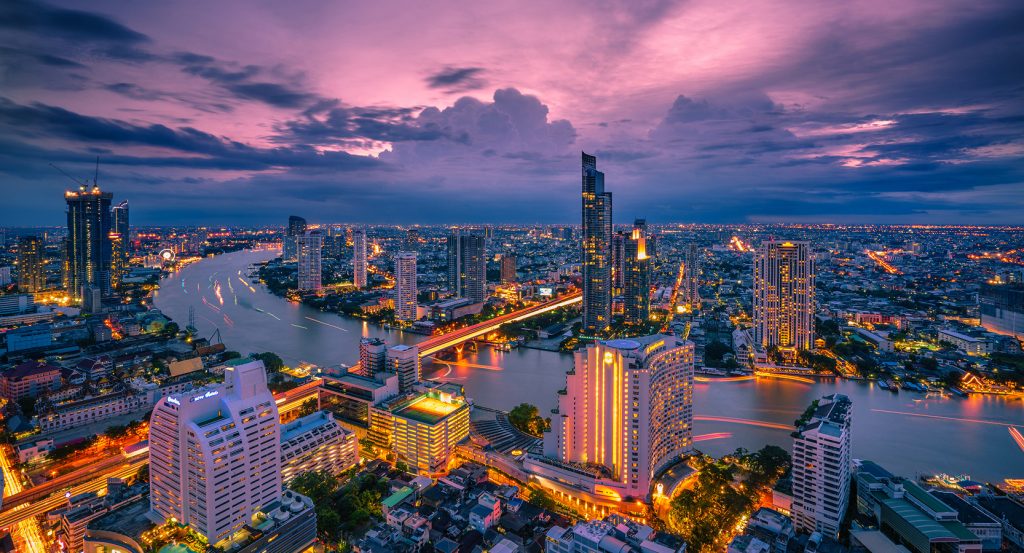
Bangkok's hotel geography follows the Chao Phraya River and the elevated transit corridors extending eastward through a vast metropolitan landscape of temples, commercial towers, and residential neighborhoods. The Riverside district provides the capital's most atmospheric luxury setting, particularly along the eastern bank between Si Phraya and Sathon. Prestigious hotels occupy substantial waterfront sites with landscaped gardens, private piers, and terraces overlooking the constant movement of riverboats. Contemporary towers stand alongside restored historic buildings, and river-facing suites frame views of illuminated temples and the surrounding skyline. Across the water, Thonburi offers a quieter environment through traditional canal communities, residential streets, and secluded waterfront properties. Luxury accommodation near the river emphasizes spacious grounds and a more intimate relationship with Bangkok's historic waterways. Northward, Rattanakosin forms the ceremonial heart of the capital, where grand temple complexes, royal institutions, and historic commercial streets create a distinctive architectural landscape. Boutique hotels occupy restored shophouses and traditional buildings near the Grand Palace, with internal courtyards and rooftop terraces providing intimate settings within the historic district. Eastward, the neighborhoods surrounding Yaowarat introduce a dense urban environment of traditional Chinese commercial buildings, markets, and narrow streets animated by restaurants and specialty shops. Small design hotels occupy adapted heritage properties, providing access to Bangkok's celebrated Chinatown dining culture. South of the historic center, Bang Rak extends through established commercial streets and substantial office buildings near the river. Its accommodation combines prestigious international properties with intimate boutique establishments near galleries, restaurants, and major transportation connections. Farther east, Silom and Sathon form an important business and luxury hotel corridor, with contemporary towers rising above landscaped avenues and established residential streets. Properties near Lumphini Park benefit from access to expansive green space and the surrounding commercial districts. Northward, Siam and Ratchaprasong occupy Bangkok's principal luxury shopping environment, where substantial hotels connect directly with major retail complexes, pedestrian skywalks, and elevated rail stations. The district's architecture emphasizes contemporary glass towers, sophisticated commercial interiors, and convenient access to cultural attractions. Eastward, Sukhumvit Road extends through a succession of international residential and hospitality neighborhoods. Asok offers major transportation connections and substantial business hotels, and Phrom Phong presents an upscale environment through refined shopping centers, restaurants, and contemporary residential towers. Farther east, Thong Lo and Ekkamai contain design-oriented boutique hotels, sophisticated dining establishments, and quieter residential streets. Across Bangkok, accommodation ranges from ceremonial riverside luxury and intimate historic properties to contemporary high-rise hotels embedded within the capital's energetic commercial neighborhoods. Foresyte may earn a commission when you book.
Foresyte Travel's top five choices.
5. The Peninsula Bangkok
The Peninsula Bangkok opened in 1998 on the Thonburi bank of the Chao Phraya River, extending the Hongkong and Shanghai Hotels group into a city whose historic development has always been inseparable from the waterway. Architects Tandem Architects and Design 103 conceived a distinctive W-shaped tower that angles its principal elevations toward the river, giving the building a sculptural profile across from Bangkok's older commercial core. Its location placed a major international hotel on the western bank during a period when Bangkok's highest-profile hospitality properties remained concentrated across the river. The Peninsula's dedicated boats strengthened the river itself as an organizing element connecting the property with Central Bangkok. The hotel helped establish Thonburi's waterfront as part of the modern luxury geography of the Chao Phraya.
4. The Siam
The Siam opened in 2012 on the Chao Phraya River in Bangkok's Dusit district as a project of the Sukosol family, whose hospitality history in Thailand spans generations. Musician and actor Krissada Sukosol Clapp shaped the property with architect and designer Bill Bensley, assembling an intensely personal collection of Thai antiques, artworks, historic photographs, and architectural fragments throughout the complex. Bensley organized the hotel around courtyards, gardens, monochromatic interiors, and strong Art Deco references that depart sharply from conventional Thai resort architecture. Several historic teak houses associated with art collector Connie Mangskau were relocated to the grounds and incorporated into the property. The Siam turns one family's collecting, cultural interests, and hospitality lineage into an unusually personal architectural composition along Bangkok's quieter northern riverfront.
3. Capella Bangkok
Capella Bangkok opened in 2020 on the Chao Phraya as a central component of Chao Phraya Estate, the riverfront development created by Country Group Development. Hamiltons International designed the low-rise hotel to stretch horizontally along the water, giving the river greater architectural importance than the vertical skyline dominating much of Central Bangkok. BAMO developed the interiors around stone, timber, restrained surfaces, and broad openings that maintain the Chao Phraya as the dominant visual element throughout the property. Its arrival formed part of a major redevelopment of the Charoen Krung waterfront, a corridor whose nineteenth-century road and river commerce helped shape Bangkok's transition into a modern capital. Capella Bangkok represents the twenty-first-century reinvestment transforming one of the city's oldest commercial corridors into a new concentration of riverfront hospitality.
2. Four Seasons Hotel Bangkok at Chao Phraya River
Four Seasons Hotel Bangkok at Chao Phraya River opened in 2020 within Chao Phraya Estate, establishing a new Bangkok flagship for the company after its former Rajadamri property changed brands. Architect Jean-Michel Gathy designed the riverfront complex as a succession of low horizontal volumes, courtyards, pools, terraces, and water surfaces descending toward the Chao Phraya. The composition deliberately makes the river and open sky dominant elements across a site surrounded by Bangkok's dense vertical development. Contemporary Thai art forms another structural component of the property, extending through dedicated exhibition spaces and commissioned works integrated into the architecture. Four Seasons helped reposition the historic Charoen Krung corridor through a form of urban resort architecture organized around the river that drove Bangkok's growth for centuries.
1. Mandarin Oriental, Bangkok
Mandarin Oriental, Bangkok traces its history to the Oriental Hotel, established beside the Chao Phraya during the nineteenth century as Bangkok expanded its commercial connections with Europe and the wider world. The Authors' Wing preserves the architectural memory of that early hotel and its associations with writers including Joseph Conrad, Somerset Maugham, and Noël Coward. Danish businessmen Hans Niels Andersen and his partners transformed the Oriental during the late nineteenth century, establishing a grand hotel serving the merchants, diplomats, and travelers moving through Siam's principal port city. Thai entrepreneur Italthai leader Itthiphol Tangkaravakoon?
Where your story begins.
Foresyte Travel reveals places that feel extraordinary long before you arrive.
Enjoy editorial crafted for luxury travelers.
Foresyte may earn a commission when you book.