
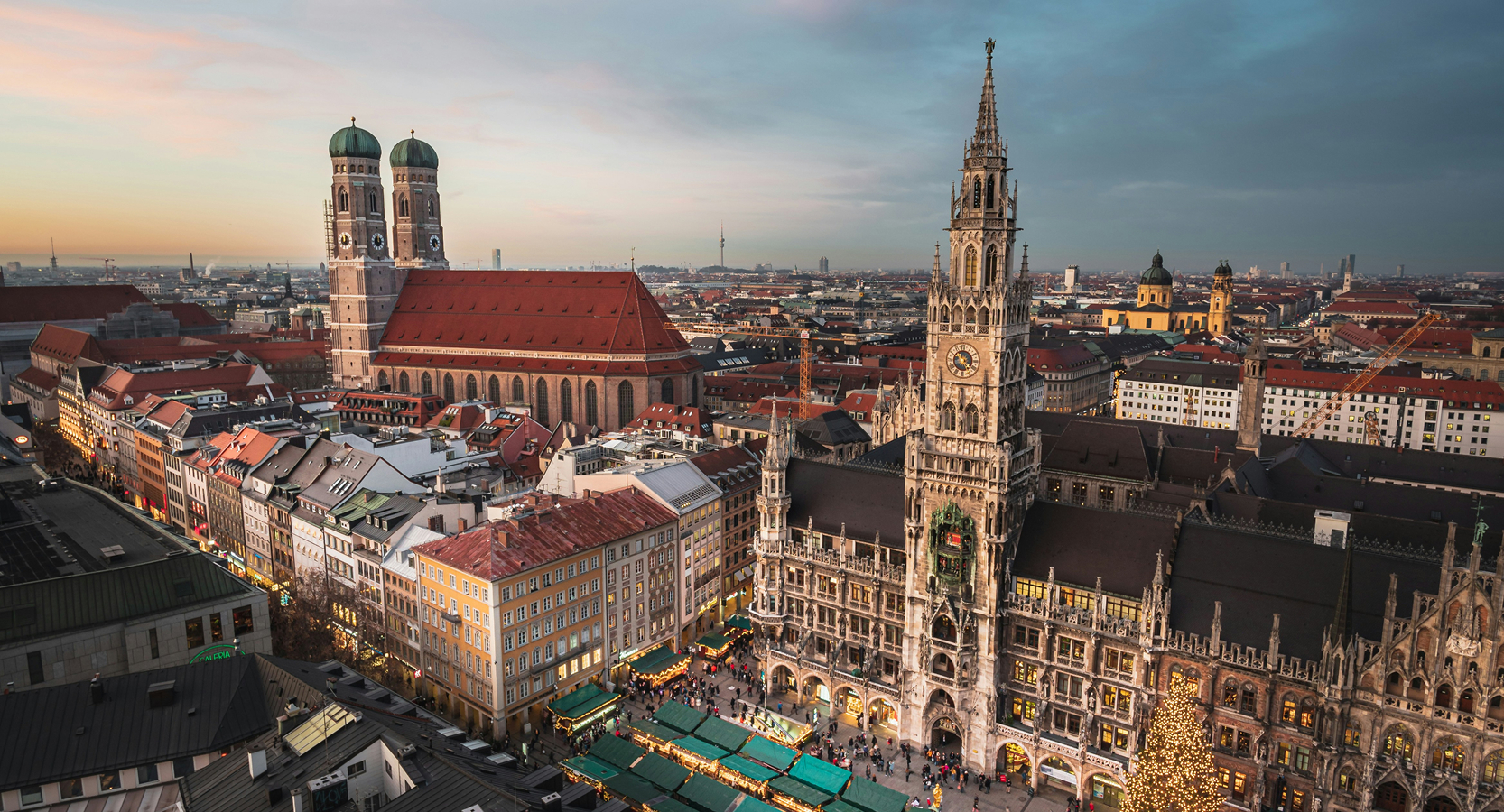
Top places to stay in Munich, Germany.
Munich's development into one of Europe's most storied cities grew from the wealth of the Bavarian monarchy, the commercial importance of its brewing industry, and the arrival of international travelers drawn to its royal collections and celebrated festivals. Founded in 1158 under Henry the Lion, Munich developed around a market crossing of the Isar River and became the principal residence of the Wittelsbach dynasty in 1255. Its position as a ducal capital brought merchants, courtiers, and visiting officials to inns clustered around the central marketplace. The establishment of the Kingdom of Bavaria in 1806 elevated Munich's political standing, and royal patronage under Ludwig I transformed the city through expansive architecture, museums, and ceremonial boulevards. Railway connections beginning in 1839 accelerated commercial travel and encouraged increasingly sophisticated accommodation near the principal station. The Bayerischer Hof opened in 1841 under the patronage of King Ludwig I, establishing a prestigious address for aristocrats, diplomats, and prominent international visitors. The inauguration of Oktoberfest in 1810, celebrating the marriage of Crown Prince Ludwig and Princess Therese, had already created a recurring attraction that would eventually become one of the world's most recognizable festivals. Industrial expansion during the late nineteenth century strengthened Munich's position as a center of manufacturing, publishing, and commerce. The Hotel Vier Jahreszeiten opened on Maximilianstraße in 1858, becoming an elegant institution associated with the city's fashionable royal boulevard. Munich's cultural prominence during the Belle Époque attracted artists, composers, and intellectuals whose presence supported a sophisticated metropolitan hospitality economy. The Nazi dictatorship and Second World War brought persecution, destruction, and the devastation of much of the historic center. Postwar reconstruction restored major hotels and commercial districts as Munich emerged as the prosperous capital of Bavaria within West Germany. The 1972 Summer Olympics accelerated infrastructure development and expanded international accommodation, although the terrorist attack on Israeli athletes profoundly marked the Games. Subsequent growth in technology, finance, and international trade broadened demand for luxury and business hotels. The opening of Munich Airport at its present location in 1992 strengthened global connections. Contemporary investment has introduced design-oriented boutique properties, restored historic buildings, and sophisticated urban hotels. Munich's hospitality character reflects the enduring influence of Bavarian royal patronage, commercial prosperity, and a festival culture that continues to attract visitors from around the world.
Munich's hotel landscape extends across a relatively compact historic center and an expansive collection of residential districts, with accommodation shaped by expansive boulevards, landscaped parks, and the architectural character of the Bavarian capital. Altstadt-Lehel forms the principal luxury district, organized around Marienplatz, the Frauenkirche, and the pedestrian streets of the historic core. Prestigious hotels occupy prominent positions near major shopping avenues, with substantial stone façades, refined interiors, and intimate courtyards contributing to the atmosphere. The surrounding streets connect important museums, historic churches, and established restaurants within a highly walkable environment. Eastward, Lehel introduces a quieter residential setting through elegant apartment buildings, traditional streets, and proximity to the southern reaches of the Englischer Garten. Boutique accommodation occupies carefully restored properties near the Isar, offering access to landscaped riverbanks and established neighborhood restaurants. North of the historic center, Maxvorstadt presents one of Munich's most distinguished cultural environments through expansive museum buildings, university institutions, and broad nineteenth-century avenues. Hotels near Königsplatz and the surrounding streets provide convenient access to major art collections and a sophisticated collection of cafés and galleries. Farther north, Schwabing combines substantial historic apartment buildings with lively commercial corridors and intimate residential streets. Accommodation near Leopoldstraße offers access to restaurants, independent businesses, and the extensive green spaces of the Englischer Garten. The neighborhood's architectural character reflects Munich's longstanding association with artists and intellectual communities. West of the central districts, Ludwigsvorstadt occupies an important transportation and commercial setting around München Hauptbahnhof. Hotels range from substantial international properties to smaller independent establishments, offering convenient connections to regional rail services and major urban attractions. The adjoining Isarvorstadt district provides a more intimate atmosphere through restored residential buildings, independent restaurants, and established neighborhood streets. Its Gärtnerplatz area is particularly attractive for visitors seeking a lively pedestrian environment near the historic center. Southward, the Glockenbachviertel presents another distinctive urban setting through colorful apartment buildings, boutique shops, and an energetic dining scene. East of the Isar, Haidhausen preserves a village-like character through historic squares, substantial residential blocks, and traditional commercial streets. Boutique hotels and contemporary properties near Rosenheimer Platz provide access to cultural venues and convenient transportation connections. Farther east, Bogenhausen offers a more prestigious residential landscape through substantial villas, elegant apartment buildings, and landscaped streets overlooking the river valley. Luxury accommodation emphasizes privacy and proximity to established cultural institutions. Northwest of the center, Neuhausen-Nymphenburg introduces a greener environment through broad avenues, residential neighborhoods, and the extensive grounds surrounding Nymphenburg Palace. Hotels in this area provide a quieter alternative to the central commercial districts. Across Munich, accommodation ranges from ceremonial luxury properties and sophisticated design hotels to intimate neighborhood establishments, with each district contributing a distinct expression of Bavarian architectural and urban character. Foresyte may earn a commission when you book.
Foresyte Travel's top five choices.
5. Hotel Vier Jahreszeiten Kempinski München
Hotel Vier Jahreszeiten Kempinski München opened in 1858 on Maximilianstraße under King Maximilian II, who sought a hotel capable of receiving the international elite visiting the Bavarian capital. The building became part of the expansive boulevard created during his reign, linking the historic center with the Maximilianeum through a unified program of architecture and urban planning. Its nineteenth-century Palm Court introduced a vast stained-glass ceiling above one of the hotel's principal ceremonial spaces, reinforcing the scale expected of Munich's emerging grand-hotel culture. Kempinski assumed management in 1970, connecting the property with a hospitality company whose origins reach back to Berthold Kempinski's nineteenth-century Berlin enterprise. Vier Jahreszeiten binds royal-era urban development, Maximilianstraße, and the modern Kempinski organization within one of Munich's enduring grand hotels.
4. Sofitel Munich Bayerpost
Sofitel Munich Bayerpost occupies Munich's former Royal Bavarian Post Office beside the Hauptbahnhof, an expansive structure completed in the early twentieth century for the expanding communications network of the Bavarian state. The building's imposing stone exterior survived successive changes in transportation and postal technology before a major redevelopment converted the institutional complex into a hotel. Architects Fred Angerer and Gerald Hadler directed the transformation, preserving the historic envelope while inserting a contemporary interior organized around glass, stone, and dramatically scaled public spaces. Sofitel opened the property in 2004, giving a major piece of Munich's transportation-era infrastructure a new function at the western gateway to the historic center. Bayerpost captures the conversion of a state communications complex into a contemporary hotel without erasing the architectural authority of its original civic purpose.
3. Rosewood Munich
Rosewood Munich opened in 2023 within two historic buildings on Kardinal-Faulhaber-Straße near Odeonsplatz, bringing together centuries of Bavarian institutional and aristocratic history. The complex incorporates the former Bavarian State Bank headquarters and the adjacent Palais Neuhaus-Preysing, an eighteenth-century aristocratic residence associated with Munich's courtly development. Hilmer Sattler Architekten Ahlers Albrecht directed the architectural transformation, integrating protected facades, historic staircases, vaulted spaces, and surviving decorative elements into the new hotel. Tara Bernerd & Partners developed interiors that connect contemporary furnishings with Bavarian craftsmanship and the substantial proportions of the existing buildings. Rosewood Munich converts a concentrated fragment of the city's banking and noble heritage into one of the most significant recent hospitality projects in Munich's historic center.
2. Mandarin Oriental, Munich
Mandarin Oriental, Munich occupies a nineteenth-century building on Neuturmstraße that originally opened in 1880 as the Hotel Continental. The property stands immediately behind Maximilianstraße near the medieval core, embedding it within the dense network of streets connecting the Residenz, Marienplatz, and Isartor. Rafael Hotels transformed the building into a high-end hotel during the late twentieth century before Mandarin Oriental assumed control in 2000, establishing the group's first property in Germany. Subsequent redevelopment expanded the hotel's relationship with surrounding historic structures and reinforced its unusually intimate scale within Central Munich. Mandarin Oriental Munich links a nineteenth-century hotel building with the international hospitality investment that reshaped the city's highest tier around the turn of the twenty-first century.
1. Hotel Bayerischer Hof
Hotel Bayerischer Hof was founded in 1841 at the request of King Ludwig I, who wanted Munich to possess a first-class hotel suitable for distinguished visitors to the Bavarian capital. Hotelier Joseph Anton Volkhardt established the property on Promenadeplatz, beginning a family connection that ultimately placed the hotel under the stewardship of successive generations of the Volkhardt family. The building suffered devastating destruction during the Second World War, and Falk Volkhardt led its reconstruction as Munich recovered from the conflict. Later interventions brought major creative figures into the property, including architect Andrée Putman, who designed the Blue Spa atop the building, and Axel Vervoordt, who reshaped substantial interior spaces through his distinctive approach to materials and historic form. Bayerischer Hof connects royal Munich, wartime destruction, postwar reconstruction, family stewardship, and international design across more than 180 years of the city's history.
Where your story begins.
Foresyte Travel reveals places that feel extraordinary long before you arrive.
Enjoy editorial crafted for luxury travelers.
Foresyte may earn a commission when you book.







































































































