Top places to stay in New Zealand.
Queenstown owes its hospitality heritage to the dramatic alpine landscape of New Zealand's Southern Alps, where nineteenth-century gold discoveries, the growth of Lake Wakatipu tourism, and the emergence of world-class adventure recreation established a celebrated resort culture combining mountain luxury, outdoor exploration, and the traditions of South Island hospitality. For generations, Ngāi Tahu Māori traveled through the Wakatipu basin, gathering seasonal resources and following established routes across the Southern Alps. European pastoral settlement expanded during the 1850s, bringing sheep stations and commercial activity into the surrounding valleys. The discovery of gold in the Arrow River in 1862 triggered a dramatic influx of prospectors, merchants, and entrepreneurs, establishing Queenstown as an important center of the Otago gold rush. Hotels and boardinghouses appeared along the developing waterfront, accommodating miners and travelers whose journeys through the mountains required considerable endurance. The Eichardt family established a prominent lakeside hotel during the 1860s, creating an enduring connection between Queenstown's commercial beginnings and its later reputation for refined accommodation. As alluvial gold production declined, the settlement increasingly attracted visitors drawn to the scenery of Lake Wakatipu and the surrounding peaks. The introduction of steamship services strengthened connections between lakeside communities, supporting excursions that became an important part of regional tourism. The launch of the TSS Earnslaw in 1912 introduced a substantial passenger vessel that eventually became one of the region's most recognizable visitor attractions. During the twentieth century, improvements to mountain roads and the growth of domestic tourism encouraged the establishment of holiday cottages, guesthouses, and lakeside hotels. The opening of Coronet Peak's commercial ski field in 1947 transformed Queenstown's winter economy, establishing organized alpine recreation as a powerful new source of visitors. The development of additional skiing facilities during the following decades strengthened its reputation as a southern hemisphere mountain destination. Queenstown Airport's expansion supported increasingly direct connections with major New Zealand and Australian cities, accelerating investment in international accommodation. The establishment of commercial bungy jumping at the Kawarau Bridge in 1988 introduced a new chapter in adventure tourism through the pioneering enterprise of A. J. Hackett and Henry van Asch. During the 1990s and 2000s, boutique lodges, luxury retreats, and international hotel groups expanded throughout the basin, responding to demand for distinctive experiences amid the mountains. Queenstown's evolution from gold-rush settlement to alpine resort reflects the entrepreneurial character of a community whose dramatic natural surroundings continually inspired new forms of travel.
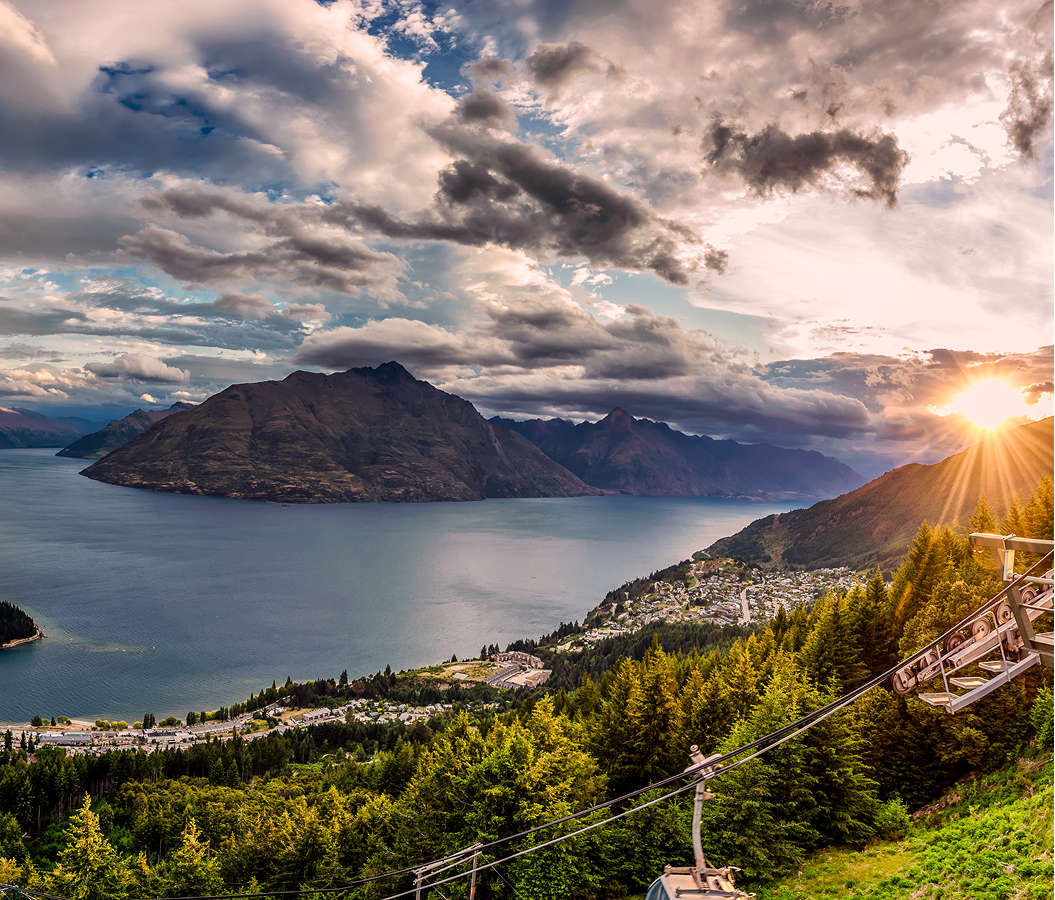
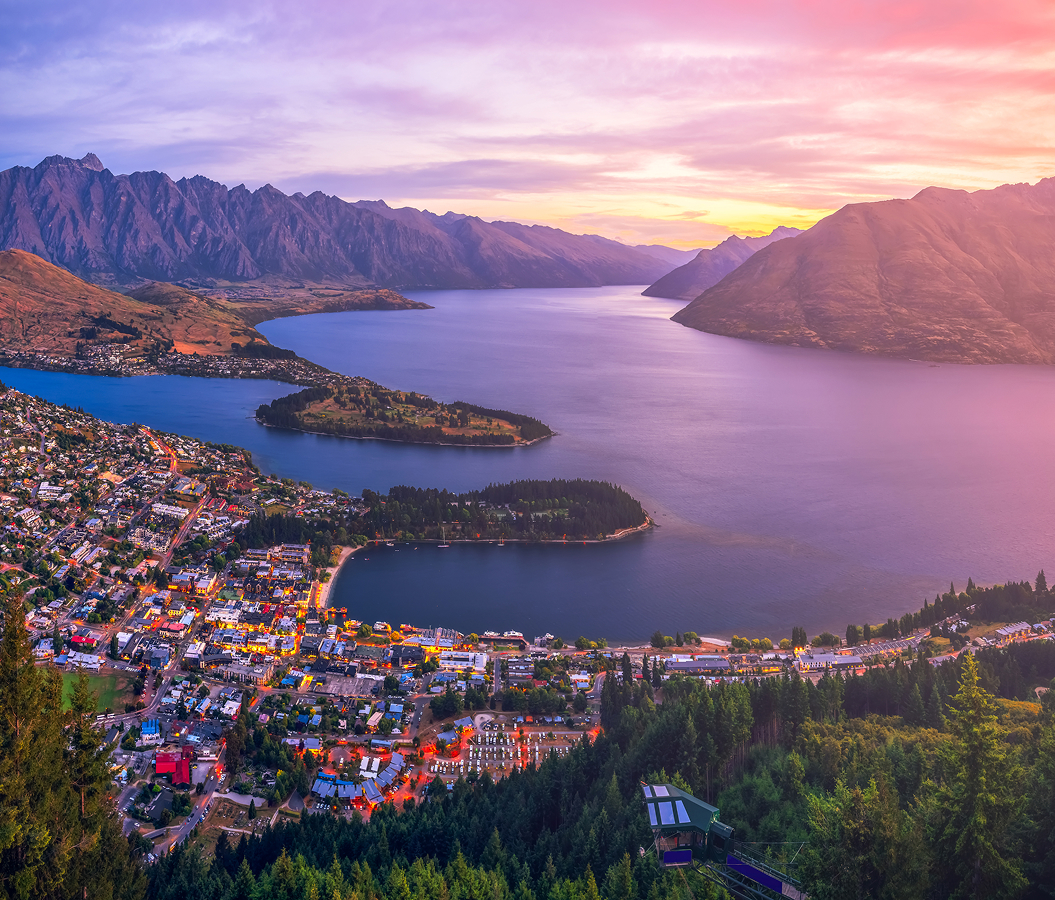
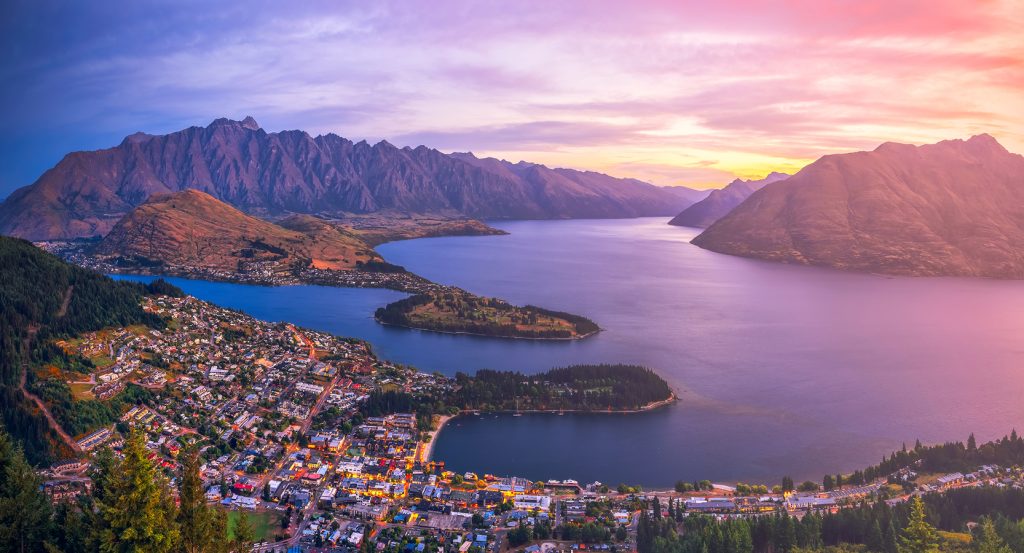
Queenstown's hotels occupy a remarkable glacial landscape where the deep waters of Lake Wakatipu curve beneath steep mountain ranges, creating accommodation settings defined by elevation, shoreline access, and uninterrupted alpine views. The compact town center extends around Queenstown Bay, with hotels concentrated along established commercial streets and the rising slopes behind the waterfront. Its architectural character combines historic stone buildings, contemporary hospitality properties, and substantial timber-clad structures designed to respond to the surrounding mountain scenery. The lakefront promenade provides a natural gathering place, connecting accommodation with restaurants, excursion departures, and landscaped public spaces overlooking the Remarkables range. East of the center, the Frankton Road corridor follows the elevated northern shoreline through a succession of hotels, apartments, and private residences positioned above the water. Properties along this route command expansive views across the lake, with terraces and broad windows emphasizing the dramatic relationship between the mountains and the changing light. Farther east, Frankton occupies a strategic position near the airport and the outlet of the Kawarau River, where contemporary hotels serve visitors seeking convenient transportation connections and access to the wider Wakatipu basin. The neighboring shores of the Frankton Arm provide a quieter waterfront environment through residential developments, lakeside walking paths, and accommodation overlooking sheltered water. North of the town center, the slopes approaching Queenstown Hill support secluded lodges and substantial vacation residences among established vegetation and elevated residential streets. Their hillside positions offer panoramic perspectives across the settlement and surrounding peaks, creating an intimate alternative to the activity of the central waterfront. Westward, the road toward Glenorchy follows the lake beneath increasingly dramatic mountain scenery, passing wooded coves and secluded residential enclaves. The Sunshine Bay and Fernhill neighborhoods occupy elevated positions along this route, with boutique accommodation and vacation properties overlooking the western reaches of the lake. Farther north, the settlement of Glenorchy introduces a more remote alpine environment near the head of Lake Wakatipu, where intimate lodges and substantial rural retreats occupy a landscape of braided rivers, open pastures, and towering mountains. East of Queenstown, the countryside surrounding Lake Hayes offers a contrasting setting through vineyards, established rural estates, and refined boutique accommodation. The lake's sheltered waters and gently rolling hills create a landscape particularly suited to secluded luxury lodges and intimate country retreats. Nearby Arrowtown preserves the architectural character of a nineteenth-century gold-mining settlement through historic stone cottages, mature trees, and carefully maintained commercial buildings. Boutique properties occupy restored residences and landscaped grounds near the village's intimate streets, offering access to independent restaurants and the surrounding countryside. Beyond Arrowtown, the Gibbston Valley extends through a broad river corridor bordered by rugged hills, with vineyard accommodation and secluded lodges positioned among cultivated slopes and rural properties. These distinct settings allow visitors to experience Queenstown through the energy of its waterfront, the privacy of elevated mountain retreats, or the quieter agricultural landscapes surrounding its celebrated alpine basin. Foresyte may earn a commission when you book.
Foresyte Travel's top five choices.
5. QT Queenstown
QT Queenstown occupies a steep Brunswick Street site above Lake Wakatipu, translating the Australian-born QT brand into the alpine terrain of New Zealand's South Island. The property opened in 2017 as part of Event Hospitality & Entertainment's expansion of the design-driven hotel collection beyond Australia. Nic Graham shaped the interiors around dark timber, saturated furnishings, commissioned artwork, and theatrical details that established a deliberately contemporary counterpoint to Queenstown's prevailing alpine lodge tradition. Floor-to-ceiling glazing directs the building toward Lake Wakatipu and the Remarkables, making the surrounding geography fundamental to its architectural composition. QT Queenstown established a distinctly contemporary chapter in the resort town's accommodation growth as Queenstown developed into an international year-round destination.
4. The Rees Hotel & Luxury Apartments
The Rees Hotel & Luxury Apartments takes its name from William Gilbert Rees, the Welsh-born settler whose arrival on the shores of Lake Wakatipu in 1860 preceded Queenstown's transformation during the Otago gold rush. Rees established a sheep station across an enormous tract of surrounding country, placing his homestead near the future town before gold discoveries radically altered the district's population and economy. The hotel occupies the eastern lakeshore along Frankton Road, physically tying its setting to the pastoral landscape that defined the basin before the mining boom. Stone, timber, and expansive lake-facing glazing frame the Remarkables across water that once formed part of Rees's remote high-country environment. The property connects Queenstown's pastoral origins with the resort economy that subsequently transformed the Lake Wakatipu basin.
3. Blanket Bay
Blanket Bay occupies a secluded stretch of Lake Wakatipu near Glenorchy, where the Humboldt and Richardson mountain ranges compress the landscape into one of the Southern Alps' most dramatic inhabited settings. American financier Tom Tusher developed the lodge with architect Jim McLaughlin, establishing a property whose physical character drew directly from the working high-country stations of New Zealand's South Island. Stone walls, massive timber members, deep roofs, and broad lake-facing openings give the complex the scale and material weight of a mountain homestead shaped by severe alpine conditions. Its 1999 debut helped establish the northern end of Lake Wakatipu as a serious luxury destination beyond Queenstown's increasingly developed resort center. Blanket Bay became an influential expression of the high-country lodge tradition that subsequently shaped New Zealand's international luxury hospitality profile.
2. Eichardt's Private Hotel
Eichardt's Private Hotel traces its history to Queenstown's nineteenth-century gold rush, when William Gilbert Rees's former woolshed near the lake was converted to accommodate the settlement growing around the newly discovered Otago goldfields. Albert Eichardt became proprietor during the 1860s, and his name endured as the establishment evolved into one of the town's defining hospitality institutions. Its position on Marine Parade places the property directly against Lake Wakatipu at the historic center of Queenstown, linking the building to the compact waterfront settlement from which the modern resort developed. Successive rebuilding and restoration transformed the early commercial premises into an intimate luxury hotel while preserving its relationship with the town's original waterfront. Eichardt's represents a direct architectural and commercial connection between gold-rush Queenstown and the international resort that grew from it.
1. Rosewood Matakauri
Rosewood Matakauri occupies the western shore of Lake Wakatipu beyond Central Queenstown, facing Cecil Peak and Walter Peak across an immense alpine basin. American investor and philanthropist Julian Robertson and his wife, Josie, developed Matakauri as the third property in a New Zealand lodge collection that also included Kauri Cliffs and Cape Kidnappers. The lodge opened in 2010 with interiors by Virginia Fisher, whose use of stone, timber, wool, and expansive glazing connected the buildings materially and visually with the surrounding high-country landscape. Rosewood assumed management in 2023, bringing Matakauri into the international portfolio alongside the Robertson family's two North Island lodges. The property represents the culmination of a lodge model that joined remote New Zealand landscapes, private patronage, architecture, and international hospitality at the highest end of the country's tourism economy.
Where your story begins.
Foresyte Travel reveals places that feel extraordinary long before you arrive.
Enjoy editorial crafted for luxury travelers.
Foresyte may earn a commission when you book.