
Why The Rees Hotel matters.
The Rees Hotel is a lakeside hotel where Frankton's alpine shoreline meets the legacy of William Gilbert Rees, Queenstown's first European settler, and a contemporary property shaped around Lake Wakatipu.
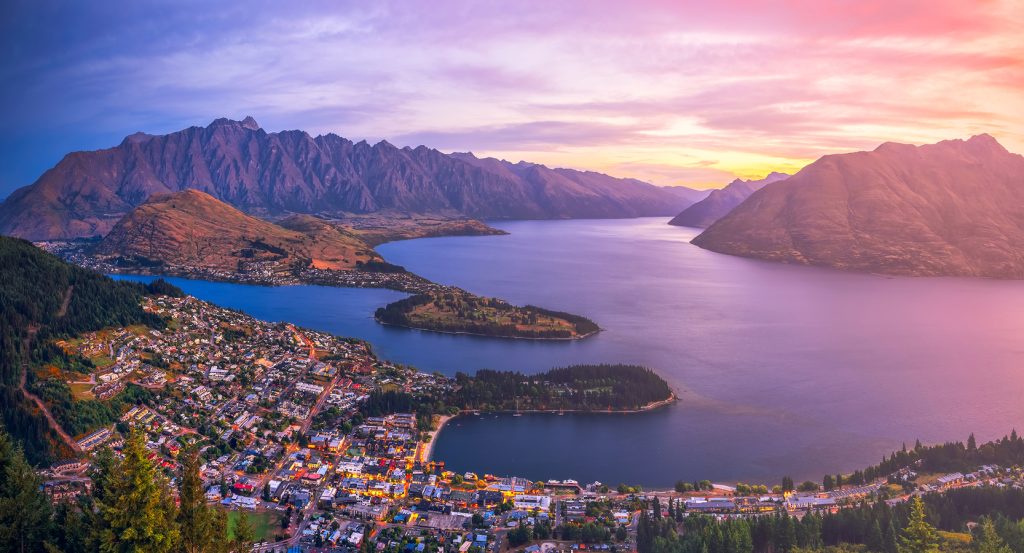
Along Frankton Road on Lake Wakatipu's southern shoreline, The Rees faces The Remarkables across Frankton Arm, with Kelvin Heights, Sunshine Bay, Cecil Peak and Kawarau Falls framing the meeting of water, wooded slopes and Queenstown's rising alpine terrain. The hotel's position sets a long stretch of lake between its buildings and the mountain range, giving the property a direct relationship with the basin that shaped Queenstown's settlement and growth. A lakeside walkway leads toward the town centre, while the shore gives the hotel a connection with movement across the water. The Rees also preserves a beech grove at Beech Cove, where endemic mistletoes grow among native trees along the property's western edge. The result is a lakeside hotel whose outlook, foreshore and namesake connect the built property with Queenstown's human and natural histories.
What defines The Rees Hotel.
The Rees Hotel is best known for carrying William Gilbert Rees's name into a contemporary lakeside development and for linking a major hospitality project to the history of Queenstown's founding. Rees and his wife, Frances, settled beside Lake Wakatipu in 1861 and established a pastoral station in the Wakatipu basin before the Otago gold rush altered the settlement's future. Gold discoveries in 1862 brought prospectors into the district and accelerated Queenstown's growth. The hotel takes its name from Rees, whose place in the region's early European history gives the property a specific historical connection beyond its shoreline location. That connection took a consequential step in 2004, when Rees's descendants approved use of the family name for the hotel development. Construction began in 2007, and the complex opened in 2009 after an investment reported at NZ$100 million. The development brought the Rees name into a new architectural and commercial setting, beside the same lake associated with the pastoralist's settlement. Kerry Avery designed five Lakeside Residences to complement the existing hotel, extending its built form along the shore. The architecture places stone, timber and expansive glazing against the lake-facing terrain, with the mountain and water outlook shaping the buildings' orientation. The Rees also preserves a beech grove at Beech Cove, where two endemic mistletoe types grow within a reserve at the property's western boundary. The hotel's environmental work includes greywater reuse for gardens and a major heating, ventilation and air-conditioning upgrade undertaken in 2021 and 2022. Renewable electricity supplied through Manawa Energy forms another part of its environmental program. The Rees received Skål International's Sustainable Tourism Award in the Urban Accommodation category in 2018 and 2020. In 2024, Qualmark awarded the hotel Gold Sustainable Tourism Business status alongside a five-star rating. Its cultural program includes regional rare books, historical and contemporary art, and Māori artworks. The True South Dining Room extends the property's regional connection through a New Zealand-focused menu built around local farmers and fishermen. In July 2026, the restaurant entered the inaugural MICHELIN Guide New Zealand selection. Micka McDonald became general manager in 2025 after a decade in roles at the property, while Mark Rose, who had led the hotel as general manager and chief executive since 2009, moved into a director role. The Rees's development links its namesake's history with the hotel's architecture, environmental commitments, cultural program and successive leadership.
How The Rees Hotel fits.
The Rees Hotel works as a base for an outing that connects Queenstown's community winter-sports history, the cultural layers of a hillside walk and the aviation links that opened the Wakatipu basin to longer-distance travel.
Begin at Queenstown Ice Arena, where a locally used outdoor artificial ice surface laid in 1966 grew into a permanent indoor institution. The rink's popularity helped prompt the formation of the Queenstown Ice Hockey Club and Ice Skating Club, giving the facility a community role beyond recreation. Financial difficulties closed the outdoor rink in 1995, and Tahitian investors led by Christophe Huck, alongside local businessman Firdaus Siddick, completed a fully enclosed arena in 1996. More than 2,000 people attended its opening. The arena later hosted a three-game senior international ice hockey series between Australia and New Zealand's Ice Blacks in 2017, extending its local history into international competition. Continue to Te Tapunui Queenstown Hill Time Walk, a route that climbs through pine forest toward the Basket of Dreams sculpture and viewpoints over the town and lake. Te Tapunui is a Māori name associated with great sacredness, linking the hillside to the long history of Māori travel and activity in the Wakatipu region. Interpretation panels along the track connect the landscape with the history of Tāhuna, the Māori name for Queenstown. Caroline Robinson created the Basket of Dreams sculpture, which sits above the town as a point of reflection along the ascent. The route brings cultural history, walking terrain and a broad view of the basin into one continuous hillside outing. Conclude at Queenstown Airport, whose origins lie at the former Frankton racecourse, where the first aircraft landed in 1931. The airport received its licence on 14 August 1935, and the Wigley family formed Queenstown-Mount Cook Airways in 1938 to develop air links through the Southern Lakes. Mount Cook Airlines' DC-3 made its first Christchurch flight to Queenstown on 3 February 1964, carrying about thirty passengers and two crew. An international connection followed on 1 July 1995, when the first flight from Sydney arrived. The progression moves from a locally sustained ice-sports institution through Te Tapunui's Māori and Queenstown histories to the airport's expanding air connections, tracing how community life, cultural memory and regional access shape the destination surrounding the hotel.
Where your story begins.
Foresyte Travel reveals places that feel extraordinary long before you arrive.
Enjoy editorial crafted for luxury travelers.

















































































































