Perfect weekend in Sydney, Australia.
Sydney's rise from a British penal settlement to Australia's largest city unfolded across a coastal landscape shaped by thousands of years of Aboriginal history, maritime commerce, colonial expansion, and international migration. Situated along Port Jackson on the southeastern coast of Australia, the city occupies a vast natural harbor surrounded by sandstone headlands, sheltered coves, and waterways extending inland from the Tasman Sea. The Gadigal people of the Eora Nation inhabited the southern shores of the harbor long before European colonization, maintaining communities sustained by fishing, shellfish gathering, and extensive knowledge of the surrounding coastal environment. Other Aboriginal peoples, including the Cammeraygal and Wangal, occupied territories around the harbor and its western waterways. British colonization began in 1788 when the First Fleet, commanded by Captain Arthur Phillip, established a settlement at Sydney Cove following the arrival of eleven ships carrying convicts, soldiers, and colonial officials. Named for British Home Secretary Lord Sydney, the settlement became the administrative center of New South Wales and expanded through convict labor, maritime trade, and agricultural production. The nineteenth century brought substantial economic growth as wool exports, immigration, and the Australian gold rushes strengthened commercial connections between Sydney and international markets. The establishment of responsible government in New South Wales in 1856 contributed to the development of parliamentary institutions, followed by Australian Federation in 1901. The completion of the Sydney Harbour Bridge in 1932 strengthened transportation connections between the northern and southern shores, becoming an enduring achievement of Australian civil engineering. During the twentieth century, successive waves of immigration from Europe, Asia, and the Middle East reshaped the city's population, economy, and public institutions. Sydney's selection as host of the 2000 Summer Olympic Games accelerated investment in transportation, sporting facilities, and metropolitan infrastructure, reinforcing its prominence as a Pacific commercial and cultural center.
Australian painting, literature, performing arts, and contemporary design have flourished in Sydney through institutions and creative communities closely connected to the country's evolving national history. The Art Gallery of New South Wales, established in 1871, houses significant collections of Australian, Aboriginal and Torres Strait Islander, Asian, and European art, including works by prominent Australian painters associated with the Heidelberg School and later modernist movements. The Museum of Contemporary Art Australia occupies a historic waterfront building and presents exhibitions devoted to contemporary artistic practices, including substantial contributions from Indigenous Australian artists. Sydney's literary history includes Patrick White, whose novels explored Australian society and psychological complexity, earning him the Nobel Prize in Literature in 1973. The city also supported the careers of writers including Christina Stead and David Malouf, whose fiction contributed to the international development of Australian literature. The Australian Museum, founded in 1827, preserves extensive natural history and anthropological collections, connecting scientific inquiry with the biodiversity and human histories of the Australian continent. Sydney's performing arts traditions encompass classical music, theater, contemporary dance, and popular music, with organizations including the Sydney Symphony Orchestra and Sydney Theatre Company contributing to the country's professional artistic institutions. The city's culinary traditions draw upon Pacific seafood, Australian agriculture, and the cooking practices introduced by generations of immigrants. Sydney rock oysters, eastern rock lobster, barramundi, and seasonal shellfish occupy prominent places in regional dining, accompanied by Mediterranean, Cantonese, Vietnamese, Lebanese, and contemporary Australian preparations. Italian immigration contributed substantially to the development of Sydney's café and restaurant traditions, strengthening the city's longstanding appreciation for espresso, artisanal baking, and neighborhood dining. Contemporary chefs have expanded these foundations through native Australian ingredients, sustainable seafood, and close relationships with regional agricultural producers. A weekend in Sydney connects Aboriginal history, colonial architecture, international artistic traditions, and the exceptional coastal landscapes that have shaped Australia's most populous city.
Three day itinerary.
Day 1: Circular Quay
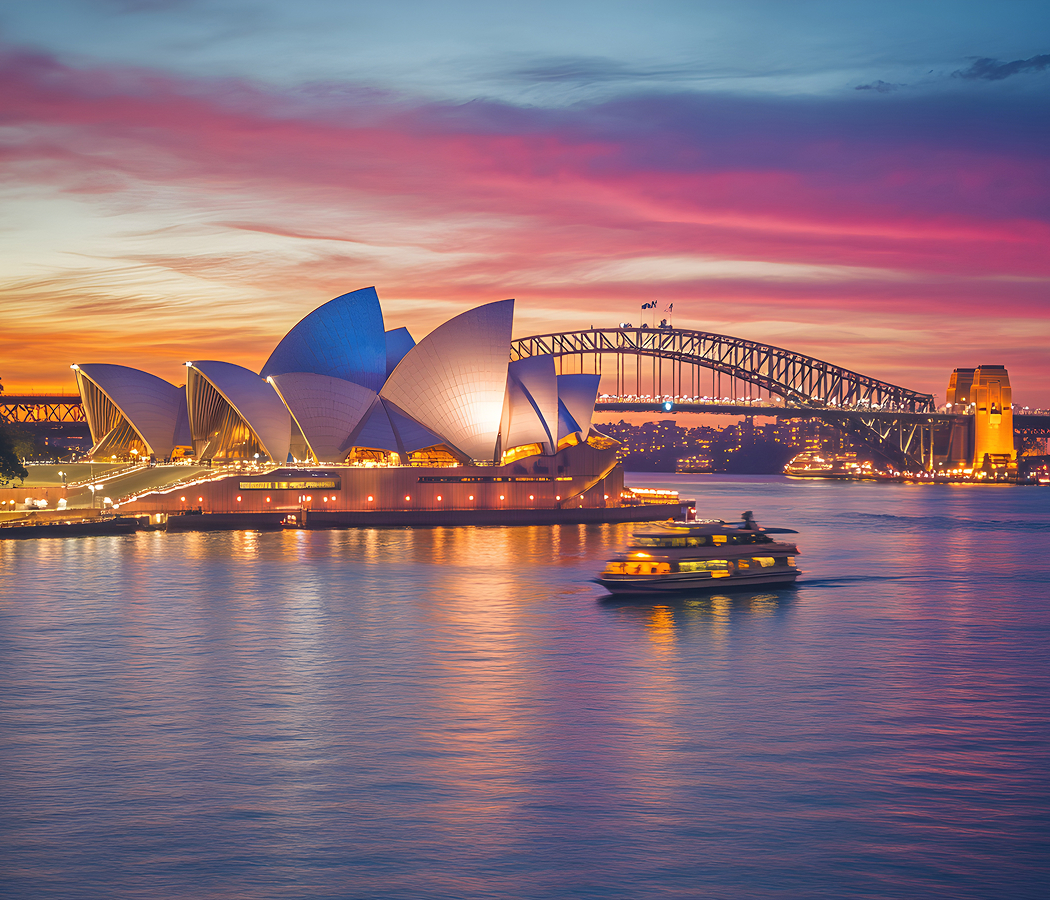
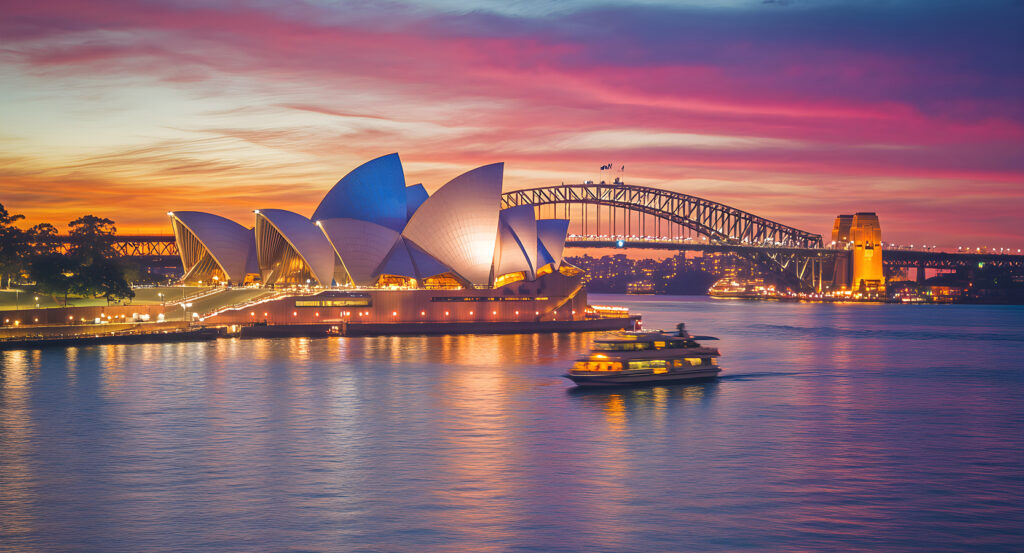
Circular Quay is best known for concentrating Sydney's maritime origins and modern civic character around the southern edge of Sydney Cove. The Gadigal people maintained a deep relationship with the harbor long before British settlement established Sydney Cove as the colonial foothold in 1788. Circular Quay subsequently became a working maritime terminal where ferries, shipping, warehouses, and commercial infrastructure connected the growing city with its harbor. Railway construction during the twentieth century inserted major transportation infrastructure directly above the waterfront, creating an interchange among trains, ferries, buses, and pedestrian routes. The Sydney Opera House occupies Bennelong Point to the east, and The Rocks rises toward the Sydney Harbour Bridge to the west. Circular Quay compresses Indigenous geography, colonial settlement, maritime transportation, and Sydney's defining architectural works into a single harbor precinct.
Day 1: Bennelong
Bennelong is best known for Peter Gilmore's contemporary Australian cooking inside the Sydney Opera House. Gilmore built his reputation through an ingredient-driven approach that gives Australian produce, seafood, vegetables, meat, and native ingredients unusual clarity within highly controlled compositions. The restaurant occupies the smallest of Jørn Utzon's major Opera House shells, embedding dinner within the architectural work that transformed Sydney's international identity. Its soaring concrete structure gives the dining room a spatial character inseparable from the building itself. Gilmore's cuisine establishes an equally direct relationship with Australia through ingredients and seasonality. Bennelong joins Australian gastronomy with the country's most consequential twentieth-century building, giving the opening dinner substantially greater destination power than Platform 818.
Day 2: Royal Botanic Garden Sydney
Royal Botanic Garden Sydney is best known for preserving an extraordinary botanical landscape on the eastern shore of Sydney Cove beside the central city. Governor Lachlan Macquarie established the government garden during the early nineteenth century on land adjoining the colonial administrative precinct. Scientific collecting, acclimatization, horticultural experimentation, and plant exchange subsequently expanded its purpose far beyond ornamental gardening. Australian species coexist with plants gathered across tropical, subtropical, temperate, and arid environments, turning the grounds into a living record of botanical science and global exchange. The garden's position between Sydney Harbour, Government House, the Domain, and the Opera House gives its collections exceptional urban prominence. Its landscape connects scientific history with the ecology and physical geography underlying Central Sydney.
Day 2: Aalia Restaurant
Aalia Restaurant is best known for expanding Sydney's understanding of Middle Eastern cuisine through a kitchen devoted to regional techniques and dishes extending beyond familiar restaurant conventions. Levantine, North African, and broader Middle Eastern traditions inform preparations built around grains, vegetables, seafood, meat, spices, fermentation, and charcoal. The kitchen gives historical recipes and less familiar regional preparations the technical precision of contemporary Sydney dining. Bread, fire, preserved ingredients, aromatic spice structures, and carefully developed sauces provide recurring foundations across the menu. Its Martin Place location places this culinary investigation inside Sydney's commercial core. AALIA gives the lunch position greater gastronomic depth than Nour while preserving a Middle Eastern culinary direction.
Day 2: Sydney Opera House
Sydney Opera House is best known for Jørn Utzon's transformation of Bennelong Point through one of the twentieth century's defining works of architecture. Utzon won the international design competition in 1957 with a proposal whose soaring roof forms required years of structural experimentation. Engineer Ove Arup and his collaborators helped resolve the geometry through a system derived from sections of a sphere, allowing precast concrete ribs to support the tiled shells. Political conflict culminated in Utzon's resignation in 1966, leaving Australian architects Peter Hall, Lionel Todd, and David Littlemore to complete major interior work. Queen Elizabeth II formally opened the building in 1973. Its synthesis of architecture, engineering, performance, and harbor geography permanently altered both Sydney's waterfront and Australia's cultural image.
Day 2: Sixpenny
Sixpenny is best known for Daniel Puskas's deeply controlled contemporary Australian cooking within a modest Stanmore terrace. The restaurant takes its name from the sixpenny restaurants that operated in Australia during the nineteenth century, connecting its fine-dining format with a much older strand of local food history. Puskas builds menus around Australian produce, fermentation, preservation, baking, vegetables, seafood, meat, and ingredients developed through close relationships with growers and producers. The intimate residential setting concentrates attention on the kitchen's technical precision and ingredient quality. Sixpenny occupies Sydney's three-hat culinary tier in 2026, placing it among the city's most accomplished restaurants. Its distinctly Australian authorship makes it a decisive elevation over Primi Italian.
Day 3: Yellow
Yellow is best known for transforming a historic Potts Point artists' building into one of Sydney's most accomplished plant-focused restaurants. The Macleay Street property once housed an influential artists' community associated with figures including Brett Whiteley, giving the dining room an unusual connection with Sydney's twentieth-century creative culture. Its culinary character subsequently developed around vegetables, herbs, flowers, fungi, grains, and other plant ingredients treated with fine-dining precision. Fermentation, roasting, extraction, preservation, and intricate sauces build depth from produce across a multicourse botanical format. The beverage program gives comparable attention to wine and alcohol-free pairings. Yellow's concentration on plants distinguishes it sharply within Sydney's upper restaurant tier and gives brunch a genuinely authored culinary identity.
Day 3: Darling Harbour
Darling Harbour is best known for the large-scale redevelopment that transformed a former industrial waterfront into a major civic and recreational precinct. The harbor developed as a working landscape of wharves, rail yards, warehouses, factories, and freight infrastructure serving Sydney's expanding nineteenth- and twentieth-century economy. Deindustrialization created the conditions for sweeping redevelopment during the 1980s, culminating in a new public district associated with Australia's bicentenary. Museums, exhibition facilities, promenades, entertainment venues, and public spaces subsequently replaced much of the earlier industrial fabric. Barangaroo's later transformation extended the reinvention of Sydney's western harbor edge farther north. Darling Harbour records the city's transition from industrial port infrastructure toward a service, cultural, and visitor economy centered on waterfront public space.
Day 3: Bondi Beach
Bondi Beach is best known for making Sydney's relationship with the Pacific Ocean a defining component of Australian urban culture. The broad crescent of sand lies between sandstone headlands whose geology gives Sydney's eastern coastline its characteristic cliffs and rock platforms. Surf bathing expanded dramatically during the early twentieth century as changing social conventions opened Sydney's beaches to daytime recreation. Bondi Surf Bathers' Life Saving Club emerged in 1907 during the formative period of organized Australian surf lifesaving. The Bondi Icebergs swimming club later embedded year-round ocean swimming into the beach's cultural character through its pool at the southern end. Surfing, lifesaving, swimming, coastal walking, and dense metropolitan life converge at Bondi, making the beach a powerful expression of Sydney's Pacific geography.
Day 3: Saint Peter at The Grand National Hotel
Saint Peter at The Grand National Hotel is best known for Josh Niland's dramatic rethinking of Australian seafood through whole-fish cookery. Niland built the restaurant around the concept that fish possesses culinary possibilities extending far beyond conventional fillets, developing techniques for dry-aging, curing, butchery, charcuterie, stocks, sauces, and the use of parts routinely discarded by seafood kitchens. Australian species sit at the center of that work, turning marine biodiversity into the restaurant's principal culinary resource. Saint Peter's move into the Grand National Hotel expanded the project into a larger Paddington home while preserving its fish-focused discipline. Niland's methods have influenced professional kitchens far beyond Australia. Saint Peter occupies Sydney's three-hat tier in 2026, giving the final dinner an unmistakably Australian culinary thesis rooted in the surrounding ocean.
Where your story begins.
Foresyte Travel reveals places that feel extraordinary long before you arrive.
Enjoy editorial crafted for luxury travelers.
Foresyte may earn a commission when you book.