Why Bondi Beach matters.
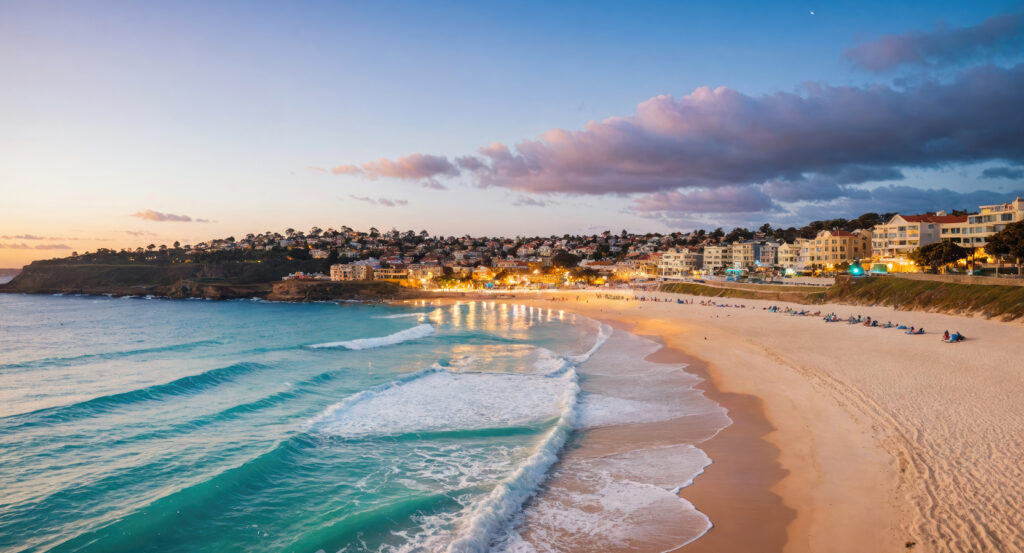
Bondi Beach is a crescent-shaped Pacific surf beach where Sydney's Eastern Suburbs' coastal geography meets the development of Australian surf lifesaving, the emergence of public beach recreation and the international recognition of Sydney's ocean swimming culture.
Stretching along Campbell Parade near Hall Street and a short walk from Bondi Pavilion, the beach occupies an east-facing bay between Ben Buckler Point and Mackenzies Point, with a broad sand shoreline bordered by coastal headlands and the residential streets of Bondi. A continuous promenade separates the beach from the adjoining commercial frontage. Sandstone cliffs and rock platforms frame the northern and southern approaches. Surf breaks extend across the bay, with wave conditions varying along the shoreline. The result is a public coastal landscape where ocean recreation, surf lifesaving and urban beach culture developed within one of Sydney's most recognizable natural settings.
What defines Bondi Beach.
Bondi Beach is best known for its Pacific surf, organized surf lifesaving, ocean swimming traditions and role in the development of Australia's public beach culture. The coastal area forms part of the traditional lands of the Gadigal and Birrabirragal peoples, whose communities maintained longstanding relationships with the surrounding marine environment. The name Bondi derives from an Aboriginal word associated with the sound of water breaking over rocks, although interpretations of its precise linguistic origin differ. During the nineteenth century, the beach and adjoining land formed part of private estates as European settlement expanded eastward from Central Sydney. In 1851, Edward Smith Hall and Francis O'Brien received a land grant encompassing the beach and surrounding coastal property. O'Brien subsequently acquired Hall's interest, consolidating the estate under his ownership. Public access became a contentious issue as Sydney residents increasingly sought recreational use of the shoreline. The New South Wales government intervened in 1882, securing the beach for public recreation and establishing a lasting principle of public coastal access. During the late nineteenth century, restrictions on daytime bathing limited the development of ocean swimming. Changes to municipal regulations in the early twentieth century permitted broader public bathing, accelerating the growth of Sydney's beach culture. The Bondi Surf Bathers' Life Saving Club was founded in 1907, becoming one of the earliest organized surf lifesaving institutions in Australia. Its members developed rescue methods and patrol practices suited to the powerful surf conditions of the eastern Australian coastline. The development of electric tram services improved access from Central Sydney, encouraging increasing numbers of residents to visit the beach. Bondi's public facilities expanded during the interwar period, including the construction of substantial bathing and recreational infrastructure. The beach became an important setting for competitive swimming, surf carnivals and organized lifesaving activities. Its cultural importance expanded through photography, film and international tourism, establishing Bondi as a prominent symbol of Australian coastal recreation.
Bondi Surf Bathers' Life Saving Club developed patrol practices and rescue techniques that became central to organized beach safety across Australia. Its early members used rescue lines, belts and coordinated swimming methods to assist bathers caught in dangerous surf conditions. The beach's exposed orientation produces variable wave patterns, including breaking surf suitable for board riding and strong currents requiring careful assessment. Designated swimming areas are supervised by professional lifeguards and volunteer surf lifesavers during operating periods. The northern section of the beach generally provides more sheltered conditions under suitable swell patterns, supporting recreational swimming and surf instruction. The southern section receives more powerful surf and contains rock platforms associated with ocean swimming facilities. Bondi Icebergs Club occupies the southern headland, incorporating an ocean pool built into the coastal rock shelf. Its swimming traditions developed through winter bathing activities established in 1929. The pool's position exposes its seaward edge to breaking waves, creating a direct relationship between constructed swimming infrastructure and the surrounding Pacific Ocean. Bondi Pavilion stands behind the central beach, preserving a substantial public building associated with the development of municipal recreation facilities. Completed in 1929, the building originally contained changing facilities, bathing amenities and public gathering spaces. Its architectural composition incorporates Mediterranean Revival elements, including arcades, tiled roofs and a central courtyard. The pavilion subsequently developed as a cultural venue supporting exhibitions, performances and community activities. Campbell Parade forms the principal urban frontage, connecting the beachfront promenade with cafés, shops and residential streets. Public lawns and pedestrian paths extend between the road and the sand, accommodating recreation and access to the beach. The beach's physical organization combines supervised swimming, surf recreation, coastal walking and municipal facilities within a densely populated urban setting.
How Bondi Beach fits.
Bondi Beach works as the coastal centerpiece for a Sydney Eastern Suburbs itinerary connecting ocean swimming infrastructure, sandstone shoreline landscapes and the public recreational spaces developed along the Pacific coast.
Begin at Bondi to Bronte Coastal Walk, the pedestrian route extending south from Bondi along Sydney's eastern shoreline. The path follows sandstone cliffs and coastal headlands, connecting beaches, rock platforms and public reserves above the Pacific Ocean. Its development created a continuous recreational route through a landscape shaped by marine erosion and coastal weathering. The walk passes Tamarama Beach, a small cove framed by steep headlands and associated with Sydney's surf and beach recreation traditions. Public viewpoints provide perspectives across the ocean and adjoining coastal formations. The route connects natural coastal geography with the municipal parks and pathways developed along the Eastern Suburbs shoreline. Continue to Bronte Beach, the sheltered coastal beach situated south of Tamarama. The beach occupies a narrow valley opening toward the Pacific, with parkland extending inland from the sand. Bronte Park contains lawns, picnic facilities and recreational spaces associated with the development of public coastal recreation. The beach's southern rock platform incorporates Bronte Baths, an ocean swimming pool constructed during the nineteenth century. Its position within the coastal rock shelf provides a designated swimming environment beside the open ocean. The surrounding landscape connects Sydney's early bathing infrastructure with the recreational use of coastal parks and beaches. Conclude at Waverley Cemetery, the nineteenth-century cemetery situated on the sandstone cliffs overlooking the Pacific Ocean. Established in 1877, the cemetery contains substantial Victorian funerary monuments and memorials associated with Sydney's colonial and early national history. Its graves include prominent Australian writers, political figures and public personalities. The cemetery's terraced layout follows the coastal terrain, incorporating sandstone monuments and formal pathways overlooking the ocean. Its heritage significance extends beyond individual burials to the preservation of nineteenth-century funerary architecture and landscape design. The progression moves from coastal walking infrastructure through historic ocean swimming facilities and culminates in a nineteenth-century memorial landscape, connecting Bondi Beach with the recreational and civic history of Sydney's eastern coastline.
Where your story begins.
Foresyte Travel reveals places that feel extraordinary long before you arrive.
Enjoy editorial crafted for luxury travelers.
Foresyte may earn a commission when you book.