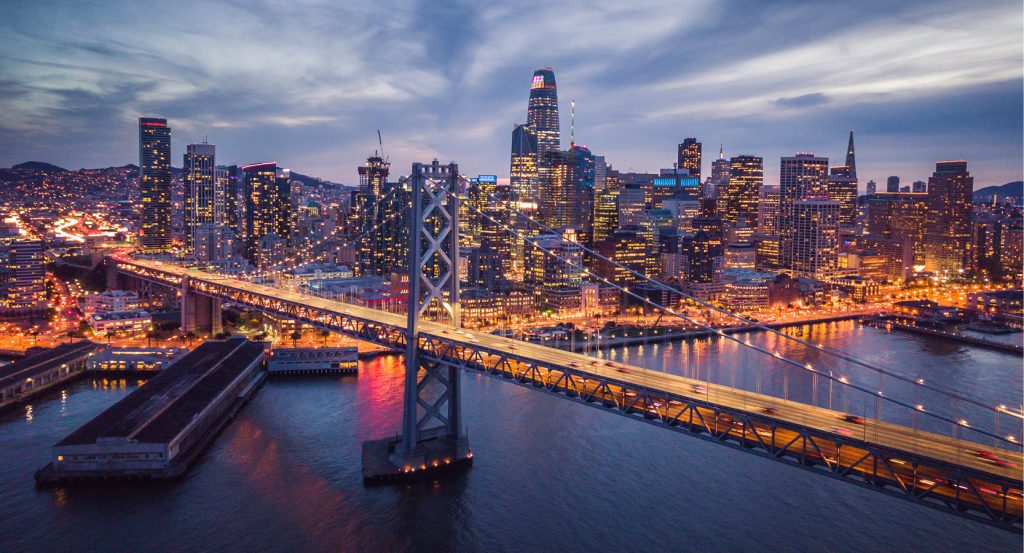
Perfect weekend in San Francisco, California.
San Francisco rose from a small settlement on the Pacific coast into one of America's foremost centers of maritime commerce, financial enterprise, technological innovation, and cultural experimentation. Situated on a hilly peninsula between the Pacific Ocean and San Francisco Bay, the city developed around a natural harbor that connected California with trading networks across the Pacific. The region formed part of the ancestral homeland of the Ramaytush Ohlone, whose communities maintained fishing, hunting, and trading traditions throughout the surrounding coastal landscape. Spanish colonists established the Presidio of San Francisco and Mission District de Asís in 1776, extending colonial administration into northern California. Following Mexican independence in 1821, the settlement developed under Mexican authority, with the small commercial community of Yerba Buena attracting merchants and maritime traders. American forces occupied the settlement in 1846 during the Mexican-American War, and the community adopted the name San Francisco in 1847. The discovery of gold in the Sierra Nevada in 1848 transformed the city's economic prospects, bringing prospectors, merchants, and immigrants from across the world. San Francisco became the principal commercial gateway to the California goldfields, acquiring banks, warehouses, shipping enterprises, and substantial residential districts. Completion of the transcontinental railroad in 1869 strengthened California's connections with eastern markets, supporting further commercial growth. The earthquake and fire of April 1906 devastated extensive portions of the city, prompting an ambitious reconstruction that reshaped its commercial center and residential landscape. During the twentieth century, San Francisco developed through maritime trade, military investment, financial services, and successive waves of immigration. The establishment of major universities and research institutions throughout the Bay Area subsequently contributed to the expansion of biotechnology, computing, and digital technology. The city's political and cultural influence also grew through labor organizing, civil rights activism, and movements that challenged established American social conventions.
Californian artistry found an influential center in San Francisco, where literature, photography, experimental music, and political activism contributed to major movements in American cultural history. The Beat Generation developed a strong association with the city during the 1950s, particularly through the work of Allen Ginsberg, whose poem Howl challenged literary conventions and prevailing social attitudes. Lawrence Ferlinghetti established City Lights Publishers in 1955, contributing to the distribution of experimental poetry and independent literature. San Francisco's musical history acquired international prominence during the 1960s, when performers including Jefferson Airplane, the Grateful Dead, and Janis Joplin contributed to the development of psychedelic rock. The city's artistic institutions expanded through private philanthropy and civic investment, with the San Francisco Museum of Modern Art becoming an important center for twentieth-century and contemporary art. Its collections encompass works by Henri Matisse, Frida Kahlo, Jackson Pollock, and numerous artists associated with modern artistic movements. The de Young Museum, established in 1895, developed collections of American painting, sculpture, textiles, and art from Africa and Oceania. San Francisco's culinary culture developed through Pacific fisheries, California agriculture, and the cooking traditions of successive immigrant communities. Italian American restaurants established enduring specialties involving fresh pasta, seafood, and regional Mediterranean preparations. Japanese immigration contributed sushi, noodle dishes, and refined approaches to seasonal ingredients, and the city's longstanding Chinese American communities profoundly influenced the development of Chinese cooking throughout the United States. The Bay Area's agricultural relationships support restaurants devoted to seasonal vegetables, artisan cheeses, regional wines, and sustainably raised meats. Alice Waters helped popularize California cuisine through her emphasis on seasonal ingredients and direct relationships with agricultural producers, influencing generations of American chefs. San Francisco's sourdough bread tradition developed during the nineteenth century, becoming closely associated with the city's bakeries and maritime food culture. Dungeness crab, Pacific oysters, and local fish contribute to coastal preparations rooted in the surrounding waters. A weekend in San Francisco brings together the extraordinary history of Pacific commerce, the creative achievements of its immigrant communities, and a culinary culture shaped by California's agricultural abundance and enduring spirit of experimentation.
Three day itinerary.
Day 1: Golden Gate Bridge
Golden Gate Bridge is best known for transforming the entrance to San Francisco Bay through one of the twentieth century's defining achievements in suspension-bridge engineering. Chief engineer Joseph B. Strauss led the project, with Charles Alton Ellis and Leon Moisseiff making critical contributions to its structural design and Irving Morrow shaping the towers, lighting, and International Orange color scheme. Construction began in 1933 across a strait notorious for powerful currents, deep water, wind, and fog. The 4,200-foot main span became the longest suspension-bridge span in the world when the bridge opened in 1937, connecting San Francisco directly with Marin County. Its engineering scale, Art Deco detailing, extraordinary setting, and instantly recognizable towers made the bridge both essential regional infrastructure and the dominant architectural symbol of San Francisco.
Day 1: Californios
Californios is best known for Val M. Cantu's transformation of Mexican culinary traditions into one of San Francisco's most ambitious tasting-menu restaurants. Cantu drew on his family's Mexican heritage and restaurant background to build a cuisine grounded in masa, chiles, seafood, vegetables, fermentation, and ingredients with deep histories across Mexico and California. The tasting menu treats corn as a foundational agricultural product, using nixtamalization and other techniques to expose differences among varieties and preparations. Cantu progressively expanded the restaurant from an intimate Mission District operation into a larger institution whose cooking explores the long cultural exchange between Mexico and California. MICHELIN elevated Californios to three stars in 2026, placing Cantu's cooking among the highest-ranked restaurants in California and marking a major achievement for contemporary Mexican fine dining.
Day 2: Lombard Street
Lombard Street is best known for the eight tightly spaced hairpin turns descending its steep block between Hyde and Leavenworth streets on Russian Hill. The street's natural grade made the original straight descent exceptionally difficult for early automobiles, prompting property owner Carl Henry to propose a switchback configuration during the 1920s. The resulting brick-paved roadway reduced the effective gradient by extending the route laterally across the hillside. Landscaped planting beds subsequently filled the spaces between turns, creating the highly recognizable combination of red brick, hydrangeas, retaining walls, and residential architecture. The block became an unusual example of street engineering responding directly to San Francisco's extreme topography, converting a transportation problem into one of the city's most distinctive pieces of urban infrastructure.
Day 2: Rich Table
Rich Table is best known for Evan and Sarah Rich's distinctly Californian cooking in the heart of Hayes Valley. The couple developed their careers in acclaimed kitchens before opening the restaurant on Gough Street in 2012, bringing fine-dining technique into a deliberately relaxed neighborhood format. Seasonal produce, seafood, house-made pasta, fermentation, and globally sourced ingredients support cooking that moves freely across culinary traditions while retaining Northern California agriculture as its foundation. Porcini doughnuts became an early signature, translating the aroma of dried mushrooms into a lively savory preparation emblematic of the restaurant's technical confidence. Rich Table became one of Hayes Valley's defining restaurants and an influential expression of San Francisco's ability to combine serious cooking with the intimacy of an independent neighborhood establishment.
Day 2: Chinatown
Chinatown is best known for preserving the oldest continuously established Chinese enclave in North America and a foundational center of Chinese American history. Chinese immigrants concentrated around Portsmouth Square and neighboring streets during the nineteenth century as migration expanded through the California Gold Rush, railroad construction, commerce, and Pacific trade. The Chinese Exclusion Act of 1882 imposed severe restrictions on immigration and intensified discrimination against the community. The 1906 earthquake and fire destroyed much of Chinatown, after which merchants and community leaders rebuilt the district with an architectural language deliberately emphasizing Chinese motifs. Family associations, temples, restaurants, herbal shops, markets, schools, newspapers, and civic organizations subsequently reinforced the neighborhood's institutional depth. Chinatown became both a refuge from exclusion and a major center from which Chinese American political, commercial, and cultural life expanded across the United States.
Day 2: Benu
Benu is best known for Corey Lee's synthesis of East Asian culinary traditions with the technical discipline of contemporary American fine dining. Lee was born in South Korea and developed his career in elite kitchens before serving as chef de cuisine at The French Laundry. He opened Benu in San Francisco in 2010, constructing tasting menus around Korean, Chinese, and broader East Asian ingredients interpreted through fermentation, meticulous stocks, seafood, precise temperature control, and exacting presentation. Preparations involving kimchi, seafood, broths, dumplings, and preserved ingredients reveal cultural lineages through highly refined technique. MICHELIN awarded Benu three stars, establishing Lee as one of the most consequential chefs in American fine dining and giving Asian culinary traditions an unusually powerful position within San Francisco's highest tier of gastronomy.
Day 3: State Bird Provisions
State Bird Provisions is best known for Stuart Brioza and Nicole Krasinski's reinvention of contemporary California dining through small plates served from roving carts. The couple developed the restaurant after years in major American kitchens, opening in San Francisco in 2011 with a format that loosened the conventional sequence of appetizer, entrée, and dessert. Servers circulate dishes through the dining room in a system inspired partly by dim sum, allowing the kitchen to produce a constantly changing range of vegetables, seafood, meats, grains, and inventive savory preparations. The restaurant takes its name from California's state bird, the quail, which inspired an early signature dish. Brioza and Krasinski received the James Beard Award for Best Chef: West in 2015, cementing the restaurant's influence on modern California dining.
Day 3: Alcatraz Island
Alcatraz Island is best known for the federal penitentiary that held some of the most notorious prisoners in American history within the formidable geography of San Francisco Bay. The United States fortified the island during the nineteenth century before converting portions of it to military imprisonment. The Department of Justice established the federal penitentiary in 1934, using the island's cold water, strong currents, and physical isolation as additional barriers to escape. Al Capone, George “Machine Gun” Kelly, and Robert Stroud were among its inmates before the prison closed in 1963. Native American activists occupied Alcatraz from 1969 to 1971, turning the abandoned prison into a major site of Indigenous political activism. The island preserves overlapping histories of military power, federal incarceration, Indigenous resistance, and the strategic geography of San Francisco Bay.
Day 3: San Francisco Cable Cars
San Francisco Cable Cars are best known for preserving the world's last manually operated cable-car system as functioning public transportation across the city's steep terrain. Andrew Smith Hallidie developed the technology after observing the difficulties horses faced hauling streetcars over San Francisco's hills, and the first successful cable railway began operation on Clay Street in 1873. Moving underground cables allowed cars to grip and release propulsion mechanically, producing a transportation system suited to grades that challenged conventional street railways. Electric streetcars and automobiles eventually displaced most cable lines, and municipal proposals threatened the surviving network during the twentieth century. Preservation campaigns led by Friedel Klussmann helped secure its future. The remaining Powell and California Street lines preserve both a working transportation technology and a mechanical system inseparable from San Francisco's topography.
Day 3: Quince
Quince is best known for Michael and Lindsay Tusk's integration of Northern Italian technique, California agriculture, and meticulous contemporary fine dining. Michael Tusk developed his culinary foundation in European and California kitchens before the couple opened Quince in 2003. Relationships with regional farms progressively became central to the restaurant, with produce from Fresh Run Farm giving the kitchen unusually close control over varieties, maturity, and seasonal experience. Handmade pasta forms a major component of Tusk's cooking, connecting Italian craft traditions with grains, vegetables, meats, and seafood drawn from Northern California. MICHELIN awarded Quince three stars, establishing the restaurant among San Francisco's most distinguished culinary institutions and demonstrating the extraordinary refinement possible when California agriculture becomes the structural foundation of fine dining.
Where your story begins.
Foresyte Travel reveals places that feel extraordinary long before you arrive.
Enjoy editorial crafted for luxury travelers.
Foresyte may earn a commission when you book.