Why San Francisco Cable Cars matters.
San Francisco Cable Cars are a historic urban transportation system where Nob Hill's steep streets meet the engineering ingenuity of nineteenth-century California, the preservation of Victorian-era transit technology and the enduring cultural character of San Francisco's hillside neighborhoods.
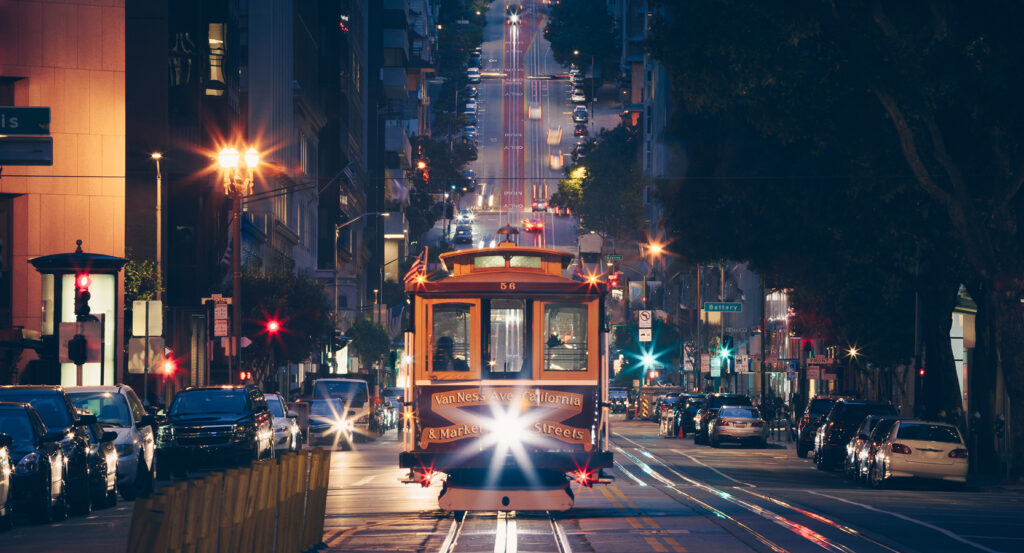
Running through Nob Hill between Chinatown and Russian Hill, the historic cable car network follows Powell Street and California Street across the city's central hills, connecting the downtown commercial districts with northern waterfront destinations through steep grades, prominent intersections and closely spaced blocks of residential and commercial architecture. Steel rails and narrow underground cable slots trace the routes through paved streets, with overhead signs marking stops along the established lines. Open-sided passenger cars carry exterior running boards and polished wooden seating, preserving the distinctive appearance of nineteenth-century street transportation. Manual turntables, historic boarding platforms and the characteristic sound of grip mechanisms contribute to the system's recognizable street presence. The result is an operational historic railway whose surviving machinery and distinctive vehicles preserve an essential chapter in San Francisco's transportation history.
What defines San Francisco Cable Cars.
San Francisco Cable Cars are best known for their mechanically propelled streetcars, which climb the city's steep hills through a continuously moving underground cable system developed during the nineteenth century. Andrew Smith Hallidie conceived the technology as a solution to the difficulties experienced by horse-drawn streetcars on San Francisco's demanding grades. His engineering background included wire-rope manufacturing and the development of cable systems for mining and industrial transportation. Hallidie's Clay Street Hill Railroad began operating on August 2, 1873, establishing the world's first successful cable-hauled urban street railway. The original line climbed the steep slope of Clay Street, demonstrating the practical advantages of mechanical traction in a city characterized by substantial changes in elevation. Its success encouraged competing companies to construct additional routes across the expanding metropolitan area. During the 1880s, cable railway development accelerated as San Francisco's population increased and new residential districts emerged beyond the established commercial center. Companies including the California Street Cable Railroad and the Market Street Cable Railway introduced extensive networks connecting downtown with surrounding hills and neighborhoods. The system reached its greatest extent during the late nineteenth century, when numerous cable lines carried passengers through the city's rapidly developing streets. Electric streetcars subsequently introduced a more economical transportation technology, encouraging operators to convert many existing routes. The earthquake and fire of 1906 destroyed substantial portions of the cable railway infrastructure, accelerating the replacement of damaged lines with electric service. Surviving cable routes continued operating on particularly steep streets where conventional streetcars faced difficult conditions. A major preservation campaign emerged during the 1940s when municipal proposals threatened additional cable car service reductions. Friedel Klussmann organized the Citizens' Committee to Save the Cable Cars, mobilizing public support for the preservation of the historic system. San Francisco voters approved a protective charter amendment in 1947, establishing a significant political victory for transportation preservation. Further consolidation during the 1950s produced the three surviving routes, establishing the foundation of the modern municipal cable car network.
How San Francisco Cable Cars fits.
San Francisco Cable Cars work as the transportation anchor for a Central San Francisco outing connecting the city's historic commercial districts, its expansive civic architecture and the cultural institutions associated with the development of its northeastern neighborhoods.
Begin at Union Square, the prominent public plaza occupying a central position within San Francisco's downtown shopping district. The square originated during the nineteenth century and acquired its name through gatherings supporting the Union during the American Civil War. Its central monument commemorates Admiral George Dewey's victory at Manila Bay during the Spanish-American War, incorporating a tall column crowned by a sculptural figure. Surrounding department stores, hotels and commercial buildings establish an important architectural connection with the city's development as a major Pacific Coast commercial center. The landscaped plaza accommodates public gatherings and seasonal events within one of San Francisco's principal downtown districts. Continue to Grace Cathedral, the expansive Episcopal cathedral occupying an elevated position on California Street. Construction of the present Gothic Revival building began in 1928, following the destruction of the congregation's earlier cathedral during the 1906 earthquake and fire. Its architectural composition incorporates pointed arches, elaborate stonework and stained-glass windows associated with European ecclesiastical traditions. The cathedral's bronze doors reproduce Lorenzo Ghiberti's celebrated Gates of Paradise from the Florence Baptistery, introducing an important connection with Renaissance sculpture. Interior labyrinths provide carefully arranged paths for contemplative walking, contributing to the building's distinctive religious and cultural character. Conclude at Huntington Park, the landscaped public garden occupying a prominent hilltop block opposite the cathedral. The park developed on the former site of the mansion of railroad magnate Collis P. Huntington, whose family contributed the property for public use. Its central fountain, decorative plantings and carefully arranged pathways establish an intimate recreational setting amid substantial residential architecture. Mature trees provide shade across the lawns and seating areas, creating a quiet public landscape within the surrounding historic neighborhood. The park's elevated location and established architectural setting contribute to the distinctive character of San Francisco's central hills. The progression moves from Union Square's historic commercial plaza through Grace Cathedral's expansive religious architecture and culminates at Huntington Park's landscaped hilltop grounds, connecting three consequential dimensions of San Francisco's civic, architectural and neighborhood development.
Where your story begins.
Foresyte Travel reveals places that feel extraordinary long before you arrive.
Enjoy editorial crafted for luxury travelers.