
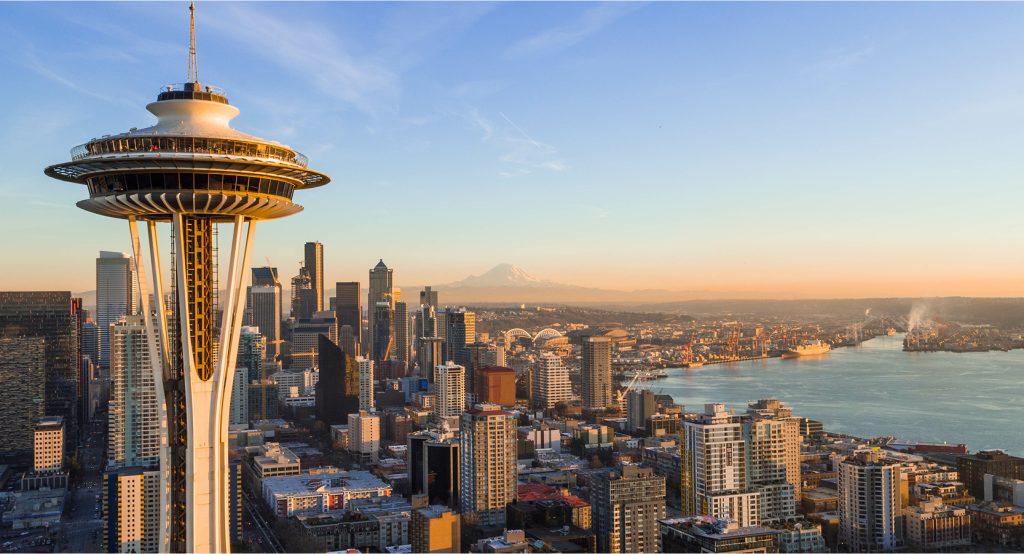
Top places to stay in Seattle, Washington.
Seattle built its hospitality heritage around the maritime commerce of Puget Sound, the prosperity of the Klondike Gold Rush, and the expansion of Pacific trade, with the city's subsequent rise as a center of aviation, technology, and cultural innovation bringing new dimensions to Northwest urban luxury. The Duwamish and other Coast Salish peoples inhabited the shores of Elliott Bay and the surrounding waterways for generations before American settlement, establishing communities whose maritime traditions were deeply connected to the region's forests, rivers, and marine resources. The establishment of Seattle in the early 1850s introduced a commercial settlement centered on lumber production and maritime trade, with sawmills and waterfront businesses attracting workers, merchants, and travelers to the eastern shore of Puget Sound. Henry Yesler's steam-powered sawmill, established in 1853, became an important foundation of the local economy, supporting the development of boardinghouses and early lodging establishments near the commercial waterfront. The Great Seattle Fire of 1889 destroyed much of the central business district, prompting reconstruction in brick and stone and establishing the substantial commercial architecture that would characterize the historic downtown. The arrival of the Great Northern Railway in 1893 strengthened Seattle's connections with the American interior, encouraging investment in transportation infrastructure and metropolitan accommodation. The Klondike Gold Rush of 1897 transformed the city into a principal outfitting and departure point for prospectors traveling to Alaska and the Yukon, generating extraordinary commercial activity and expanding demand for hotels, restaurants, and passenger services. The opening of the Washington Hotel on Denny Hill in 1900 introduced an expansive expression of turn-of-the-century hospitality, although the subsequent regrading of the hill brought its existence to an early conclusion. The Alaska-Yukon-Pacific Exposition of 1909 attracted international visitors and strengthened Seattle's reputation as a commercial gateway to the North Pacific. The opening of the Olympic Hotel in 1924 established a distinguished metropolitan institution, with its expansive public interiors and prominent downtown location reflecting the prosperity of a city increasingly connected to international shipping and commerce. During the Second World War, Seattle's shipbuilding and aircraft manufacturing industries expanded dramatically, with Boeing becoming central to the region's industrial character and supporting the growth of commercial aviation. The postwar expansion of air travel encouraged the development of modern hotels serving corporate visitors and passengers arriving through Seattle-Tacoma International Airport. The Century 21 Exposition of 1962 introduced the Space Needle and Seattle Center, strengthening the city's international reputation for technological ambition and modern design. The development of substantial downtown hotels during the following decades reflected the expansion of convention travel, financial services, and international commerce. The emergence of Microsoft in the greater Seattle region and the establishment of Amazon in the city during the 1990s introduced a new period of economic growth, transforming the metropolitan hospitality industry through expanding demand for corporate accommodation and international business travel. The restoration of historic commercial buildings subsequently encouraged a complementary tradition of boutique hotels, connecting architectural preservation with the city's growing creative economy. The opening of the Four Seasons Hotel Seattle in 2008 introduced a prominent luxury waterfront property overlooking Elliott Bay, reflecting the increasing importance of sophisticated urban hospitality within the central business district. The subsequent expansion of technology campuses, residential towers, and cultural institutions into South Lake Union and neighboring districts extended Seattle's accommodation industry beyond its traditional downtown concentration. The city's hotel history expresses the relationship between Pacific maritime commerce, industrial innovation, international transportation, and the technological economy that has transformed Seattle into one of North America's most influential metropolitan centers.
Foresyte Travel's top five choices.
5. Inn at the Market
Inn at the Market is inseparable from Pike Place Market, the public market established in 1907 and preserved after Seattle voters defeated plans for its demolition during the urban-renewal era. Developer and architect Ibsen Nelsen helped shape the Market's rehabilitation during the 1970s, and the hotel later emerged within the protected historic district overlooking its dense network of stalls, shops and passageways. Its low-rise brick architecture follows the scale of the surrounding Market buildings, preserving views across Elliott Bay toward the Olympic Mountains from a site embedded directly within one of Seattle's most consequential preservation projects. The property derives its significance from an unusually direct relationship with the civic campaign that protected Pike Place Market and permanently changed Seattle's approach to historic urban conservation.
4. Hotel 1000, The Unbound Collection
Hotel 1000, The Unbound Collection occupies a modern tower near the historic intersection of 1st Avenue and Madison Street, placing the property between Seattle's waterfront and the commercial core that grew above Elliott Bay. The hotel originated during the major wave of downtown residential and hospitality construction preceding the 2008 financial crisis, combining hotel accommodations with private residences inside a purpose-built high-rise. Loews Hotels acquired and extensively renovated the property before Hyatt incorporated it into The Unbound Collection in 2022, giving the building successive identities under two major American hospitality groups. That evolution reflects the broader reinvestment that transformed the blocks between Pioneer Square, the waterfront and Seattle's central business district into an increasingly residential and hospitality-oriented section of downtown.
3. Lotte Hotel Seattle
Lotte Hotel Seattle occupies a contemporary glass tower adjoining the former First United Methodist Church, a 1908 sanctuary whose preservation became central to one of Downtown's most consequential adaptive-reuse developments. The church congregation sold the property after a prolonged preservation dispute, and Daniels Real Estate ultimately restored the historic sanctuary as The Sanctuary while constructing a new hotel tower beside it. Philippe Starck developed the hotel's interiors through highly patterned surfaces, sculptural furnishings and dramatic material contrasts, bringing one of Europe's most influential contemporary designers into the project. Lotte's 2020 opening marked the South Korean hospitality group's entrance into the mainland United States and joined its international expansion to the preservation of an important piece of Seattle's early-twentieth-century architectural fabric.
2. Fairmont Olympic Hotel, Seattle
Fairmont Olympic Hotel, Seattle opened in 1924 on the Metropolitan Tract, the downtown land whose lease income has supported the University of Washington since the institution relocated from the site during the nineteenth century. George B. Post & Sons designed the Italian Renaissance-inspired building around expansive public rooms, limestone and terra-cotta façades, establishing a grand hotel at the center of Seattle's rapidly expanding commercial district. The property hosted generations of political leaders, performers and civic events as the Olympic became one of the principal social institutions of twentieth-century Seattle, and the building entered the National Register of Historic Places in 1979. Its continuing relationship with the university-owned Metropolitan Tract connects the hotel directly to Seattle's educational history, downtown development and century-long tradition of civic gathering.
1. Four Seasons Hotel Seattle
Four Seasons Hotel Seattle emerged from the redevelopment of a prominent downtown block immediately beside Pike Place Market and the Seattle Art Museum, opening in 2008 as the company's first property in Washington State. Seattle architecture firm NBBJ designed the mixed-use building with hotel and residential components organized behind a glass façade descending toward Elliott Bay, integrating the project into the steep topography between 1st Avenue and the waterfront. Its construction formed part of a broader transformation of the surrounding cultural district following the Seattle Art Museum's downtown expansion and the continuing redevelopment of the central waterfront. The property occupies a strategically important piece of Seattle's urban fabric where the historic Market, major cultural institutions, the commercial core and Elliott Bay converge within a few blocks.
Where your story begins.
Foresyte Travel reveals places that feel extraordinary long before you arrive.
Enjoy editorial crafted for luxury travelers.







































































































