
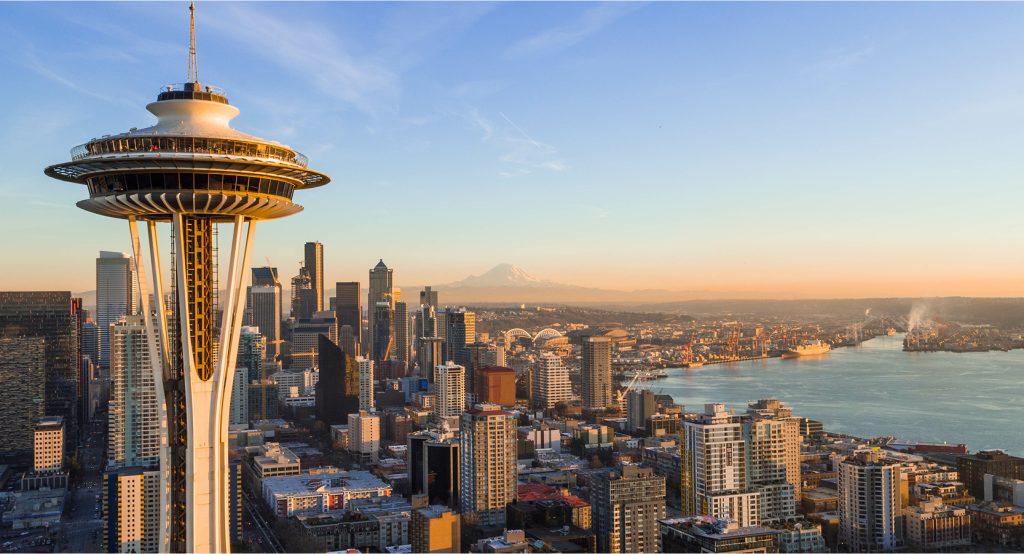
Why Pike Place Market matters.
Pike Place Market is a historic public market where Downtown's maritime trading heritage meets the agricultural traditions of Washington State, immigrant entrepreneurship and one of America's most consequential urban preservation movements.
Set along Pike Place near Pike Street and just steps from the steep streets descending toward Elliott Bay, the market occupies a series of interconnected buildings overlooking Seattle's central waterfront, with commercial passages extending between 1st Avenue, Western Avenue and the surrounding downtown blocks. Its red neon Public Market Center sign and illuminated clock rise above a dense arrangement of covered stalls, brick facades and open-air walkways. The Main Arcade features long rows of produce stands and flower vendors beneath a timber-and-steel canopy, with additional retail passages descending through multiple interior levels. Narrow staircases, exposed structural elements and irregular corridors connect independent shops, restaurants and small commercial spaces across the hillside. The result is an exceptionally layered urban marketplace whose working agricultural stalls, historic architecture and waterfront geography preserve the physical character of Seattle's early commercial development.
What defines Pike Place Market.
Pike Place Market is best known for establishing a direct commercial relationship between regional farmers and urban consumers before becoming the centerpiece of a nationally influential historic preservation campaign. During Seattle's early twentieth-century expansion, farmers supplying the city encountered commission merchants who controlled wholesale distribution and imposed substantial costs on agricultural producers. City Councilmember Thomas Revelle championed a municipal marketplace where growers could sell directly to residents, reducing dependence on intermediaries. Seattle established the market through legislation in August 1907, opening its first public trading day on August 17. Eight farmers arrived with produce that quickly sold to an enormous crowd, demonstrating the demand for affordable food and direct agricultural commerce. Developer Frank Goodwin subsequently constructed the first permanent market building, creating infrastructure for a growing community of merchants. Italian immigrant farmer Giuseppe Desimone developed substantial agricultural and commercial interests within the district, eventually gaining control of the Pike Place Public Market Company. Japanese American farmers also became central to its produce trade, building businesses that connected regional agriculture with Seattle's expanding immigrant communities. Their forced removal and incarceration during World War II severely disrupted the marketplace and contributed to the decline of its established agricultural economy. By the 1960s, municipal redevelopment proposals threatened to replace substantial portions of the historic district with modern commercial construction. Architect Victor Steinbrueck helped organize Friends of the Market, mobilizing residents, preservation advocates and merchants against demolition. Seattle voters approved Initiative 1 on November 2, 1971, establishing a protected seven-acre historic district through a decisive public referendum. The city created the Pike Place Market Preservation and Development Authority in 1973 to rehabilitate buildings and sustain the marketplace's economic and residential community. Extensive restoration subsequently preserved the district's historic structures and established a model for protecting working urban markets through coordinated public stewardship.
How Pike Place Market fits.
Pike Place Market works as the cultural and commercial anchor for a Seattle outing connecting the city's maritime ecology, major artistic collections and the historic waterfront transportation infrastructure that supported its development.
Begin at Seattle Aquarium, the marine science institution established on Pier 59 in 1977 to interpret the ecosystems of Puget Sound and the northeastern Pacific Ocean. Its original waterfront location developed within a former commercial pier, adapting Seattle's maritime infrastructure for public education and marine conservation. The aquarium's Window on Washington Waters presents a substantial underwater environment populated by fish and marine organisms associated with regional coastal habitats. Its exhibits introduce the ecological relationships connecting kelp forests, rocky shorelines and the deeper waters of the Salish Sea. The Ocean Pavilion, opened in 2024, expanded the institution's international conservation mission through a major exhibition devoted to the tropical waters of the Coral Triangle. Its large central habitat contains reef fish, rays and other marine species associated with one of the world's most biologically diverse ocean regions. Continue to Seattle Art Museum, the city's principal encyclopedic art institution, founded in 1933 through the philanthropic leadership of Richard E. Fuller. Its original building in Volunteer Park, designed by Carl F. Gould, established a permanent home for a collection shaped by Fuller's interest in Asian art. The museum relocated its principal downtown operations in 1991 to a building designed by Robert Venturi and Denise Scott Brown. A subsequent expansion completed in 2007 increased its exhibition capacity and strengthened its presence within the central business district. Its collections encompass Indigenous American art, European painting, African sculpture and contemporary international works. The institution's substantial holdings of Northwest Coast art connect Seattle's cultural development with the artistic traditions of Indigenous communities throughout the Pacific Northwest. Conclude at Colman Dock, the historic ferry terminal serving as Seattle's principal passenger gateway to Bainbridge Island and Bremerton. The site developed during the late nineteenth century as the waterfront became a major center of passenger steamship operations and regional maritime transportation. Joshua Green's Puget Sound Navigation Company helped consolidate the region's ferry services during the early twentieth century, establishing important transportation connections across the surrounding waterways. Washington State Ferries subsequently assumed responsibility for much of the regional system, creating one of the largest ferry networks in the United States. The terminal's modern passenger facilities incorporate extensive waterfront glazing and pedestrian circulation areas overlooking Elliott Bay. Its ferry routes provide direct views of the downtown skyline and the Olympic Mountains, connecting the central city with the communities of Puget Sound. The progression moves from Seattle Aquarium's marine conservation programs through Seattle Art Museum's international artistic collections and culminates at Colman Dock's enduring maritime transportation network, connecting three defining dimensions of Seattle's waterfront heritage.
Where your story begins.
Foresyte Travel reveals places that feel extraordinary long before you arrive.
Enjoy editorial crafted for luxury travelers.








































































































